Key Takeaways
- What plastic injection molding really involves – beyond the basics – and why the right plastic injection moulding service plays a critical role in quality, cost, and scalability
- How the injection molding and molding process perform across precision, materials, design flexibility, and real-world manufacturing challenges
- When injection molding is the right choice for your business – and how expert evaluation can turn a production method into a long-term manufacturing advantage
What Is Plastic Injection Molding and How Does It Work?
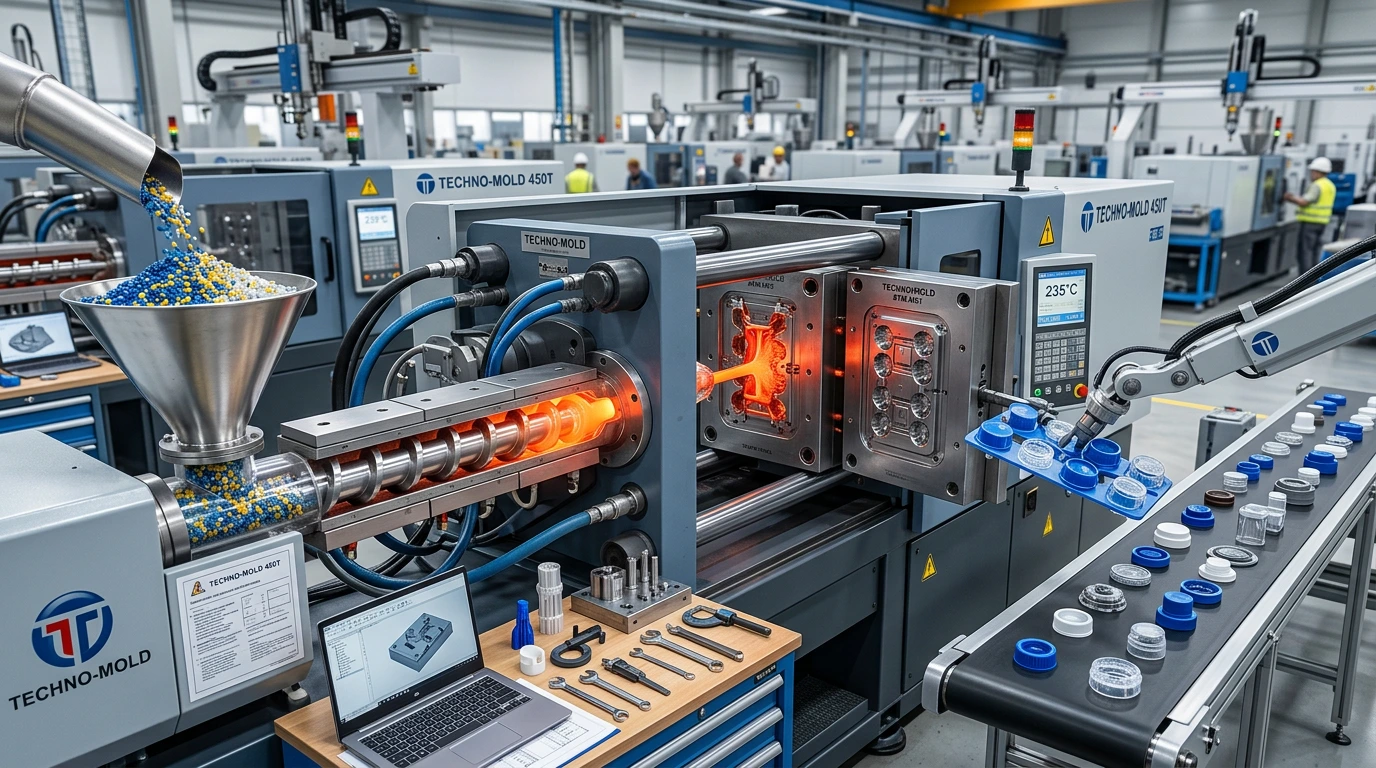
What is injection moulding? At its core, it’s a highly controlled molding process used to manufacture precision plastic components at scale. In a typical plastic injection molding setup, thermoplastic material is melted, injected into a carefully engineered mould under pressure, cooled, and then ejected as a finished part. While the principle sounds simple, the real value lies in how tightly each variable, temperature, pressure, cooling time, and material flow is managed.
This is why plastic injection moulding service providers play such a critical role in modern manufacturing. Injection molding enables consistent quality, tight tolerances, and repeatability across millions of parts, making it indispensable for industries such as FMCG, automotive, medical, electronics, and industrial packaging. From thin-wall containers to complex, multi-cavity components, the process supports both functional performance and aesthetic requirements.
For industry insiders, injection molding isn’t just about shaping plastic, it’s about optimizing the entire system. Material selection, mould design, machine capability, and process optimization all work together to determine cost efficiency, cycle time, part durability, and long-term mould health. Understanding how the injection molding process works is the first step toward unlocking reliable, scalable manufacturing outcomes.
Why Injection Molding Is Widely Used in Manufacturing
Injection molding has become one of the most widely adopted manufacturing methods because it delivers a rare combination of scale, precision, and efficiency. For companies relying on a dependable plastic injection moulding service, the process supports both high-volume production and consistent quality: two factors that are critical in competitive global markets.
Key reasons plastic injection molding is so widely used include:
- Scalability
Once the mould and process are optimized, the same setup can produce thousands or even millions of identical parts with minimal variation. - Repeatability and precision
The controlled molding process ensures tight tolerances, uniform wall thickness, and reliable part dimensions across production runs. - Cost efficiency at scale
While tooling requires upfront investment, per-part costs drop significantly at higher volumes, making injection molding highly economical over time. - Design and material flexibility
A wide range of polymers and part complexities can be accommodated without compromising performance.
Together, these advantages explain why injection molding remains a manufacturing mainstay across industries and applications.
How Does the Injection Molding Process Work?
The injection molding workflow follows a carefully sequenced molding process designed for precision and repeatability. It begins with raw plastic material, typically pellets, being fed into the injection molding machine, where it is heated until molten. This material is then injected under controlled pressure into a custom-designed mould cavity.
Once inside the mould, the plastic cools and solidifies into the desired shape. After sufficient cooling, the mould opens and the finished part is ejected, ready for inspection or secondary operations. While this may sound straightforward, each stage is finely tuned to ensure part quality, cycle time efficiency, and mould longevity.
For manufacturers working with a plastic injection moulding service, understanding this high-level flow helps set the foundation for deeper discussions around process optimization, material behavior, and tooling performance in real-world production environments.
Step-by-Step Injection Molding Process
The injection molding workflow follows a structured, repeatable molding process that converts raw plastic material into a finished component. While each stage involves detailed technical control, the overall sequence remains consistent across most plastic injection molding applications.
At a high level, the process includes four core steps:
- Clamping – The mould is securely closed under controlled force to withstand injection pressure
- Injection – Molten plastic is injected into the mould cavity at precise temperature and pressure
- Cooling – The material cools and solidifies, forming the final part geometry
- Ejection – The mould opens and the finished part is released
For manufacturers working with a plastic injection moulding service, understanding this flow helps set expectations around cycle time, quality consistency, and process stability before exploring each step in detail.
Clamping
Clamping is the first and one of the most critical stages in the injection molding cycle. During this step, the two halves of the mould are securely closed and held together by the injection molding machine before molten plastic is introduced. The clamping force must be precisely calculated to counteract the pressure generated during injection and packing.
In a well-controlled molding process, insufficient clamping force can lead to mould separation, flash formation, and dimensional inconsistencies. Excessive clamping force, on the other hand, can accelerate mould wear and increase energy consumption. This balance is why an experienced plastic injection moulding service carefully matches clamping force to part geometry, cavity count, material viscosity, and injection pressure.
For high-volume plastic injection molding, stable and repeatable clamping ensures part quality, protects mould integrity, and supports long-term process reliability.
Injection
Injection is the stage where the molding process truly takes shape. Once the mould is securely clamped, molten plastic is injected into the cavity under carefully controlled pressure and speed. In plastic injection molding, this step determines how well the material fills the mould, replicates fine details, and achieves uniform wall thickness.
For an effective injection molding cycle, parameters such as injection speed, pressure, melt temperature, and screw position must be precisely tuned. If the injection is too slow or uneven, it can lead to short shots, flow marks, or weld lines. Excessive pressure, on the other hand, may cause flash or internal stresses in the part.
This is where an experienced plastic injection moulding service adds significant value by optimizing the injection phase to ensure complete cavity filling, consistent part quality, and repeatable performance across high-volume production runs.
Cooling
Cooling is where the injected plastic solidifies and the final part properties are set. After the mould cavity is filled, heat is transferred out of the molten plastic through the mould, allowing it to cool and harden into its intended shape. In injection molding, this stage often accounts for the largest portion of the overall cycle time.
From a molding process standpoint, cooling must be carefully controlled. Inadequate or uneven cooling can lead to warpage, sink marks, internal stresses, or dimensional instability. Overcooling, on the other hand, unnecessarily extends cycle time and reduces production efficiency. This is why an experienced plastic injection moulding service focuses heavily on cooling channel design, mould temperature control, and material-specific cooling requirements.
Optimized cooling directly impacts part quality, repeatability, and cycle time, making it a key driver of cost efficiency in high-volume plastic injection molding operations.
Ejection
Ejection is the final step in the injection molding cycle, where the mould opens and the finished part is safely removed. Once adequate cooling has occurred, ejector pins, plates, or sleeves push the solidified component out of the mould cavity. This step may appear simple, but in a precision-driven molding process, it requires careful design and timing.
Poor ejection can result in part deformation, surface marks, or damage, especially for thin-wall or complex geometries. An optimized plastic injection moulding service pays close attention to ejector placement, ejection force, and mould surface finish to ensure smooth part release. After ejection, the mould resets and closes again, ready for the next cycle.
Consistent and damage-free ejection is essential for maintaining part quality, protecting the mould, and sustaining efficient, high-volume plastic injection molding production.
Injection Molding Materials Used
Material selection is a critical decision in any plastic injection molding project, as it directly impacts part performance, process stability, and overall cost. The right material ensures the molding process runs smoothly while meeting functional and commercial requirements.
Key factors considered during material selection include:
- Mechanical properties such as strength, flexibility, and impact resistance
- Thermal behaviour, including heat resistance and cooling characteristics
- Flow properties, which affect how well the material fills the mould
- End-use conditions, such as chemical exposure, load, and environment
In injection molding, thermoplastics are commonly used due to their ability to be melted and reshaped consistently. A knowledgeable plastic injection moulding service evaluates these parameters early to ensure reliable production, consistent quality, and scalability across high-volume manufacturing.
Common Thermoplastics Used in Injection Molding
Material choice is central to a successful plastic injection molding outcome. Different thermoplastics behave differently during the molding process, affecting part performance, durability, and cost. Below are some of the most commonly used materials in injection molding, along with their typical applications:
- ABS (Acrylonitrile Butadiene Styrene)
Known for toughness, impact resistance, and good surface finish. Commonly used in consumer goods, enclosures, and automotive interiors. - PP (Polypropylene)
Lightweight, flexible, and chemically resistant. Widely used in packaging, caps, closures, and household products. - PE (Polyethylene)
Offers excellent moisture resistance and toughness. Used in containers, bottles, and industrial components. - Nylon (Polyamide)
High strength, wear resistance, and thermal stability. Ideal for gears, mechanical parts, and load-bearing components. - PC (Polycarbonate)
High impact strength and transparency. Used in medical devices, electronics housings, and safety components.
Material | Strength | Heat Resistance | Cost Efficiency | Compliance Suitability | Typical End-Use Applications |
ABS | High impact strength | Moderate | Medium | Consumer & industrial compliant | Consumer goods, housings, automotive interiors |
PP (Polypropylene) | Moderate | Moderate | High (very cost-effective) | Food & FMCG compliant | Packaging, caps, closures, household products |
PE (Polyethylene) | Moderate | Low to moderate | High | Food & chemical compliant | Bottles, containers, industrial packaging |
Nylon (Polyamide) | Very high | High | Medium to high | Industrial compliant | Gears, mechanical parts, load-bearing components |
PC (Polycarbonate) | Very high | High | High | Medical & electrical compliant | Medical devices, electronics, safety components |
Types of Injection Molding Processes
Beyond standard injection molding, manufacturers use several process variations to meet specific design, performance, and production requirements. These advanced approaches expand what a plastic injection moulding service can deliver across industries.
Common injection molding process types include:
- Multi-shot (or multi-material) molding – Combines two or more materials in a single cycle for functional or aesthetic integration
- Insert molding – Molds plastic around metal or other components to create integrated parts
- Overmolding – Adds a secondary layer over a base component for grip, sealing, or insulation
- Thin-wall molding – Enables lightweight parts with reduced material usage and faster cycle times
- Gas-assisted molding – Uses gas to create hollow sections, reducing weight and sink marks
Each variation adapts the core molding process to solve specific design and manufacturing challenges efficiently.
Advantages of Plastic Injection Molding
Plastic injection molding is widely adopted because it combines precision, efficiency, and design freedom in a single, scalable molding process. When supported by the right plastic injection moulding service, it enables manufacturers to achieve consistent quality while optimizing cost and production speed, especially at higher volumes.
High Precision and Repeatability
Injection molding is built for consistency.
Once the mould and process parameters are set, parts can be produced with tight tolerances and minimal variation across large production runs. This level of repeatability is critical for components that must fit or function together reliably.
Cost Efficiency at Scale
While tooling involves an upfront investment, per-unit costs reduce significantly as volumes increase.
Short cycle times, automation, and low material waste make plastic injection molding highly economical for long-term, high-volume manufacturing programs.
Design Flexibility
The process supports complex geometries and detailed features.
Design elements such as thin walls, ribs, snap-fits, and textured surfaces can be integrated without adding assembly steps, allowing customisation without compromising manufacturability.
Limitations of Injection Molding
While plastic injection molding is a powerful and widely used manufacturing method, it’s important to approach it with a balanced perspective. Understanding its limitations helps set realistic expectations and ensures the molding process is applied where it truly makes sense.
High Initial Tooling Cost
Injection molds are complex, precision-engineered tools.
They require detailed design, high-quality steel or aluminum, and advanced machining, all of which contribute to higher upfront costs. For low-volume production, this investment may outweigh the benefits, making a plastic injection moulding service more suitable for medium- to high-volume programs.
Design Changes Are Costly
Once a mould is manufactured, making changes can be time-consuming and expensive.
Late-stage design modifications may require reworking or rebuilding tooling, increasing cost and delaying timelines. This is why thorough design validation and simulation early in the injection molding process are critical to minimize risk and avoid downstream changes.
Injection Molding vs Other Manufacturing Processes
Understanding how injection molding compares with other manufacturing methods helps clarify when a plastic injection moulding service is the right fit—and when another process may be more suitable.
Injection Molding vs Blow Molding
- Injection molding is used to produce solid, detailed components with precise geometries and tight tolerances. It supports complex shapes, structural features, and a wide range of applications beyond packaging.
- Blow molding is specifically designed for hollow parts such as bottles and containers. It excels at producing uniform wall thickness in hollow forms but offers limited design complexity.
Injection molding suits precision parts; blow molding is ideal for hollow packaging products.
Injection Molding vs Compression Molding
- Injection molding involves injecting molten plastic into a closed mould, allowing excellent control over flow, detail, and repeatability.
- Compression molding places heated material into a mould and compresses it into shape, often using thermoset plastics and simpler geometries.
Injection molding is better for complex, high-precision parts, while compression molding suits thicker, less intricate components.
Injection Molding vs 3D Printing
- Injection molding is optimized for high-volume production, delivering consistent quality and low per-unit costs once tooling is in place.
- 3D printing is ideal for prototyping, design validation, and low-volume runs, with minimal upfront investment.
3D printing supports speed and flexibility early on; injection molding dominates when scaling to mass production.
Industries That Use Plastic Injection Molding
Plastic injection molding supports a wide range of industries by delivering consistent quality, scalability, and design flexibility. When backed by a reliable plastic injection moulding service, the process adapts easily to different performance, compliance, and volume requirements across sectors.
Automotive and Industrial Components
In automotive and industrial applications, injection molding is used to manufacture functional and structural parts that must perform reliably under stress. These include housings, connectors, brackets, gears, and technical components where strength, dimensional accuracy, and repeatability are critical throughout long production runs.
Medical and Healthcare Products
The medical sector relies heavily on plastic injection molding for its precision and process control. Components such as medical devices, diagnostic housings, and disposables demand strict compliance, traceability, and tight tolerances. A controlled molding process ensures consistent quality while meeting regulatory and hygiene standards.
Consumer Goods and Packaging
Consumer goods and packaging applications benefit from the high-volume efficiency of injection molding. The process supports visually appealing, lightweight, and cost-effective parts, making it ideal for everyday products where aesthetics, consistency, and scalability matter just as much as performance.
Quality Control in Injection Molding
Quality control is what separates a basic setup from a mature, reliable plastic injection moulding service. In high-volume plastic injection molding, consistency is everything; part quality, cycle stability, and long-term mould performance all depend on how well the molding process is monitored and controlled. From material handling to process validation and in-process checks, strong quality systems ensure that every part meets functional and dimensional expectations, run after run.
Common Injection Molding Defects and How to Avoid Them
Even in well-designed processes, defects can occur. The key lies in early detection and corrective action.
- Sink marks
Caused by uneven cooling or thick sections.
Avoided by: optimizing wall thickness, packing pressure, and cooling design. - Warping
Results from uneven shrinkage during cooling.
Avoided by: balanced cooling, proper mould temperature control, and material selection. - Flash
Occurs when molten plastic escapes the mould cavity.
Avoided by: correct clamping force, proper mould fit, and controlled injection pressure. - Short shots
Happen when the cavity is not completely filled.
Avoided by: adjusting injection speed, pressure, and melt temperature.
Effective quality control turns injection molding into a predictable, repeatable manufacturing process rather than a trial-and-error exercise.
Curious How Professional Injection Molding Services Improve Part Quality?
Behind every consistent, high-performing plastic component is a well-managed plastic injection moulding service. From material selection and mould design to process optimization and quality control, professional injection molding goes far beyond simply producing parts, it focuses on getting them right, every time. This structured approach reduces defects, improves repeatability, and protects long-term mould health, especially in high-volume manufacturing.
If you’re looking to enhance part quality, improve process reliability, or scale production with confidence, it helps to work with experts who understand the full injection molding lifecycle.
Explore our Plastic Injection Moulding Service at Efficient Innovations and see how a technically driven, consultative approach can support better outcomes across your manufacturing programs.
When Should You Choose a Plastic Injection Moulding Service?
Choosing a plastic injection moulding service makes sense when your business needs reliable, scalable, and repeatable production. It’s especially well-suited for:
- Medium to high production volumes where per-unit cost efficiency matters
- Parts requiring precision and consistency across large batches
- Complex or custom designs that benefit from a controlled injection molding process
- Regulated industries where quality, compliance, and traceability are critical
If your product demands long-term production stability and predictable quality, working with an experienced plastic injection molding partner helps reduce risk and supports sustainable growth.
Conclusion
Understanding what is injection moulding, how the molding process works, and where it adds the most value helps businesses make informed manufacturing decisions. From precision and scalability to material selection and quality control, plastic injection molding offers powerful advantages when applied in the right context.
The key lies in evaluating your product requirements, volumes, and compliance needs early and partnering with the right plastic injection moulding service to translate those insights into reliable production. With expert guidance, injection molding becomes not just a manufacturing method, but a long-term strategic asset.
Frequently Asked Questions
- How does the injection molding process work step by step?
The injection molding process follows four main steps: clamping the mould, injecting molten plastic, cooling the part to solidify it, and ejecting the finished component. This controlled molding process ensures consistency, precision, and repeatability in high-volume plastic injection molding production. - How long does an injection molding cycle take?
An injection molding cycle typically ranges from a few seconds to a few minutes. Cycle time depends on part size, material type, wall thickness, cooling requirements, and mould design. Optimized plastic injection molding focuses on reducing cycle time without compromising quality. - How much does plastic injection molding cost?
The cost of plastic injection molding includes upfront tooling investment and per-part production costs. While moulds can be expensive initially, unit costs decrease significantly at scale, making a plastic injection moulding service highly cost-effective for medium- to high-volume production. - Injection molding vs 3D printing: which is better?
3D printing is ideal for prototyping and low-volume parts due to minimal tooling. Injection molding, however, excels in mass production, offering better consistency, surface finish, and cost efficiency per unit once volumes increase and the molding process is optimized. - Is injection molding suitable for low-volume production?
Injection molding can work for low volumes, but tooling costs may outweigh benefits. It’s typically more suitable when volumes justify mould investment. For early-stage or limited runs, alternatives may be explored before transitioning to a full plastic injection moulding service. - What are common injection molding defects?
Common injection molding defects include sink marks, warping, flash, and short shots. These issues are usually linked to material behavior, cooling imbalance, or incorrect process settings and can be minimized through proper mould design and process control. - What industries use injection molding the most?
Industries such as automotive, medical, FMCG, electronics, packaging, and industrial manufacturing rely heavily on plastic injection molding due to its precision, scalability, and repeatability across complex and high-volume component requirements. - What is plastic injection molding used for?
Plastic injection molding is used to manufacture precise plastic components such as housings, containers, medical devices, packaging parts, automotive components, and consumer products—anywhere consistent quality and high-volume production are required. - What materials are used in plastic injection molding?
Common materials used in plastic injection molding include ABS, polypropylene (PP), polyethylene (PE), nylon, and polycarbonate (PC). Material choice depends on strength, heat resistance, compliance needs, cost, and end-use application. - When should I choose a plastic injection moulding service?
You should choose a plastic injection moulding service when you need repeatable quality, tight tolerances, and cost efficiency at scale—especially for complex parts, regulated industries, or long-term production programs requiring a stable and optimized molding process.