Key Takeaways
- What extrusion blow moulding really is, how the blow moulding process works, and where it fits among different blow molding types used in modern manufacturing
- Why extrusion blow moulding is widely chosen for hollow products and how materials, design flexibility, and process control influence performance and cost
- When extrusion blow moulding is the right choice for your product, and how expert evaluation can help turn a production method into a scalable manufacturing advantage
To understand modern hollow plastic manufacturing, it helps to start with what is blow moulding and why it matters. Extrusion blow moulding is a core process used to produce everyday items like bottles, containers, and industrial packaging at scale. Among different blow molding types, it stands out for its efficiency, versatility, and ability to deliver consistent hollow forms, making it a cornerstone of global plastic manufacturing.
What Is Blow Moulding?
Blow moulding is a plastic forming method used to manufacture hollow parts by inflating heated plastic inside a mould. In the blow moulding process, molten or softened plastic is shaped into a tube (parison or preform), enclosed within a mould, and expanded using air pressure until it conforms to the mould cavity. Once cooled, the mould opens and the finished hollow product is released.
This process is especially valued for its ability to produce lightweight, seamless containers with uniform wall thickness. Understanding what is blow moulding at this level creates the foundation for exploring specific methods such as extrusion blow moulding and other specialized blow molding types.
How Blow Moulding Evolved in Plastic Manufacturing
The evolution of blow moulding is closely tied to the growing demand for efficient production of hollow plastic products. As industries scaled and packaging needs expanded, the blow moulding process emerged as a reliable alternative to traditional materials like glass and metal.
Key drivers behind its evolution include:
- Rising demand for hollow plastic containers that were lightweight, durable, and cost-effective
- Advancements in plastic materials that enabled better melt strength and uniform wall distribution
- Improvements in machinery and process control, allowing higher output and consistent quality
- Development of specialized blow molding types, including extrusion blow moulding, to suit different product and volume requirements
This progression explains why extrusion blow moulding became indispensable; it offered a scalable, repeatable solution for manufacturing hollow components while meeting the efficiency and quality expectations of modern plastic production.
What Is Extrusion Blow Moulding?
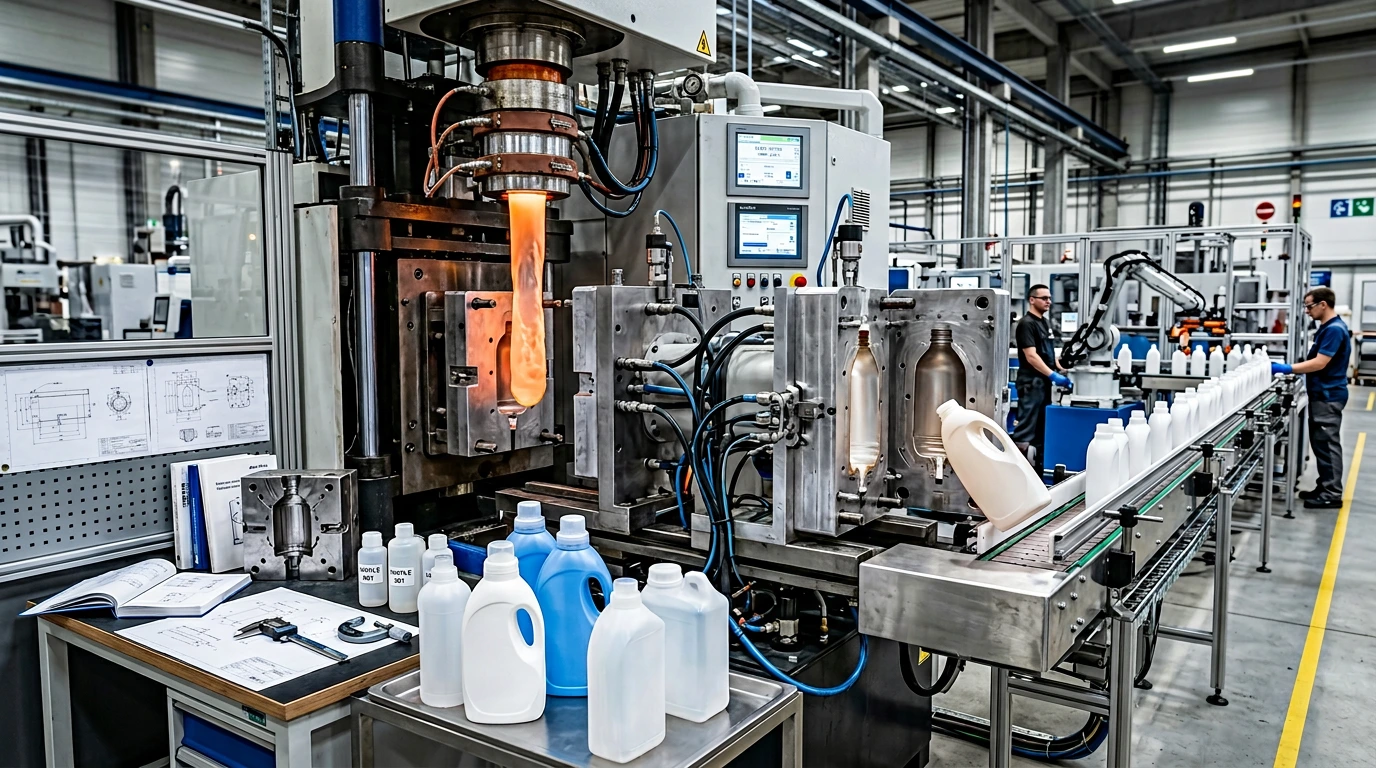
Extrusion blow moulding is a specialized blow moulding technique used to manufacture hollow plastic products in a continuous, efficient manner. In this process, molten plastic is first extruded into a hollow tube called a parison, which is then enclosed within a mould and expanded using air pressure to form the final shape.
What sets extrusion blow moulding apart from general blow moulding is how the parison is formed through extrusion rather than injection. This core principle makes it ideal for producing containers with uniform walls, integrated handles, and varying thickness profiles. Among different blow molding types, extrusion blow moulding is widely used for bottles, containers, and industrial packaging where scalability and consistency are essential.
How Does the Extrusion Blow Moulding Process Work?
The extrusion blow moulding process is a continuous blow moulding process designed to produce hollow plastic parts efficiently and at scale. It combines plastic extrusion with air-driven forming, allowing manufacturers to create consistent containers with controlled wall thickness and shape, making it one of the most widely used blow molding types.
Step-by-Step Extrusion Blow Moulding Process
At a high level, the process flows seamlessly from raw plastic material to a finished hollow product, with each stage building on the previous one to ensure shape accuracy, uniform walls, and repeatable quality.
Plastic Extrusion and Parison Formation
The process begins with molten plastic being extruded through a die to form a hollow tube called a parison. This step is critical, as parison thickness and melt strength directly influence part quality in extrusion blow moulding.Mold Closing and Air Inflation
Once the parison reaches the correct length, the mould closes around it. Compressed air is then blown inside, expanding the parison until it conforms to the mould cavity, defining the final shape.Cooling and Solidification
The inflated plastic cools against the mould walls, allowing the material to solidify while maintaining dimensional stability and uniformity.Part Ejection and Trimming
After cooling, the mould opens and the finished part is ejected. Any excess material is trimmed, completing the blow moulding cycle and preparing the mould for the next run.
Materials Used in Extrusion Blow Moulding
Material selection plays a decisive role in the success of extrusion blow moulding. The right material influences not only product performance and durability, but also cycle time, cost efficiency, and long-term reliability of the blow moulding process. Selecting materials early, based on application and regulatory needs, helps manufacturers balance performance with scalability.
Common Plastics Used in Extrusion Blow Moulding
Material | Key Properties | Typical Applications |
HDPE (High-Density Polyethylene) | High strength, excellent chemical resistance, good stiffness | Bottles, containers, jerry cans, industrial packaging |
LDPE (Low-Density Polyethylene) | Flexible, lightweight, good impact resistance | Squeeze bottles, flexible containers, household products |
PP (Polypropylene) | Good fatigue resistance, chemical stability, lightweight | Caps, containers, automotive and consumer packaging |
PVC (Polyvinyl Chloride) | Rigid or flexible, good clarity, strong chemical resistance | Medical containers, industrial bottles, specialty packaging |
These materials are widely used across blow molding types, with extrusion blow moulding offering flexibility in wall thickness and container design.
Factors Affecting Material Selection
When choosing materials for extrusion blow moulding, manufacturers typically evaluate:
- Product strength – Ability to withstand load, impact, and handling
- Flexibility requirements – Squeeze performance or rigidity needs
- Chemical resistance – Compatibility with contents and environment
- Compliance and regulations – Food, medical, or industrial standards
Balancing these factors ensures the selected material performs reliably while remaining cost-effective within the broader blow moulding strategy.
Types of Blow Moulding Processes
To understand where extrusion blow moulding fits, it’s useful to look at the broader landscape of blow molding types. While all blow moulding methods are used to create hollow plastic parts, each process differs in how the plastic is formed, shaped, and finalised, making them suitable for different applications.
Extrusion Blow Moulding
Extrusion blow moulding is the most versatile and widely used blow moulding process for hollow products. It allows flexibility in container shape, wall thickness variation, and integrated features like handles. This makes it ideal for bottles, containers, and industrial packaging produced at scale.
Injection Blow Moulding
Injection blow moulding combines injection molding and blow moulding. A preform is injection-molded first and then blown into shape. This method offers excellent neck finish and dimensional accuracy but is generally limited to smaller containers.
Injection Stretch Blow Moulding
Injection stretch blow moulding (ISBM) adds a stretching step before blowing, improving strength and clarity. It is commonly used for PET bottles, especially in beverage and personal care packaging where transparency and material efficiency are critical.
Advantages of Extrusion Blow Moulding
Extrusion blow moulding offers a balanced set of technical advantages that make it a reliable choice for manufacturing hollow plastic products at scale. Its strengths lie in process flexibility, design capability, and cost efficiency, particularly when applied to high-volume production rather than niche or low-run applications.
Design Flexibility and Complex Shapes
One of the most practical advantages of extrusion blow moulding is the freedom it offers in product design. The process supports:
- Integrated handles, eliminating the need for secondary assembly
- Complex contours and asymmetric shapes that would be difficult to achieve with other blow molding types
- Variable wall thickness, allowing material to be distributed where strength or rigidity is needed
This flexibility makes the blow moulding process well-suited for functional containers as well as ergonomically designed products.
Cost-Effective for High Volumes
From an economics standpoint, extrusion blow moulding is optimised for scale:
- Tooling costs are generally lower than more complex moulding processes
- Once tooling is in place, per-unit costs decrease significantly as production volumes increase
- Short cycle times and minimal material waste improve overall cost efficiency
These factors make extrusion blow moulding a practical solution for consistent, large-scale manufacturing of hollow plastic components.
Limitations of Extrusion Blow Moulding
A credible evaluation of extrusion blow moulding requires transparency. While the process is highly effective for many hollow products, it does come with limitations that manufacturers should consider early in the design and planning stages of the blow moulding process.
Limited Precision Compared to Injection Moulding
Extrusion blow moulding does not offer the same dimensional accuracy as injection molding.
Tolerances are generally wider because the parison expands freely inside the mould. As a result, applications requiring very tight tolerances, sharp details, or precise neck finishes may be better suited to other blow molding types or alternative processes.
Material Waste and Flash Trimming
Another consideration is material waste.
Excess plastic, commonly known as flash, which forms during mould closing and must be trimmed after part ejection. While this adds to material usage, waste can often be reduced through:
- Optimized parison control
- Efficient trimming systems
- Regrinding and reusing compatible materials
Understanding these trade-offs helps manufacturers apply extrusion blow moulding where its strengths outweigh its constraints.
Extrusion Blow Moulding vs Other Moulding Processes
Understanding how extrusion blow moulding compares with other moulding methods helps manufacturers choose the right process based on part geometry, performance expectations, and production scale. Below is a clear, side-by-side comparison focused on practical decision factors.
Comparison | Extrusion Blow Moulding | Injection Moulding / ISBM |
Extrusion Blow Moulding vs Injection Moulding | Best suited for hollow products such as bottles, containers, and jerry cans | Ideal for solid or highly detailed parts requiring tight tolerances |
Part Geometry | Hollow parts with uniform or variable wall thickness | Solid components or precision neck finishes |
Tooling Complexity | Moderate tooling complexity | Higher tooling complexity for injection moulding |
Extrusion Blow Moulding vs Injection Stretch Blow Moulding (ISBM) | Designed for high-volume functional containers | Optimized for clarity, strength, and appearance |
Material Focus | Works well with HDPE, LDPE, PP, PVC | Commonly used with PET |
Typical Applications | Industrial packaging, household containers, chemical bottles | Beverage bottles, personal care packaging |
Production Objective | Cost efficiency and design flexibility | Lightweighting, transparency, and performance consistency |
This comparison highlights that extrusion blow moulding excels where hollow form, scalability, and functional design matter, while other moulding processes serve applications requiring precision, clarity, or solid-part construction.
Industries That Use Extrusion Blow Moulding
Extrusion blow moulding is widely adopted across industries that require durable, hollow plastic components produced efficiently at scale. Its ability to handle varied shapes and volumes makes it a dependable blow moulding process for both functional and industrial applications.
Packaging and Containers
Packaging is the most prominent application of extrusion blow moulding. The process is ideally suited for producing:
- Bottles for food, beverages, personal care, and household products
- Jerry cans for chemicals, lubricants, and industrial liquids
- Drums and large containers used in bulk storage and transportation
The flexibility of this blow moulding method allows manufacturers to incorporate handles, variable wall thickness, and robust designs for safe handling and logistics.
Automotive and Industrial Components
In automotive and industrial sectors, extrusion blow moulding is used for parts that demand strength and reliability rather than cosmetic precision. Typical applications include:
- Air ducts and fluid ducts
- Reservoirs and expansion tanks
- Fuel, coolant, and industrial storage tanks
Here, the process supports complex hollow geometries while maintaining consistency, making extrusion blow moulding a practical choice among different blow molding types for demanding environments.
Quality Control in Extrusion Blow Moulding
Quality control is a strong indicator of process maturity in extrusion blow moulding. Consistent part performance depends on how well the blow moulding process is monitored, controlled, and optimized across production runs. From parison control to cooling consistency, robust quality systems help ensure repeatability, reduce waste, and maintain long-term process reliability, especially in high-volume manufacturing.
Common Defects and How to Avoid Them
Even with a stable setup, certain defects can occur if process variables are not tightly controlled:
- Wall thickness variation
Caused by uneven parison formation or poor material distribution.
Avoided by: precise parison programming, die control, and consistent extrusion parameters. - Flash
Excess material forms at mould parting lines.
Avoided by: accurate mould alignment, proper clamp force, and optimized parison size. - Weak seams (pinch-off failure)
Occur when the mould does not seal the parison effectively.
Avoided by: proper pinch-off design, correct material temperature, and controlled mould closing.
Effective quality control transforms extrusion blow moulding from a basic forming method into a predictable, production-ready manufacturing process.
Want Expert Support for Blow Moulding Projects?
Successful extrusion blow moulding goes beyond running a machine; it requires the right balance of material selection, parison control, tooling design, and process optimisation. When these elements are aligned, the blow moulding process becomes more predictable, efficient, and scalable. This is where experienced, technically driven support can significantly reduce risk and improve outcomes across product lifecycles.
When Should You Choose Extrusion Blow Moulding?
Choosing extrusion blow moulding makes sense when your product requires a hollow form, consistent wall distribution, and efficient large-scale production. It’s particularly well-suited for manufacturers focused on functional containers, industrial parts, or packaging where durability and repeatability matter more than tight cosmetic tolerances. Understanding where your product sits in its lifecycle helps determine whether this blow moulding process is the right fit.
Prototype vs Mass Production Considerations
- Early-stage or prototyping
For low volumes or design validation, alternative methods may be more flexible and cost-effective. - Mass production
Extrusion blow moulding excels once designs are finalised and volumes increase, delivering lower per-unit costs, stable quality, and scalable output.
If your product is ready to move beyond trials and into sustained production, extrusion blow moulding offers a reliable path from concept to volume manufacturing.
Conclusion
Understanding extrusion blow moulding, from how the blow moulding process works to where it fits among different blow molding types, helps manufacturers make more confident production decisions. When applied in the right context, it offers a practical balance of design flexibility, scalability, and cost efficiency.
The real value comes from evaluating your product, volumes, and performance requirements early. With expert guidance, extrusion blow moulding can move from a manufacturing option to a reliable, long-term production strategy.
Frequently Asked Questions
- What is extrusion blow moulding?
Extrusion blow moulding is a blow moulding method used to manufacture hollow plastic products by extruding a molten tube (parison) and expanding it inside a mould using air pressure. - How does the blow moulding process work?
In the blow moulding process, plastic is heated, shaped into a hollow form, inflated inside a mould, cooled, and then ejected as a finished hollow product. - How is extrusion blow moulding different from injection moulding?
Extrusion blow moulding is used for hollow parts, while injection moulding is designed for solid, high-precision components with tighter dimensional control. - Is extrusion blow moulding suitable for high-volume production?
Yes. Extrusion blow moulding is highly suitable for high-volume production due to its continuous process, short cycle times, and low per-unit cost at scale. - What are common defects in extrusion blow moulding?
Common issues include wall thickness variation, flash, and weak pinch-off seams, usually caused by poor parison control or mould alignment. - What are the main types of blow moulding?
The main blow molding types are extrusion blow moulding, injection blow moulding, and injection stretch blow moulding (ISBM). - What materials are used in extrusion blow moulding?
Typical materials include HDPE, LDPE, PP, and PVC, selected based on strength, flexibility, chemical resistance, and compliance needs. - What products are made using extrusion blow moulding?
Common products include bottles, containers, jerry cans, drums, automotive ducts, reservoirs, and industrial tanks. - When should I choose extrusion blow moulding over other processes?
Choose extrusion blow moulding when producing hollow parts at high volumes where design flexibility and cost efficiency matter more than tight tolerances. - Which industries use extrusion blow moulding the most?
Industries such as packaging, FMCG, chemicals, automotive, and industrial manufacturing rely heavily on extrusion blow moulding for hollow plastic components.