Key Takeaways
- The real difference in Compression Molding vs Injection Molding isn’t just process, it’s material behavior, part complexity, and production strategy.
- Tooling cost, cycle time, scalability, and surface finish all shift depending on which process you choose.
- The smartest decision isn’t about preference, it’s about aligning engineering requirements with long-term business goals.
When manufacturers evaluate molding technologies, one of the most common comparisons is Compression Molding vs Injection Molding. Both processes are widely used to shape materials into precise components, yet they differ significantly in mechanics, cost structure, material compatibility, and production efficiency.
Choosing between them is not simply a technical decision, it directly impacts tooling investment, cycle time, part quality, and long-term scalability.
In this guide, we’ll break down how each process works, where they excel, and how to determine which method aligns best with your product requirements and production goals.
What is Compression Molding?
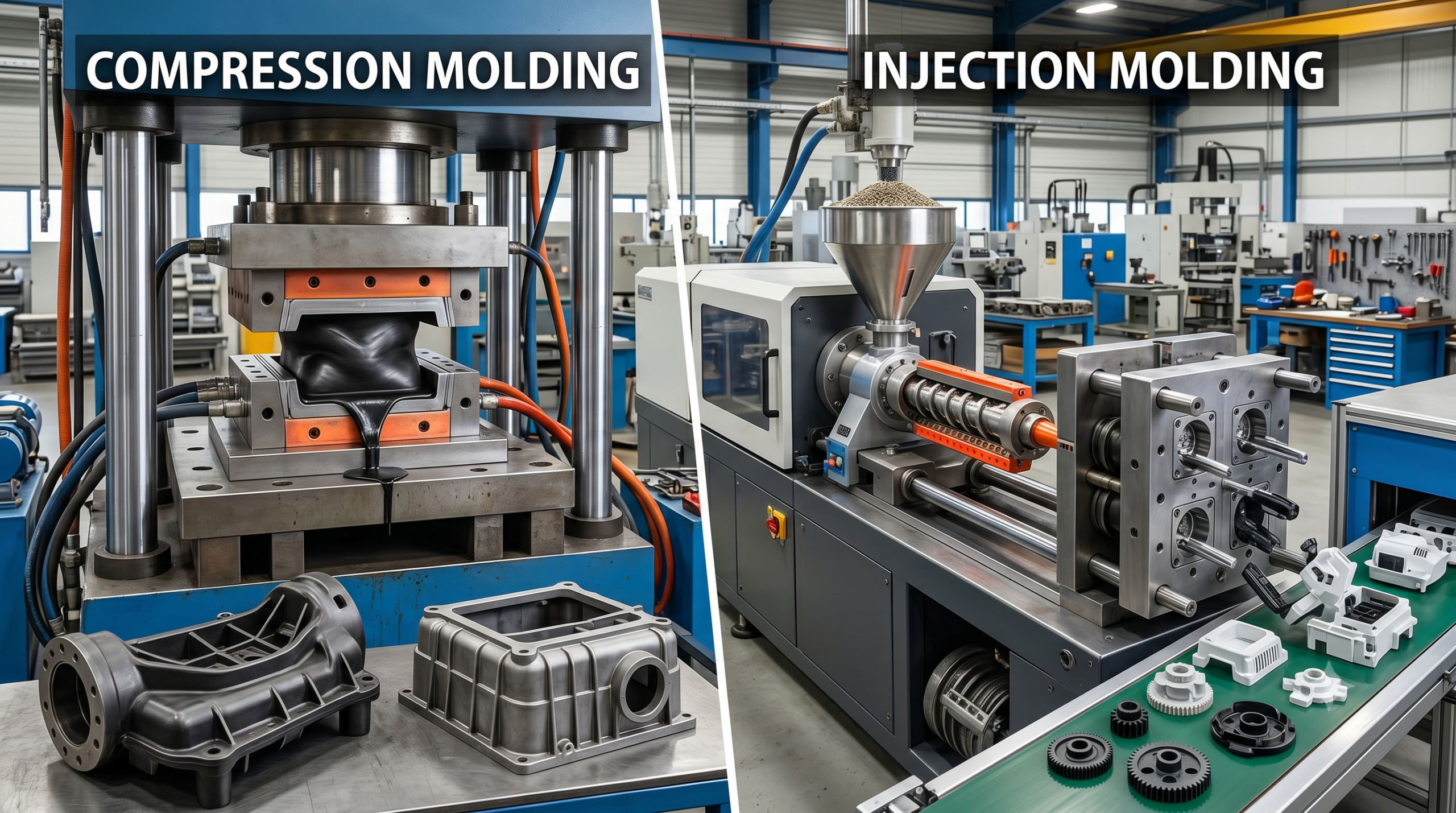
Compression molding is a manufacturing process primarily used for thermosetting plastics, elastomers, and certain composite materials. It involves placing a pre-measured amount of material into a heated mold cavity, then applying pressure to shape and cure the material.
This method is commonly used for:
- Automotive components
- Electrical insulation parts
- Rubber seals and gaskets
- Fiber-reinforced composite components
- Large, relatively simple geometries
Compression molding is valued for its ability to handle high-strength materials and produce durable parts with relatively lower tooling complexity compared to some high-precision molding processes.
How the Compression Molding Process Works
The compression molding process follows a structured sequence:
- Material Placement
A preheated or pre-measured charge (often in sheet, pellet, or bulk form) is placed directly into the open mold cavity. - Mold Closing and Heat Application
The mold closes, and heat is applied. The material softens and begins to flow within the cavity. - Pressure Application
High pressure is applied to force the material to fill the mold completely and conform to its geometry. - Curing
The material undergoes a chemical reaction (for thermosets) and cures under heat and pressure. - Cooling and Part Removal
After curing, the mold opens and the finished part is removed.
This process is particularly effective for thicker parts, reinforced materials, and applications where structural integrity is critical.
What is Injection Molding?
Injection molding is a highly controlled manufacturing process used to produce precise plastic components at medium to high production volumes. It is particularly well-suited for thermoplastics and is known for its repeatability, dimensional accuracy, and ability to manufacture complex geometries with tight tolerances.
In the discussion of Compression Molding vs Injection Molding, injection molding is typically positioned as the preferred choice for high-precision parts, automated production environments, and large-scale manufacturing where consistency and cycle efficiency are critical.
Common applications include:
- Consumer products and packaging
- Automotive interior and exterior components
- Medical device housings
- Electronic enclosures
- High-detail engineered parts
How the Injection Molding Process Works
The injection molding process follows a systematic, high-speed production cycle:
- Melting
Plastic pellets are fed into a heated barrel where they are melted by rotating screws and controlled heating elements. - Injection
The molten plastic is injected under high pressure into a closed mold cavity. - Cooling
The material cools and solidifies inside the mold, taking the exact shape of the cavity. Cooling typically represents the largest portion of the cycle time. - Ejection
Once solidified, the mold opens and ejector pins release the finished part.
This process allows for exceptional repeatability, minimal material waste, and efficient mass production making injection molding a strong counterpart when comparing Compression Molding vs Injection Molding in modern manufacturing.
Compression Molding vs Injection Molding: Core Process Differences
When comparing Compression Molding vs Injection Molding, the key differences lie in how material is introduced into the mold, how pressure is applied, and how the part ultimately takes shape. While both processes use heat and pressure to form components, their mechanics, equipment complexity, and production behaviour differ significantly.
Compression molding relies on direct pressure applied to pre-placed material. Injection molding, on the other hand, uses a controlled injection system to force molten material into a closed cavity. These foundational differences influence tooling design, precision, cycle time, and scalability.
Tooling and Equipment Requirements
One of the most noticeable differences in Compression Molding vs Injection Molding is the machinery involved.
- Compression Molding Equipment
- Uses hydraulic or mechanical presses
- Tooling is generally simpler
- Lower mechanical complexity
- Typically lower upfront equipment cost
- Uses hydraulic or mechanical presses
- Injection Molding Equipment
- Uses specialized injection molding machines with heated barrels and screw systems
- Requires more complex tooling with runners, gates, and cooling systems
- Higher automation capability
- Higher capital investment
- Uses specialized injection molding machines with heated barrels and screw systems
Injection molding systems are more technologically advanced and automated, while compression molding setups are mechanically simpler and often better suited for heavy-duty or reinforced materials.
Material Flow and Part Formation
Material behavior during molding is another critical distinction.
- Compression Molding
- Material is placed directly in the cavity
- Flow occurs due to applied pressure as the mold closes
- Less controlled material distribution
- Suitable for thicker sections and reinforced materials
- Material is placed directly in the cavity
- Injection Molding
- Material is melted and injected under controlled pressure
- Highly controlled flow through runners and gates
- Better suited for complex geometries and thin walls
- Greater dimensional precision
- Material is melted and injected under controlled pressure
In simple terms, compression molding shapes material by pressing it into form, while injection molding shapes material by precisely injecting it into form.
These process-level differences play a major role when manufacturers evaluate Compression Molding vs Injection Molding for specific performance and production goals.
Materials Used in Compression Molding vs Injection Molding
When evaluating Compression Molding vs Injection Molding, material compatibility becomes one of the most decisive factors. Not all polymers behave the same under heat and pressure. Some are designed to permanently cure, while others are meant to melt and reform repeatedly. Understanding this distinction helps manufacturers align process choice with product performance requirements.
Common Materials for Compression Molding
Compression molding is particularly well-suited for materials that require curing under heat and pressure.
Typical materials include:
- Thermosetting plastics (e.g., phenolics, epoxy resins)
- Rubber compounds (natural and synthetic elastomers)
- Fiber-reinforced composites (glass fiber, carbon fiber reinforced materials)
- Silicone-based materials
Thermosets are ideal for high-heat and high-strength applications because once cured, they do not remelt. This makes compression molding a strong choice for structural components, electrical insulation parts, and heavy-duty industrial applications.
Common Materials for Injection Molding
Injection molding is primarily used with thermoplastics that can be melted and reshaped multiple times.
Common materials include:
- ABS (Acrylonitrile Butadiene Styrene)
- Polypropylene (PP)
- Nylon (PA)
- Polycarbonate (PC)
- Polyethylene (PE)
Thermoplastics offer excellent versatility, precision molding capability, and suitability for high-volume production. They are widely used in consumer goods, automotive interiors, electronics housings, and medical components.
When comparing Compression Molding vs Injection Molding, the choice often depends on whether the application requires permanent curing (thermosets) or repeatable melt processing (thermoplastics).
Need Help Choosing the Right Molding Process?
At Efficient Innovations, we help manufacturers evaluate materials, tooling strategy, and production goals to determine the most effective molding solution. Reach out to our engineering team to make a confident, performance-driven decision for your next project.
Part Design and Complexity Comparison
When evaluating Compression Molding vs Injection Molding, part geometry plays a critical role in process selection. The complexity of the design, wall thickness, undercuts, ribs, inserts, and fine details can significantly influence manufacturability, tooling cost, and achievable precision. Some designs demand tight control and intricate flow management, while others benefit from simpler, more robust forming methods.
Design Flexibility and Tolerances
Injection molding offers greater design flexibility and tighter tolerances. It is well-suited for:
- Thin-wall components
- Complex geometries with ribs, bosses, and snap features
- Intricate details and fine textures
- High dimensional repeatability
Compression molding, by contrast, favors simpler geometries and thicker sections. While it delivers strong, durable parts, it generally offers:
- Moderate tolerance control
- Less suitability for highly intricate features
- Better performance for structural and reinforced components
In short, injection molding prioritizes precision; compression molding prioritizes strength and simplicity.
Surface Finish and Aesthetic Quality
Surface appearance is another important distinction in Compression Molding vs Injection Molding.
Injection molding typically provides:
- Smooth, consistent surface finishes
- High cosmetic quality
- Better replication of fine mold textures
- Minimal post-processing for visible parts
Compression molding may produce:
- Slightly more variation in surface texture
- Potential flash trimming requirements
- Strong structural surfaces rather than cosmetic precision
For highly visible consumer-facing components, injection molding often has the advantage. For industrial or structural applications where aesthetics are secondary, compression molding performs effectively.
Production Volume and Cycle Time
Production scale is one of the most practical factors when comparing Compression Molding vs Injection Molding. Each process serves a different throughput strategy. Cycle time, automation level, and tooling investment all influence whether a process is better suited for limited runs or continuous mass production.
Low- to Medium-Volume Production
Compression molding often performs well in low- to medium-volume scenarios.
It offers advantages such as:
- Lower initial tooling investment
- Simpler machinery and setup
- Suitability for larger, thicker parts
- Cost-effectiveness for reinforced or specialty materials
- Flexibility for moderate production runs
Because cycle times are generally longer, compression molding is often preferred when production volumes do not justify the higher capital investment of injection systems.
High-Volume Mass Production
Injection molding is optimized for high-volume, repeatable manufacturing.
Its strengths include:
- Shorter cycle times
- High automation capability
- Minimal manual intervention
- Consistent dimensional repeatability
- Lower per-part cost at scale
In the Compression Molding vs Injection Molding comparison, injection molding clearly dominates in large-scale production environments where speed, precision, and throughput efficiency are critical.
Cost Comparison: Compression Molding vs Injection Molding
Cost is often a decisive factor in the Compression Molding vs Injection Molding evaluation. However, the true comparison goes beyond initial investment. Tooling, setup, production scale, cycle time, and long-term efficiency all influence total cost of ownership. A balanced view considers both upfront capital and ongoing per-part economics.
Tooling and Setup Costs
Compression molding generally involves lower upfront tooling and equipment costs.
- Simpler mold construction
- No complex runner systems
- Press-based machinery with lower capital investment
- Faster tooling turnaround in many cases
Injection molding, in contrast, typically requires:
- More complex molds with runners, gates, and cooling systems
- Higher precision machining
- Advanced injection molding machines
- Greater automation integration
As a result, injection molding often demands a higher initial investment compared to compression molding.
Per-Part Manufacturing Cost
When evaluating long-term production cost, scale becomes critical.
- Compression Molding
- Higher cycle times
- More manual handling
- Cost-effective at low to medium volumes
- Per-part cost may remain relatively stable across moderate runs
- Higher cycle times
- Injection Molding
- Faster cycle times
- High automation
- Lower per-part cost at high volumes
- Strong economies of scale
- Faster cycle times
In the Compression Molding vs Injection Molding cost comparison, compression molding offers lower entry cost, while injection molding becomes more economical as production volume increases. The right choice depends on projected production scale and long-term manufacturing strategy.
Quality, Consistency, and Defect Control
When comparing Compression Molding vs Injection Molding, quality performance and defect control are critical considerations. Both processes can produce high-quality parts when properly engineered, but each has characteristic defect patterns tied to material behavior, pressure application, and process control. Understanding these tendencies helps manufacturers design better tooling strategies and quality control plans.
Common Defects in Compression Molding
Compression molding defects often relate to material placement and flow behavior under pressure.
Typical issues include:
- Voids – Trapped air or incomplete material consolidation can create internal gaps.
- Incomplete Fill – Insufficient material charge or uneven pressure may result in partially formed parts.
- Flash – Excess material may escape at mold parting lines, requiring trimming.
Because material flow is less controlled compared to injection systems, careful charge measurement, venting design, and pressure control are essential to maintain consistent quality.
Common Defects in Injection Molding
Injection molding defects are typically linked to flow dynamics, cooling behavior, and pressure control.
Common defects include:
- Sink Marks – Surface depressions caused by uneven cooling or thick wall sections.
- Warping – Distortion due to non-uniform cooling or residual stresses.
- Short Shots – Incomplete filling of the mold cavity due to insufficient injection pressure or improper flow.
In the Compression Molding vs Injection Molding quality comparison, injection molding offers greater process control and repeatability but requires tighter parameter management to prevent flow-related defects. Compression molding, while simpler mechanically, demands precision in material preparation and pressure application to achieve consistent outcomes.
Compression Molding vs Injection Molding: Side-by-Side Comparison
After reviewing process mechanics, materials, cost, and quality considerations, it helps to look at Compression Molding vs Injection Molding in a clear, structured format. The comparison below summarizes the core differences to support faster decision-making.
Comparison Table: Compression vs Injection Molding
Factor | Compression Molding | Injection Molding |
Primary Materials | Thermosets, rubber, fiber-reinforced composites | Thermoplastics (ABS, PP, Nylon, PC, PE) |
Tooling Cost | Lower initial tooling investment | Higher tooling cost due to complex molds and cooling systems |
Equipment Complexity | Hydraulic/mechanical press-based systems | Advanced injection machines with heated barrel and screw system |
Production Volume | Best for low to medium volumes | Ideal for high-volume mass production |
Cycle Time | Generally longer cycle times | Faster cycle times |
Part Complexity | Better for thicker, simpler geometries | Suitable for complex, thin-wall, detailed parts |
Dimensional Precision | Moderate tolerances | High precision and repeatability |
Surface Finish | Functional, may require trimming | High cosmetic quality and texture replication |
Per-Part Cost at Scale | Stable for moderate runs | Lower per-part cost at high volumes |
In summary, Compression Molding vs Injection Molding is not about which process is superior, it’s about which process aligns best with your material, volume, geometry, and cost objectives.
When Should You Choose Compression Molding?
Choosing between processes in the Compression Molding vs Injection Molding comparison ultimately comes down to application needs, material behavior, and production strategy. Compression molding is not the “simpler alternative”, it is a strategic choice in the right conditions.
Engineers and manufacturers should consider compression molding when:
- Using thermosets, rubber, or reinforced composites that require curing under heat and pressure
- Producing thicker or structurally reinforced parts where strength is prioritized over fine detail
- Operating in low- to medium-volume production environments where high injection tooling costs are not justified
- Manufacturing large components that may be challenging for injection systems
- Requiring high heat resistance and durability in end-use applications
If your project prioritizes material performance, structural integrity, and moderate production runs over ultra-high precision and automation, compression molding can be a technically sound and cost-effective solution within the broader Compression Molding vs Injection Molding evaluation.
When Should You Choose Injection Molding?
In the Compression Molding vs Injection Molding decision process, injection molding becomes the preferred choice when precision, scalability, and speed are critical. It is particularly well-suited for projects where consistency and automation directly impact profitability.
Engineers and manufacturers should consider injection molding when:
- Producing high-volume parts where lower per-unit cost at scale is essential
- Designing complex geometries with thin walls, ribs, snap fits, or fine details
- Requiring tight dimensional tolerances and high repeatability
- Prioritizing surface finish and cosmetic quality for visible components
- Needing high automation and fast cycle times
- Working with thermoplastics that require controlled melting and injection
If your product demands precision, aesthetic quality, and efficient mass production, injection molding is often the more scalable and technologically advanced solution within the broader Compression Molding vs Injection Molding comparison.
Industries Using Compression and Injection Molding
The comparison of Compression Molding vs Injection Molding becomes even clearer when viewed through industry applications. Both processes are widely adopted across sectors, but each serves different performance, material, and production priorities. Understanding where each method is commonly applied helps engineers align manufacturing strategy with real-world demands.
Automotive, Electrical, and Industrial Applications
Compression molding is frequently used in industries that prioritize structural strength, thermal resistance, and durability.
Typical use cases include:
- Automotive under-the-hood components
- Brake system parts
- Electrical insulation housings
- Switchgear and circuit breaker components
- Industrial seals, gaskets, and heavy-duty parts
- Fiber-reinforced structural panels
These applications often require thermosets, rubber compounds, or composite materials that perform well under heat and mechanical stress, making compression molding a practical choice.
Consumer Goods, Medical, and Packaging
Injection molding dominates industries that demand precision, repeatability, and high-volume output.
Common applications include:
- Consumer electronics housings
- Appliance components
- Medical device casings and disposable parts
- Packaging containers and closures
- Personal care product components
- Automotive interior trim parts
These sectors benefit from injection molding’s ability to produce complex geometries, tight tolerances, and high cosmetic quality at scale.
In the broader Compression Molding vs Injection Molding discussion, industry application often reveals the best-fit process more clearly than theory alone.
Key Factors to Consider Before Finalizing a Molding Process
Choosing between processes in the Compression Molding vs Injection Molding comparison should never be based on cost or speed alone. The right decision balances technical feasibility with business realities. Before finalizing a molding strategy, decision-makers should evaluate the full scope of product requirements, lifecycle expectations, and long-term production goals.
Consider the following checklist:
- What material properties are required?
- What level of dimensional precision is necessary?
- How complex is the part geometry?
- What are the projected annual volumes?
- What is the acceptable tooling investment?
- How critical is surface finish or cosmetic quality?
- What are the long-term scalability expectations?
A structured evaluation prevents costly redesigns or process changes later in production.
Part Requirements, Volumes, and Budget
The most effective decisions align engineering needs with financial constraints.
- Part Requirements – Structural strength, heat resistance, cosmetic finish, and tolerance levels often determine whether compression or injection molding is technically viable.
- Production Volumes – Low-to-medium volumes may favor compression molding, while high-volume mass production often justifies injection molding’s higher upfront investment.
- Budget Constraints – Initial tooling costs, machine availability, automation level, and per-part cost must all be evaluated against long-term production forecasts.
In the end, the Compression Molding vs Injection Molding decision is not just about process capability, it’s about selecting the manufacturing strategy that supports both product performance and business sustainability.
Want Expert Guidance on Molding Strategy?
Choosing between Compression Molding vs Injection Molding requires more than comparing specs, it demands a clear understanding of materials, design intent, production scale, and long-term cost impact.
At Efficient Innovations, we help manufacturers evaluate the right molding strategy with a practical, engineering-led approach. Connect with our team to make a confident, performance-driven decision for your next project.
Conclusion
The decision between Compression Molding vs Injection Molding is rarely about which process is better, it’s about which process is better suited to your specific application. Material behavior, part geometry, production volume, tooling investment, and long-term scalability all play a role in making the right choice.
Compression molding offers strength, durability, and cost efficiency for reinforced materials and moderate production runs. Injection molding delivers precision, speed, and scalability for high-volume, complex components.
A balanced evaluation, grounded in both engineering requirements and business objectives, ensures sustainable manufacturing performance. With expert assessment and structured planning, manufacturers can confidently select the molding strategy that aligns with product quality, operational efficiency, and long-term growth goals.
Frequently Asked Questions
Can compression molding replace injection molding?
Not entirely. In the Compression Molding vs Injection Molding comparison, each serves different needs. Compression molding suits thermosets and reinforced parts, while injection molding excels in high-precision, high-volume thermoplastic production.
How do I choose between compression and injection molding?
Evaluate material type, part complexity, production volume, tooling budget, and tolerance requirements. The right choice balances technical feasibility with long-term cost efficiency.
What are common defects in compression molding?
Typical defects include voids, incomplete fill, and flash at parting lines. Proper material measurement, pressure control, and venting help minimize these issues.
What is the difference between compression molding and injection molding?
Compression molding shapes material by applying heat and pressure directly in the cavity. Injection molding melts material and injects it into a closed mold under controlled pressure for higher precision.
What materials are used in compression molding?
Compression molding commonly uses thermosets, rubber compounds, silicone, and fiber-reinforced composites requiring curing under heat and pressure.
What materials are used in injection molding?
Injection molding primarily uses thermoplastics such as ABS, polypropylene (PP), nylon (PA), polycarbonate (PC), and polyethylene (PE).
When is injection molding the better choice?
Injection molding is ideal for complex geometries, tight tolerances, high cosmetic quality, and large-scale mass production.
When should compression molding be used?
Compression molding is preferred for thick, high-strength parts, reinforced materials, and low- to medium-volume production.
Which is cheaper: compression molding or injection molding?
Compression molding typically has lower tooling costs, while injection molding offers lower per-part cost at high production volumes.
Which process is better for high-volume production?
Injection molding is generally better for high-volume production due to faster cycle times, automation, and economies of scale.