Key Takeaways
- PCR is recycled resin derived from used consumer plastic products, but converting plastic waste into usable resin involves multiple stages including collection, segregation, cleaning, shredding, melting, and pelletizing.
- Collecting plastic waste at scale is a foundational challenge, requiring recycling centres, reverse vending machines, landfill collection, and consumer education on waste segregation to ensure consistent and adequate feedstock supply.
- Contamination is a persistent quality risk, as mixed grades, micro-particles of metal, glass, sand, and other plastics enter the recycling stream and cause defects like black spots, flow patterns, and hot runner damage during moulding.
- Batch-to-batch material variation directly impacts moulding performance, as cross-contamination between grades such as PE in PP-based PCR alters viscosity and mechanical properties, requiring blending with virgin resin to maintain consistent part quality.
- Achieving consistent colour is significantly harder with PCR due to its natural grey appearance, requiring higher masterbatch quantities and making bright or translucent shades difficult to achieve without specialist expertise.
- Infrastructure investment is a real barrier to PCR adoption, with companies needing dedicated storage silos to manage batch variability, gravimetric blenders for uniform mixing, and additional quality control measures that increase per-piece cost.
Post-consumer resin is a recycled resin pellet obtained from processing the existing plastic products.
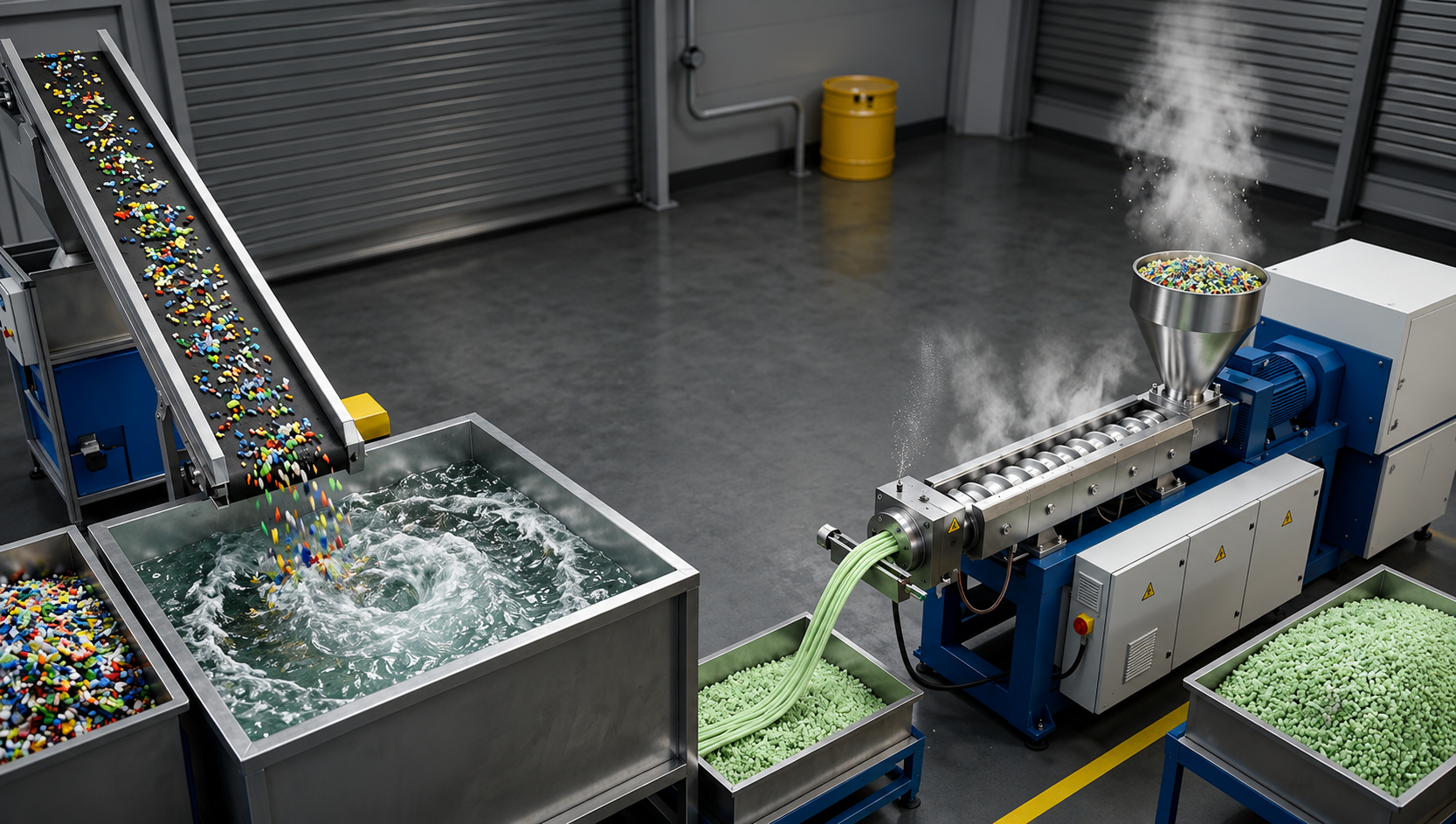
PCR manufacturing involves processes as shown below:
Stages in Plastic Waste Recycling to Produce Plastic Granules
Processing/recycling plastic sounds thrilling but it has its own challenges. These are:
What Is Post-Consumer Resin (PCR) and How Is It Made?
Post-consumer resin is a recycled resin pellet obtained from processing the existing plastic products.
PCR manufacturing involves processes as shown below:
Stages in Plastic Waste Recycling to Produce Plastic Granules
Why PCR Adoption Is Growing — But Not Without Hurdles
Processing/recycling plastic sounds thrilling but it has its own challenges. These are:
Challenge 1: Collecting Plastic Waste at Scale
- Collection
In a highly populated and diversified world, it is easy to find abundant plastic waste but difficult to collect it for recycling. There are established ways for collecting and dispatching it to factories for processing into PCR.
Recycling Centres & Reverse Vending Machines
First, setting up plastic recycling centres at every consumer market location makes people aware of such recycling centres. Organizations can also set up reverse vending machines, where people are paid for returning plastic waste.
Landfill & Doorstep Collection Methods
Second, collection workers / environmentalists gather tons of plastic bottles and waste from dumping grounds or landfills and sell it to industries for recycling. This task is now being done by machines in developing cities.
The Role of Consumer Education in Waste Segregation
Third, educating the consumer to segregate wet and dry waste at their residence so that public or private organizations can easily collect that waste and dispatch it for recycling at specific processing plants.
Waste Collection First
Waste Collection Second
Waste Collection Third
Challenge 2: Contamination — The Hidden Quality Risk in PCR
- Contamination
To segregate plastic from waste, it is important to understand what the outcome of segregation is. Plastic is collected from different locations where people use various types of products. These products are in combination with diverse other materials when collected. For example, PP caps, PET bottles, PS products, metal components, wooden components, and many more.
Mixed Grades & Colour Separation Issues
Even after segregating as per the grade, micro particles of unwanted materials such as wood, metals, and other plastics are present. Different coloured products of the same grade is another issue with this stage. Time and cost factors make colour-based separation nearly impossible.
The PET Recycling Problem: A Case Study
Let us understand the process with an example. The most common commercial plastic is PET (Polyethylene Terephthalate). All soft drink and water bottles are made from it. Recycling PET is challenging as different grades are used for soft drinks, juices, and water bottles.
Difference in colour and material properties (viscosity for example) of PET bottles as well as presence of PET containers with varying features makes it a challenge to recycle plastic in bulk. The difference in intrinsic viscosities of various materials may create recycled plastic with varying intrinsic viscosities in different sections. Intrinsic viscosity is the measure of a solute’s contribution to the viscosity of the solution.
Micro-Contaminants and Their Effect on Moulded Parts
Other additives that contaminate the batch are microscopic particles of sand, glass, plastics, or metals. These get processed with the main plastic products and the PCR obtained contains their micro particles. Small particles/ contaminants produce black spots or a tear or flow pattern during moulding of that PCR.
Challenge 3: Material Variation & Its Impact on Moulding Performance
- Variation:
Although PCR is usually obtained from plastic of the same grade, contamination or presence of other grades which gets processed during recycling alters material properties. For example, PE may be present in PP during recycling. It is difficult and expensive to segregate these. Thus, PCR obtained by recycling 100% PP usually has 5-20% PE, which makes the final product softer/ flimsy. Moreover, the percentage of PE content in PP-based PCR varies from batch to batch.
Why PCR Properties Vary Batch to Batch
Moreover, the percentage of PE content in PP-based PCR varies from batch to batch.
Blending PCR with Virgin Resin — Finding the Right Ratio
To control the pack’s properties, businesses mix PCR with virgin resin in variable percentages based on the pack’s quality requirements. For example, 25% PCR – 75% Virgin, 50% PCR – 50% Virgin, etc.
Achieving Consistent Colour in PCR Products
Another issue is the appearance of the PCR product. Natural appearance of PCR is greyish. When PCR is moulded, the product has a greyish appearance. To obtain non-greyish shades, a solid colour, the master batch/pigment is added in PCR resin. The quantity of the master batch depends on required shade depth and part geometry. To obtain a dark blue colour, you have to add more master-batch than what you add in for virgin resin. Hence, with PCR, it is difficult to obtain bright or translucent colours without the right expertise.
For moulding PCR, the processing conditions are somewhat different from moulding a virgin resin of the same grade. For example, injection pressure is usually different in PCR than in virgin material because of PCR’s inconsistent viscosity. Sometimes, even hold pressure must be altered.
Challenge 4: Infrastructure Investment Required to Use PCR
- Investment:
Although eco-friendly, some companies have to push their boundaries occasionally in-order to use PCR instead of virgin resin. A production company would have to invest in certain aspects of its production infrastructure to be able to use PCR.
PCR Silos & Storage Requirements
A PCR silo is a basic additional requirement. PCR properties vary from batch to batch. To avoid final product quality fluctuations, a company must order and store PCR in large quantities and store it in a silo. An additional silo would be a large investment for some companies.
Gravimetric Blenders & Masterbatch Costs
High master batch requirement in PCR compared to virgin resin would also increase the per piece cost price. When virgin resin is to be mixed/blended with PCR, a gravimetric blender has to be installed for uniform mixing.
How EIPL Helps You Navigate the PCR Transition
EIPL is an expert in Sustainable product design and development.
Our Team provides Sustainable solutions right from product design, redesign, or innovation to implementation, and from the prototype phase to its industrial tool qualification. Our skilled and highly experienced team ensures utilization of up-to date technical capabilities and project management techniques in delivering the projects for market launch. We have several years of experience in implementing post-consumer resin (PCR) in production at optimized costs by design of the existing packaging products. This has given us an edge as we help clients rapidly attain a sustainability tag. Rigorous follow ups and data accumulation service is also provided for every project.
Moreover, we extensively assist in management and execution of R&D prospects for qualifying Dimensional, Functional and Ergonomic aspects of a product which accelerates the project timeline. We provide a detailed analysis of the process capabilities to ensure the compatibility of PCR grade packaging with Virgin grade packaging.
Our supply chain expertise has been extremely helpful to our clients in optimal relocation of their assets in relation to their suppliers. A thorough check of the vendor’s compatibility, plant’s design, supply chain documents, quotation, etc. is carried out for successful relocation.
We ensure dedicated resources for smooth communication over the course of the projects. Effective communication skills and people management are our key attributes to connect people across the globe for successful project delivery. EIPL promises excellent value addition, execution of responsibilities, and fully reliable services.
Our team has a global reach in injection moulding. We have acquired vast knowledge and experience, over last 15 years of working with global leaders of industries in India, and 42+ other countries.
Connect with us on www.efficientinnovations.in to know more!
Article by
Darshak Mehta
Project Manager
EIPL
FAQ: Post-Consumer Resin (PCR) in Injection Moulding
- What is post-consumer resin (PCR) and how is it different from virgin plastic?
PCR is recycled plastic made from used consumer products. Unlike virgin plastic, it has variable properties due to prior use, contamination, and reprocessing. - What are the main stages involved in converting plastic waste into PCR granules?
The process includes collection, segregation, cleaning, shredding, melting, and pelletizing into reusable plastic granules. - Which plastic grades are most commonly recycled into PCR?
Common grades include PET, PP, and HDPE, widely used in bottles, caps, and packaging. - Is PCR safe to use in food and beverage packaging?
It can be safe if processed under strict regulations and certified for food-grade applications. - What are the main methods used to collect plastic waste for PCR production?
Methods include recycling centres, reverse vending machines, landfill collection, and doorstep waste segregation systems. - What is a reverse vending machine and how does it support plastic recycling?
It is a machine that accepts used plastic containers and rewards users, encouraging recycling and improving collection efficiency. - Why is consumer waste segregation critical for high-quality PCR production?
Proper segregation reduces contamination, improving material quality and recyclability. - What types of contaminants are commonly found in PCR resins?
Contaminants include other plastics, metals, wood, glass, sand, and additives. - Why is colour-based separation of plastics during recycling so difficult?
Mixed colours are hard to separate efficiently, and the process is time-consuming and costly. - How do micro-contaminants like sand, glass, or metal affect moulded PCR parts?
They cause defects like black spots, flow lines, and can damage moulds or hot runners. - Why is recycling PET particularly challenging compared to other plastics?
Different grades and intrinsic viscosities in PET products create inconsistencies during recycling. - What causes black spots or flow patterns in parts moulded from PCR?
Micro-contaminants and impurities in the material lead to visual defects during moulding. - Why do PCR material properties vary from batch to batch?
Variations arise from mixed feedstock, contamination, and inconsistent processing conditions. - How does PE contamination in PP-based PCR affect the final moulded part?
It makes the product softer and less rigid, affecting performance. - What PCR-to-virgin resin blending ratios are commonly used in production?
Common ratios include 25:75, 50:50, or other blends depending on quality requirements. - Why is it harder to achieve bright or translucent colours with PCR than with virgin resin?
PCR has a natural grey tone, requiring more pigment and making light or clear colours difficult to achieve. - How does PCR’s inconsistent viscosity affect injection pressure settings?
It requires adjustments in injection and hold pressure to maintain consistent filling and part quality. - What infrastructure investments are needed to start using PCR in production?
Investments include storage silos, blending systems, and additional quality control measures. - What is a PCR silo and why is it necessary for consistent production quality?
A PCR silo stores large batches of material to minimize variability and ensure consistent production. - What is a gravimetric blender and when is it required for PCR processing?
It accurately mixes PCR with virgin resin, ensuring consistent material composition during processing. - How does the higher masterbatch requirement in PCR affect per-piece cost?
More pigment is needed to achieve desired colours, increasing material cost per part. - Why are brands shifting to PCR materials despite the challenges?
To meet sustainability targets, reduce environmental impact, and comply with regulations. - What percentage of PCR can be used without compromising packaging performance?
It varies by application, typically ranging from 10% to 100% depending on design and quality needs. - How does using PCR contribute to a company’s sustainability goals?
It reduces reliance on virgin plastics, lowers waste, and supports circular economy initiatives. - How does EIPL support companies in transitioning from virgin resin to PCR?
EIPL provides design optimization, process validation, R&D support, and end-to-end implementation for PCR adoption.