Key Takeaways
- A physical audit injection mould programme is only as effective as the people conducting it. Discover when in-house injection mould inspection is enough, and when specialist auditors uncover risks internal teams often miss.
- The real value of a mould audit checklist begins after the inspection. Learn how leading manufacturers convert mould defect detection findings into corrective action plans, preventive maintenance roadmaps, and long-term production stability.
- Some of the most expensive tooling failures begin as small, visible warning signs. Explore why hot runner system inspection, parting surface condition, and ejection system health consistently emerge as the highest-risk areas in injection moulding equipment audit programmes.
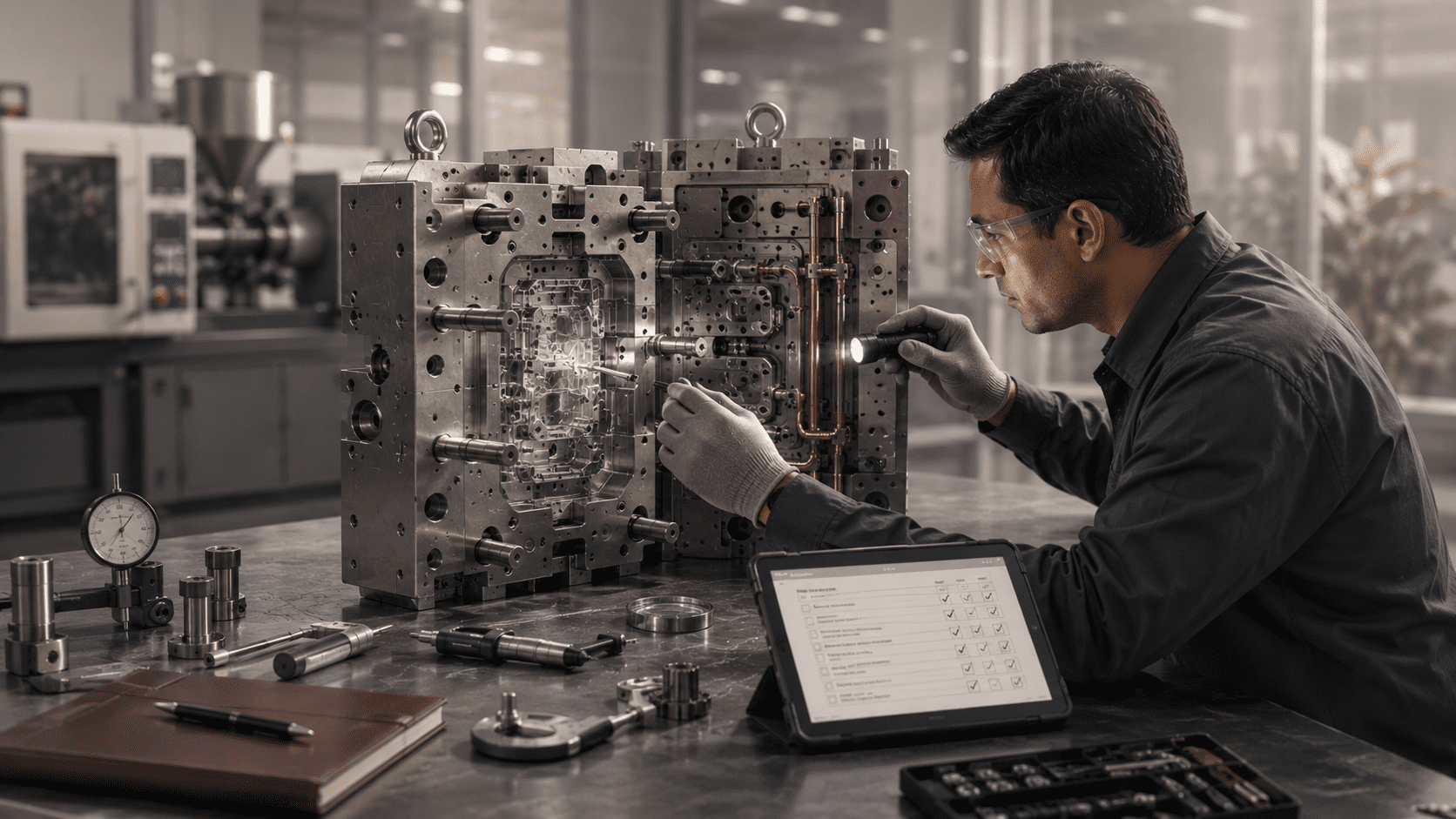
A physical audit injection mould programme is only valuable when it leads to action. Detecting wear, imbalance, or deterioration is important, but the real impact comes from understanding who should conduct the audit, how findings are prioritised, and how those insights translate into long-term production stability.
Many manufacturers rely on routine in-house injection mould inspection practices for day-to-day monitoring, while others bring in specialist auditors for independent evaluation, complex mould defect detection, or high-risk programmes. Both approaches have value, but choosing the right one depends on the tooling complexity, production criticality, and level of diagnostic expertise required.
This guide explores the practical side of injection moulding equipment audit programmes, from deciding between internal teams and external specialists to understanding what a professional mould audit checklist should uncover
after inspection. It also examines how audit findings evolve into corrective action plans, preventive maintenance roadmaps, and long-term mould maintenance audit strategies that reduce downtime, scrap, and operational risk.
Drawing on more than 15 years of hands-on experience across automotive, packaging, consumer, and medical programmes, EIPL’s approach combines structured hot runner system inspection, root-cause analysis, and production-focused engineering insight to help manufacturers move from reactive troubleshooting to controlled, predictable mould performance.
Who Should Conduct the Audit: In-House Team vs. Specialist
A physical audit does not strictly require an external provider. A competent in-house engineer can perform interim checks. However, the depth, objectivity, and benchmarking value differ significantly.
In-House Team: Process Familiarity & Availability
An internal team can effectively handle routine physical audit injection mould reviews, especially for ongoing monitoring and preventive checks. In-house engineers typically have strong familiarity with the mould’s operating history, recurring defects, production constraints, and process behaviour.
Key advantages include:
- Immediate availability and faster response
- Lower direct audit cost
- Better understanding of day-to-day process conditions
- Ability to monitor gradual deterioration trends over time
For regular injection mould inspection activities, in-house teams provide valuable continuity and operational awareness.
Specialist Auditor: Cross-Programme Benchmarking & Independent Findings
A specialist auditor brings broader exposure across industries, tooling types, and manufacturing environments. This external perspective is particularly valuable during complex failures, chronic quality issues, or high-risk production programmes.
Key advantages include:
- Independent and unbiased findings
- Structured mould audit checklist methodology
- Cross-programme benchmarking against best practices
- Advanced mould defect detection experience
- Early identification of risks internal teams may normalise over time
Specialist-led injection moulding equipment audit programmes are especially valuable for high-cavitation tools, regulated industries, and major production decision-making.
EIPL’s Recommendation: When to Use Each
EIPL recommends a hybrid approach combining routine internal monitoring with periodic specialist audits.
Typical best practice:
- Use in-house teams for regular mould maintenance audit activities and interim checks
- Use specialist audits for annual reviews, chronic quality issues, high-value tooling, or pre-critical production decisions
External audits are most effective when objective assessment, advanced hot runner system inspection, or deeper root-cause analysis is required beyond normal operational familiarity.
What Happens After the Audit? Turning Findings into Action
An audit creates value only when its findings translate into measurable improvements. A professional audit report should function as a decision-making tool, not just a technical record.
A high-quality report typically includes:
- Prioritised findings categorized as Critical, Major, or Minor
- Root cause mapping linking symptoms to underlying issues
- Recommended corrective actions with technical justification
- Estimated timelines for remediation
- Cost-impact analysis, including risk of inaction
EIPL structures reports so that both technical teams and management can act on them immediately. Many clients use the report as the foundation for a preventive maintenance roadmap, capital planning decisions, or supplier discussions.
By converting observations into a phased action plan, organisations move from reactive firefighting to controlled risk management.
Audit Report Structure: Critical, Major & Minor Findings
A physical audit injection mould review creates value only when findings are clearly prioritised and actionable. An effective audit report should classify issues by severity so teams can focus resources where operational risk is highest.
Typical categories include:
- Critical findings — Immediate risks to production, safety, or tool integrity
- Major findings — Significant deterioration likely to affect quality, uptime, or cycle stability
- Minor findings — Early-stage wear or maintenance concerns requiring monitoring or planned correction
This structured approach helps both technical teams and management quickly understand priorities, budget implications, and production risk exposure.
Root Cause Mapping & Corrective Action Plan
A strong injection mould inspection report should do more than list symptoms. It should connect visible defects to their underlying causes and define corrective actions with clear technical justification.
Effective root-cause mapping links issues such as:
- Flash to parting surface wear or alignment problems
- Burn marks to venting restrictions
- Cycle instability to cooling imbalance or hot runner system inspection findings
- Dimensional drift to guide system wear or thermal variation
Corrective action plans should include:
- Recommended repairs or maintenance actions
- Estimated timelines and urgency
- Risk of inaction
- Validation requirements after corrective work
This converts mould defect detection into a structured recovery plan rather than reactive troubleshooting.
Building a Preventive Maintenance Roadmap from Audit Findings
The most valuable audits do not end with a report, they reshape the mould maintenance audit strategy going forward.
Audit findings often become the foundation for:
- Revised preventive maintenance intervals
- Targeted hot runner system inspection schedules
- Cooling circuit cleaning plans
- Spare component planning
- Refurbishment or replacement timelines
By translating inspection results into a phased preventive maintenance roadmap, manufacturers move from reactive repair cycles toward predictable mould lifecycle management and long-term production stability.
EIPL’s Physical Mould Audit: 15 Years of Hands-On Experience
Over the past 15 years, EIPL has conducted physical audits across a wide spectrum of programmes, including automotive components, high-volume packaging, consumer goods, and regulated medical products. This cross-industry exposure enables rapid identification of patterns that individual plants may encounter only rarely.
Common issues uncovered include:
- Hot runner imbalance causing uneven cavity performance
- Progressive wear in guiding systems leading to dimensional drift
- Cooling inefficiencies extending cycle time and increasing scrap
- Undocumented material changes affecting flow behavior
Example outcomes (anonymised):
- A 16-cavity packaging tool with a 12% scrap rate was traced to HRS imbalance and gate wear; corrective maintenance restored uniform filling within one service cycle
- An automotive mould experiencing intermittent flash was found to have subtle parting line damage; targeted repair prevented an impending shutdown
These interventions typically deliver immediate quality improvements and reduce long-term maintenance costs.
If your programme shows unexplained defects, rising scrap, or performance drift, a structured physical audit can provide clarity before problems escalate. EIPL’s team can help assess risk, prioritise actions, and restore confidence in your tooling assets.
Conclusion: Prevention Is Always Cheaper Than Failure
A physical audit of injection moulds is not an operational expense. It is a form of insurance against far larger costs such as emergency downtime, mass scrap, missed deliveries, and damaged customer trust. Most catastrophic mould failures do not occur suddenly. They develop slowly through visible deterioration that a structured audit can detect early.
If there are three areas that consistently deliver the highest risk reduction, they are these:
- Hot Runner System (HRS): The most failure-sensitive subsystem. Imbalance, leakage, or valve pin issues can halt production entirely, not just degrade quality.
- Mould Halves & Parting Surfaces: These define the dimensional foundation of every part. Damage here propagates into flash, mismatch, and accuracy loss across all cavities.
- Ejection System: Often overlooked until failure. Misaligned or worn ejector components lead to part damage, cycle interruptions, and progressive tool wear.
Regular physical audits shift organisations from reactive crisis management to controlled, predictable operations. They enable maintenance to be scheduled, budgets to be planned, and quality risks to be addressed before customers ever see them.
If your programme is overdue for a physical audit, or if you have recently observed part quality changes that point to mould deterioration, EIPL’s team is ready to help.
Frequently Asked Questions
Can my in-house team conduct the physical audit, or do I need a specialist?
A trained in-house engineer can perform routine audits. However, specialists provide cross-programme benchmarking, advanced diagnostics, and independent reporting, making them ideal for annual or high-risk audits.
What should a physical mould audit report include?
A strong report provides prioritised findings (critical/major/minor), root-cause insights, photographic evidence, corrective recommendations, timeline estimates, and cost-impact analysis to support maintenance planning.
What part defects indicate that a physical audit is overdue?
Persistent flash, sink marks, burn marks, short shots, warpage, dimensional drift, or unexplained scrap increases often signal underlying mould deterioration that requires immediate audit attention.
How do I map plastic part defects back to the mould condition?
By analysing defect patterns alongside process data and mould features. For example, flash points to parting surface wear or clamp issues, while burn marks indicate venting problems. Experienced auditors use defect-to-tool mapping frameworks.
What is the ROI of a regular physical mould audit programme?
ROI comes from avoided downtime, reduced scrap, extended tool life, and fewer emergency repairs. Preventing a single major failure often offsets the cost of multiple audits, making it a highly cost-effective risk-management practice.