What Is Let Down Ratio (LDR) in Plastic Injection Moulding?
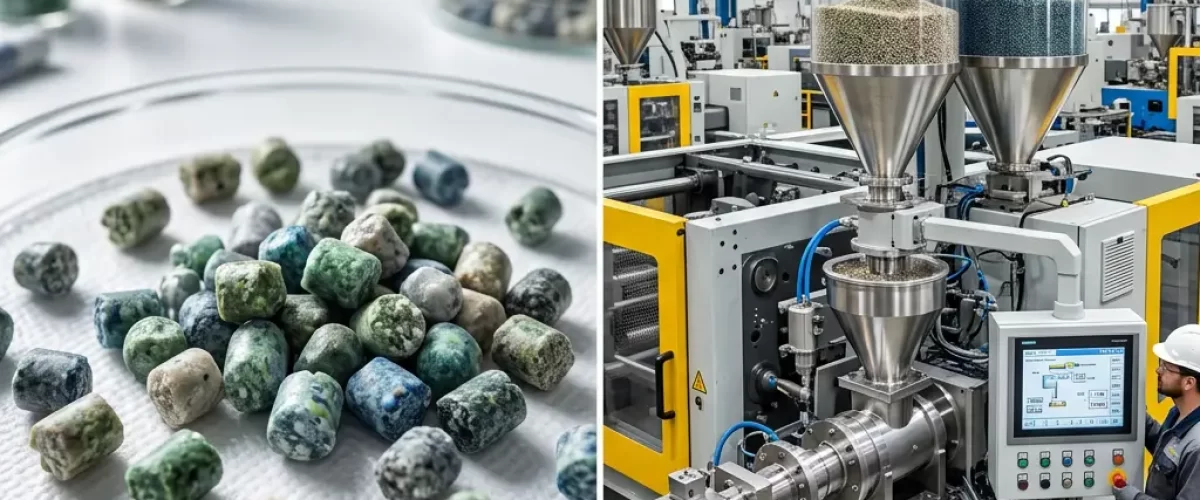
Master-batch is added to resin during moulding to impart colour to plastic products. The ratio of master-batch to base resin is known as the Let Down Ratio (LDR). It determines colour intensity, uniformity, and final appearance of the moulded product.
Key Factors That Determine Let Down Ratio in Coloured Plastics
The required LDR depends on several variables:
- Intensity of the desired colour shade
- Product geometry and volume
- Natural colour of the base resin
- Whether master-batch is liquid or solid
Each factor influences how much pigment is required to achieve the targeted visual output.
Typical Let Down Ratios for Small vs Large Plastic Products
LDR varies depending on product size and application.
For example:
- A 400 ml shampoo bottle cap typically uses 0.5% – 2% LDR.
- A 30-litre bucket may require 2% – 4% LDR.
Larger parts or deeper shades often require higher master-batch concentration.
Understanding Let Down Ratio in Post-Consumer Resin (PCR)
When working with recycled plastic grains or Post-Consumer Resin (PCR), LDR behaves differently compared to virgin resin. PCR introduces additional challenges in achieving colour uniformity and aesthetic appeal.
Natural Colour and Appearance Challenges of PCR Materials
Polypropylene (PP) PCR available in the market typically has a natural, non-uniform grey appearance when moulded without master-batch. Market surveys indicate that this raw grey look is not appealing to consumers, particularly in FMCG packaging applications.
Effect of Master-Batch Colour Selection on PCR Products
When bright colours such as white, yellow, or blue are added at standard LDR levels (0.5%–2%), the result is often a pale grey, pale yellow, or pale bluish-grey shade.
These outcomes are visually unappealing. Therefore, darker colours such as black, shiny grey, or dark blue are often selected to mask the inherent grey tone of PCR.
Why PCR Requires Higher Let Down Ratio Than Virgin Resin
Even with darker master-batch colours, standard LDR levels may not produce sufficient depth or uniformity in PCR products.
As a result, LDR is often increased from 0.5%–2% to 2%–5%, depending on part geometry and desired colour depth. This compensates for the base grey tone and variability of recycled resin.
Impact of Increased Let Down Ratio on Processing Conditions
In most cases, increasing LDR does not require major changes in processing conditions.
However, occasionally, the hot runner manifold tip temperature may need adjustment to ensure proper flow and colour dispersion, especially in thermally operated hot tip systems.
Flow Marks and Surface Defects Linked to High LDR in PCR
When LDR exceeds 5%, additional quality complications may arise.
As the molten PCR-master-batch mixture flows through the hot tip toward the cavity, visible flow marks may appear around the gate area. This is particularly noticeable with shiny or pearlized master-batches, which highlight flow lines more prominently.
Gate Blush, Scuff Marks, and Pigmentation Sensitivity Explained
Higher master-batch content increases pigmentation, which can make the surface more sensitive to external forces.
Common defects include:
- Scuff marks caused by part ejection or rubbing
- Gate blush (a shiny patch near the gate area)
- Surface blemishes linked to pigment concentration
These issues are persistent and difficult to eliminate completely.
Cost Implications of Higher Let Down Ratio in Recycled Plastics
Increasing LDR significantly impacts cost per piece. Master-batch materials add to raw material expenses, and higher concentrations directly escalate overall production cost.
Thus, balancing colour performance and economic feasibility becomes critical when using PCR.
Balancing Aesthetics, Cost, and Sustainability in PCR Packaging
Despite minor aesthetic defects, recycled resin FMCG packaging should be accepted as a step toward environmental responsibility.
EIPL specializes in sustainable product design and development, offering end-to-end solutions from design, redesign, and innovation to industrial tool qualification.
With 14+ years of global experience across 44+ countries, we support PCR implementation, optimize costs, validate dimensional and functional performance, and ensure seamless project execution.
Connect with us at www.efficientinnovations.in to know more.
FAQs
- What is let down ratio in plastic injection moulding?
Let Down Ratio (LDR) is the percentage of master-batch added to base resin to achieve the desired colour in a moulded plastic part. It determines shade intensity, colour uniformity, and overall visual appearance of the final product. - Why is let down ratio higher in post-consumer resin?
Post-consumer resin (PCR) has a natural grey, non-uniform base colour. To mask this and achieve acceptable colour depth and uniformity, a higher concentration of master-batch is often required compared to virgin resin. - What are typical let down ratios used for PCR products?
For PCR products, LDR typically ranges from 2% to 5%, depending on part geometry and desired shade. This is generally higher than the 0.5%–2% commonly used for virgin resin applications. - How does LDR affect colour consistency in recycled plastics?
Higher LDR improves colour masking and depth in PCR, but achieving uniformity can still be challenging due to base resin variability. Insufficient LDR often results in pale or uneven shades. - Does increasing let down ratio change processing conditions?
In most cases, processing conditions remain unchanged. However, slight adjustments, such as increasing hot runner tip temperature, may be required to ensure proper pigment dispersion and flow stability. - What surface defects are caused by high let down ratio in PCR?
High LDR can lead to visible flow marks near the gate, gate blush, shiny patches, and scuff marks. Increased pigmentation may also make the surface more sensitive to rubbing during ejection. - How does let down ratio impact cost per moulded part?
Increasing LDR directly increases material cost, as master-batch adds to the raw material expense. Higher percentages can significantly escalate cost per piece, especially in high-volume FMCG packaging. - Are visual defects acceptable in recycled FMCG packaging?
Minor aesthetic variations may be accepted as part of sustainable packaging initiatives. While quality standards must be maintained, slight visual imperfections are often tolerated when promoting environmentally responsible PCR products.