Key Takeaways
- A packaging audit often reveals far more than compliance gaps. Hidden inefficiencies in mould condition, process control, maintenance, and documentation can quietly impact quality and profitability.
- From pre-audit preparation and team coordination to risk prioritization and implementation planning, discover what separates a routine audit from a high-value operational improvement strategy.
- The real advantage lies in what happens after the audit, where structured action plans, phased execution, and continuous monitoring transform audit findings into long-term operational gains.
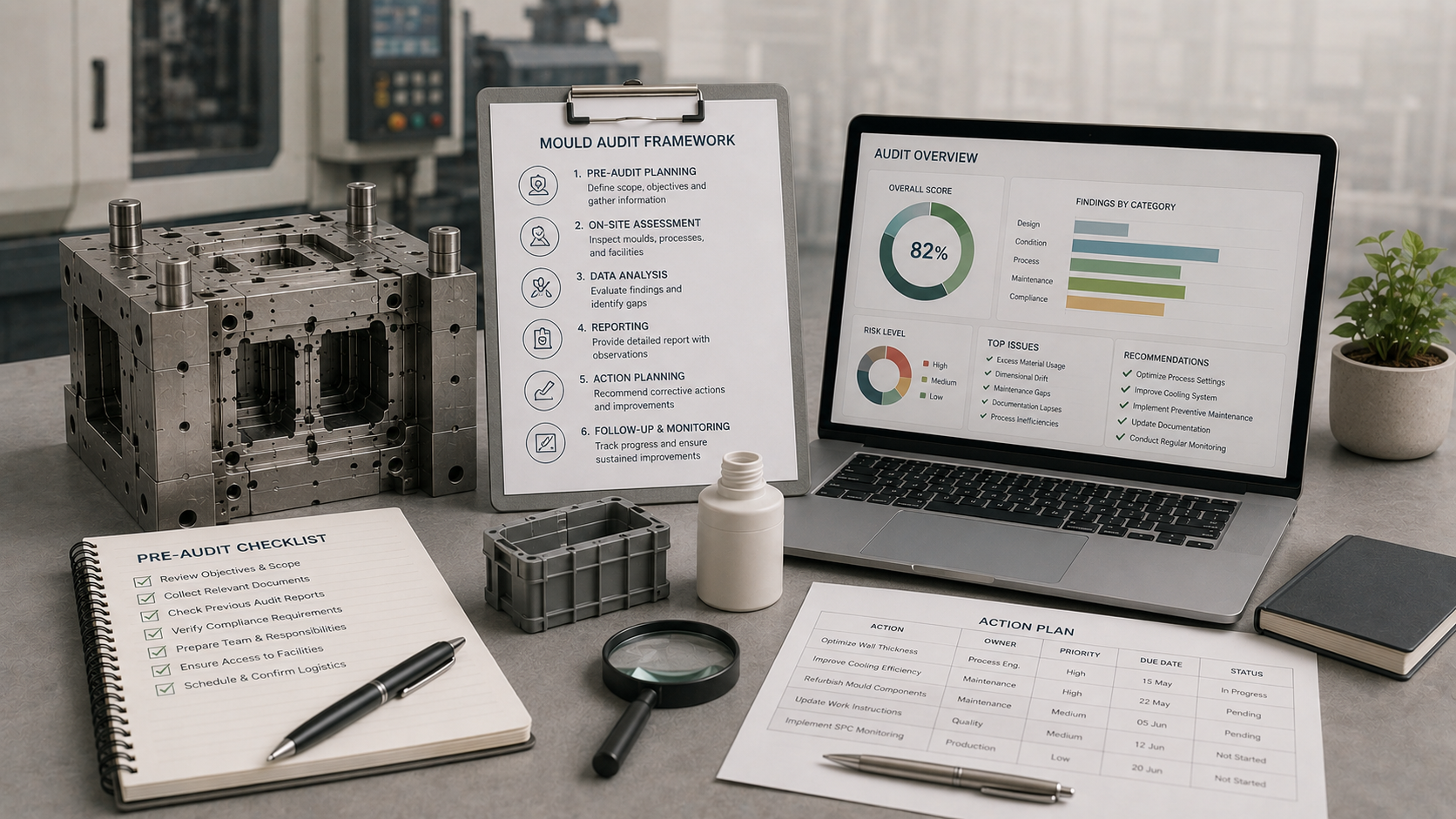
A packaging audit is not just a compliance exercise. It is a strategic opportunity to identify hidden inefficiencies, improve mould performance, and strengthen long-term operational stability. Well-executed onsite packaging operation audits help manufacturers uncover issues such as excess material usage, dimensional drift, maintenance gaps, and process inefficiencies before they escalate into larger production risks.
This blog explores how to prepare effectively for a mould audit, from organizing documentation and coordinating teams to understanding timelines and audit expectations. It also explains how to interpret audit findings, prioritize risks, and build structured action plans that deliver measurable improvements.
In addition, the guide covers implementation best practices, phased execution strategies, and long-term monitoring approaches that help organizations turn packaging audit insights into sustained quality, efficiency, and compliance improvements.
Common Findings & What They Mean
Most packaging audit engagements uncover improvement opportunities, even in well-managed operations. This is exactly what makes onsite packaging operation audits valuable.
Rather than viewing findings as problems, companies should treat them as a roadmap for improving quality, reducing costs, and preventing future production disruptions.
Excess Material Usage
One of the most frequent findings is higher-than-necessary material consumption.
Common causes:
- Overly thick walls or conservative design margins
- Process settings that lead to overpacking
- Poor mould venting or cooling inefficiency
- Lack of periodic optimization reviews
Why it matters:
Excess material directly increases unit cost and environmental footprint.
How it’s fixed:
- Design optimization or lightweighting
- Parameter tuning (pressure, hold time, temperature)
- Improved cooling and venting
- Material performance evaluation
Real-world example:
A mid-size manufacturer discovered that slight overpacking added 6–8% extra resin per part. Process adjustments delivered immediate savings without affecting product strength.
Dimensional Drift
Over time, parts may gradually move out of tolerance, often unnoticed until rejection rates rise.
Typical causes:
- Cavity wear or surface degradation
- Thermal instability
- Process parameter variation
- Insufficient calibration or monitoring
Impact:
- Assembly issues downstream
- Increased scrap and rework
- Customer complaints or returns
- Risk of product failure in the field
Solutions include:
- Mould refurbishment or polishing
- Cooling system optimization
- Tightened process controls
- Capability studies and monitoring
Early detection prevents sudden quality crises.
Maintenance Gaps
Audits frequently reveal that maintenance is reactive rather than preventive.
Common indicators:
- Incomplete service records
- Missed inspection intervals
- Emergency repairs instead of scheduled upkeep
- Overlooked wear on critical components
Consequences:
- Unexpected downtime
- Accelerated mould degradation
- Higher repair costs
- Reduced tool lifespan
Best-practice remediation:
- Implement structured preventive maintenance schedules
- Track service history digitally
- Use condition-based monitoring where possible
- Train operators for daily inspections
A proactive approach often extends mould life significantly while stabilizing production.
Regulatory or Documentation Lapses
Compliance gaps are especially concerning because they expose organizations to operational and legal risks.
Typical issues discovered:
- Missing or outdated certifications
- Incomplete traceability records
- Non-aligned documentation across departments
- Lack of evidence for process control
Potential consequences:
- Audit failures
- Production stoppages
- Fines or penalties
- Loss of key customers
Rapid remediation strategies:
- Documentation standardization
- Immediate corrective action plans
- Internal compliance reviews
- Staff training on recordkeeping
In regulated industries, documentation is as critical as technical performance.
Process Inefficiencies and Hidden Losses
Many audits uncover operational inefficiencies that quietly erode profitability.
Examples include:
- Excessive cycle times
- Frequent minor stoppages
- High scrap rates considered “normal”
- Inefficient changeover procedures
What this means:
Operations may be functioning, but far below optimal performance.
Improvement actions:
- Process mapping and bottleneck analysis
- Parameter optimization
- Operator training
- Equipment upgrades where justified
Even modest efficiency gains can deliver substantial annual savings.
A key takeaway from any audit is that problems rarely exist in isolation. Material usage, mould condition, process control, and compliance are deeply interconnected. Addressing root causes, not just symptoms, is what transforms findings into lasting operational improvements.
What You’ll Need to Prepare for the Audit
A successful packaging audit starts with proper preparation. Well-organized data, documentation, and team coordination help onsite packaging operation audits run efficiently while delivering deeper and more actionable insights.
Auditors typically require visibility into both historical performance and current operations. This involves coordination across production, maintenance, quality, and compliance teams.
Key preparation requirements include:
- Access to production, storage, and maintenance areas
- Availability of key personnel for walkthroughs and interviews
- Access to moulds, equipment, and maintenance records
- Organized documentation for performance and compliance
- Internal communication and scheduling coordination
Most facilities spend 8–20 hours preparing across departments, but this upfront effort significantly improves the accuracy and value of the packaging audit.
Documentation & Records You Should Gather
Comprehensive documentation allows auditors to move beyond surface observations and perform meaningful analysis. Preparing records in advance prevents delays and ensures no critical insights are missed.
Below is a department-wise checklist you can use:
Engineering
- ☐ Mould design drawings and specifications
- ☐ Equipment specifications and manuals
- ☐ Process control plans and parameter settings
- ☐ Change history or design revisions
- ☐ Tooling validation or qualification records
Quality Assurance
- ☐ Quality metrics and inspection reports
- ☐ Non-conformance reports and corrective actions
- ☐ Customer complaints or field failure data
- ☐ Regulatory certifications and compliance records
- ☐ Previous audit reports
Production
- ☐ Production records (last 6–12 months)
- ☐ Cycle time data and efficiency reports
- ☐ Scrap and rework statistics
- ☐ Downtime logs and incident reports
- ☐ Shift schedules and staffing plans
Procurement / Supply Chain
- ☐ Material specifications and certifications
- ☐ Supplier qualification documents
- ☐ Incoming inspection records
- ☐ Traceability documentation
Maintenance
- ☐ Preventive maintenance schedules
- ☐ Maintenance logs and repair history
- ☐ Spare parts records
- ☐ Calibration certificates
Having these organised, digitally or in indexed folders, enables faster review and deeper insights.
Team Coordination & Communication
A mould audit touches many parts of the organisation, so cross-functional coordination is essential. Clear communication prevents confusion and helps staff understand the audit’s purpose: improvement, not fault-finding.
Who should be involved:
- Operations and production leaders
- Quality and compliance teams
- Maintenance and engineering staff
- Supply chain or procurement representatives
- Site management or decision-makers
Best practices for smooth coordination:
- Brief teams on audit objectives and benefits
- Designate a single primary contact for auditors
- Ensure knowledgeable personnel are available during inspections
- Encourage openness — honest information leads to better outcomes
- Address staff concerns proactively
Avoid scheduling major maintenance shutdowns, product launches, or peak production runs during the audit window whenever possible.
Timeline & Resource Planning
A clear timeline helps organizations prepare effectively and minimize disruption during a packaging audit. While timelines vary by facility size and audit scope, most onsite packaging operation audits follow a structured schedule.
Typical audit timeline:
- Pre-audit preparation: 2–5 working days
- On-site audit: 1–3 days
- Data analysis: 3–7 business days
- Report delivery: Within 1–2 weeks
- Implementation phase: Several weeks to months
Duration is typically influenced by mould complexity, production volume, historical data availability, regulatory requirements, and overall audit scope.
Well-planned packaging audits are designed to run alongside operations with minimal disruption. Proper preparation helps organizations gain clearer insights, stronger compliance visibility, and a practical roadmap for improving quality, efficiency, and cost performance.
Interpreting Your Audit Report
Receiving a packaging audit report is only the first step. The real value comes from understanding the findings and turning them into actionable improvements. Well-structured onsite packaging operation audits present technical observations in a clear, business-focused format for both leadership and operational teams.
Typical report sections include:
- Executive summary with key findings and priority actions
- Detailed analysis of moulds, processes, materials, compliance, and costs
- Risk matrix categorizing issues by severity and urgency
- Cost-impact analysis highlighting savings opportunities and risks
- Actionable recommendations with phased implementation timelines
Many reports also use scoring systems, color coding, and risk categories to simplify prioritization.
To interpret findings effectively:
- Focus on business impact, not just technical issues
- Identify risks related to quality, compliance, cost, or operations
- Look for recurring patterns and root causes
- Prioritize actions based on urgency and feasibility
Ultimately, a packaging audit report is not just documentation, it is a decision-making tool for improving operational performance.
Understanding Risk Assessments & Prioritization
Not all findings carry equal weight. Audit teams typically prioritize recommendations using a structured methodology that balances urgency, risk, and return on investment.
Common prioritization frameworks include:
- Impact × Effort Matrix — High impact / low effort items are quick wins
- Risk Level — Safety or compliance risks outrank efficiency improvements
- Compliance Urgency — Regulatory gaps often require immediate action
- Cost-Benefit Analysis — Focus where savings or loss prevention is greatest
- Operational Criticality — Issues affecting production continuity move up the list
What priority levels usually mean:
- 🔴 High Priority — Immediate action required (safety, compliance, major cost or quality risk)
- 🟠 Medium Priority — Important improvements that enhance efficiency or reliability
- 🟢 Low Priority / Optional — Optimization opportunities with modest impact
Recommended implementation sequence:
- Address compliance and safety risks first
- Implement high-ROI operational improvements
- Tackle medium-priority efficiency gains
- Consider optional enhancements as resources allow
This structured approach prevents teams from chasing low-impact fixes while critical issues remain unresolved.
Building Your Action Plan from Audit Findings
Turning insights into results requires a disciplined implementation plan. Without clear ownership and timelines, even the best audit recommendations can stall.
A practical action plan should convert each finding into a manageable project with defined accountability.
Key steps to build your plan:
- Assign a responsible owner for every recommendation
- Define clear timelines and milestones
- Allocate budget and resources upfront
- Track progress using measurable KPIs
- Communicate status regularly to stakeholders
- Schedule follow-up reviews to verify effectiveness
Simple implementation template:
- Recommendation: Reduce cooling system inefficiency in Mould Line A
- Owner: Maintenance Manager
- Timeline: Complete by 30 Sept
- Budget: $18,000
- Expected Savings: $55,000 annually (energy + scrap reduction)
- Status Tracking: Weekly progress updates
Organizations that formalize implementation typically realize benefits 2–3× faster than those that treat the report as informational only.
A comprehensive audit report is not a verdict; it’s a roadmap. When interpreted correctly and executed systematically, it becomes a powerful tool for improving quality, reducing costs, strengthening compliance, and building long-term operational resilience.
Implementation Best Practices
Turning packaging audit findings into measurable improvements requires a structured and phased approach. Organizations that move too quickly risk operational disruption, while delayed action often reduces momentum and impact.
Key implementation considerations include:
- Phased rollout to minimize risk and maintain production continuity
- Team training and readiness for smooth adoption of new processes
- Coordination with vendors and suppliers where required
- Ongoing quality checks during implementation
- Risk mitigation planning to handle unexpected disruptions
Many companies begin with quick wins, low-effort, high-impact improvements that build confidence before moving into larger operational changes.
Phase Your Implementation for Success
A phased strategy allows organizations to prioritize improvements logically while minimizing operational disruption. Rather than attempting to fix everything at once, changes are sequenced based on risk, impact, and feasibility.
Typical phased approach:
Quick Wins (1–4 weeks)
Low-cost, high-impact actions that deliver immediate benefits.
- Address obvious inefficiencies or compliance gaps
- Adjust process parameters or maintenance routines
- Implement minor tooling fixes or housekeeping improvements
- Standardize documentation and reporting practices
Medium-Term Improvements (1–3 months)
Projects requiring moderate investment or coordination.
- Pilot testing process changes on selected lines
- Upgrading components or materials
- Implementing new quality checks or monitoring systems
- Refining workflows and training procedures
Long-Term Strategic Initiatives (3–12 months)
Transformational changes that reshape operations.
- Major equipment upgrades or redesigns
- Automation projects
- Supplier realignment or material substitutions
- Digital monitoring systems or data integration
Best practices for phasing effectively:
- Prioritize actions based on risk and ROI
- Pilot changes before full-scale rollout
- Align implementation timing with production cycles
- Coordinate closely with suppliers and service providers
- Establish checkpoints to review progress and adjust plans
This structured progression reduces uncertainty and increases the likelihood of sustained success.
Training & Change Management
Even the most technically sound improvements can fail if teams are not prepared to adopt them. Change management ensures that new processes become part of everyday operations rather than temporary initiatives.
Training should address both technical skills and behavioural adoption.
What teams typically need to learn:
- Updated operating procedures and quality standards
- Proper use of new tools, equipment, or materials
- Data recording and documentation requirements
- Maintenance practices aligned with new processes
- Safety implications of changes
Effective training methods include:
- On-the-job coaching during implementation
- Formal classroom or workshop sessions
- Visual work instructions and standard operating procedures (SOPs)
- Digital learning modules for ongoing reference
- Hands-on demonstrations and simulations
Sustaining adoption requires reinforcement:
- Regular performance reviews and feedback loops
- Refresher training sessions
- Clear accountability for compliance
- Recognition of teams that successfully adopt improvements
Ultimately, successful implementation is not just about fixing equipment or processes; it’s about building organisational capability. When teams understand the purpose behind changes and feel confident executing them, improvements become durable, scalable, and self-sustaining.
Maintaining Long-Term Success After Your Audit
A comprehensive mould audit provides a clear view of current operations, but long-term value comes from continuous follow-through. Over time, processes change, equipment wears down, and operational risks evolve. Without ongoing monitoring, even successful improvements can gradually lose effectiveness.
Leading organizations treat packaging audits as part of a continuous improvement cycle rather than a one-time exercise.
Key elements of long-term success include:
- Periodic re-audits based on operational risk
- Continuous KPI and performance monitoring
- Refresher training for process consistency
- Adaptation to new products, materials, and regulations
- Ongoing collaboration with audit and quality teams
Organizations that maintain this momentum achieve stronger operational stability, better quality consistency, and lower long-term costs.
Establishing Audit Cadence & Metrics
Determining how often to audit depends on industry requirements, operational risk, and process complexity. High-precision or regulated sectors generally require more frequent reviews than stable, low-risk operations.
Typical audit cadence guidelines:
- Full comprehensive audit: Annually (baseline reassessment)
- Targeted or spot audits: Quarterly or semi-annual
- Event-triggered audits: After major changes (new product, material, equipment, or supplier)
- Compliance-driven audits: As required by regulations or certifications
Key metrics to track between audits:
- Defect rates and customer complaints
- Scrap and rework percentages
- Cycle time stability
- Equipment downtime
- Maintenance adherence
- Regulatory deviations or non-conformances
Monitoring these indicators monthly or quarterly helps detect performance drift before it becomes a major issue.
Additional audits should be triggered when:
- Quality trends worsen unexpectedly
- Production volumes change significantly
- New technologies or materials are introduced
- Regulatory requirements shift
- Major incidents or recalls occur
A structured cadence ensures continuous visibility into operational health.
Conclusion
A successful packaging audit is not just about identifying problems. It is about creating a structured path toward better quality, stronger compliance, and improved operational efficiency. Well-executed onsite packaging operation audits help manufacturers uncover hidden risks, prioritize improvements, and build more reliable production systems.
By combining proper preparation, clear action plans, and continuous monitoring, companies can turn packaging audit findings into long-term gains in performance, cost control, and operational stability.
Frequently Asked Questions
What Is the Cost of a Mould Audit, and How Does It Compare to the Savings?
Costs vary by scope, but audits often uncover 15–25% cost-reduction opportunities through waste elimination, efficiency gains, and risk prevention. Many organizations recover the audit investment within months through operational savings alone.
What If the Audit Reveals Major Problems? Can We Afford to Fix Them?
Reports prioritize actions by risk and ROI, including low-cost quick wins and phased improvements. You control implementation pace. Identifying issues early usually costs far less than addressing failures after breakdowns or compliance incidents.
How Often Should We Conduct Mould Audits?
Frequency depends on risk, production volume, and regulatory demands. Many organisations perform annual full audits with quarterly spot checks or condition-based reviews for critical tools.
Will Your Audit Include Recommendations for Future-Proofing Our Moulds?
Yes. Beyond current issues, audits evaluate readiness for future demands, new regulations, product changes, sustainability goals, and capacity needs, helping extend mould lifespan and avoid premature obsolescence.
What Kind of Support Do We Get After the Audit Is Complete?
Post-audit support typically includes implementation guidance, progress reviews, training, and verification checks. Many organisations opt for ongoing advisory services to sustain improvements and maintain long-term operational performance.