
Injection Moulding – Troubleshooting: Beyond process approach
Injection moulding, is one of the most established plastic manufacturing processes across the world, broadly seems to comprise of an IMM, Mould and Material. But it is the time of urgency or technically speaking “the troubleshooting” when we realise that there is a lot more to it than what meets the eye. In injection Moulding there is an interplay of many domains like – mechanical, thermal, product design etc., which makes it a complex system to fundamentally isolate and thus address the issue at hand. Though there is plentiful data available for various problem statements, one problem statement can have many solutions to it, and such is the intricacy of this field. This is one of the attempts to chronicle the personal experiences of trouble shooting.
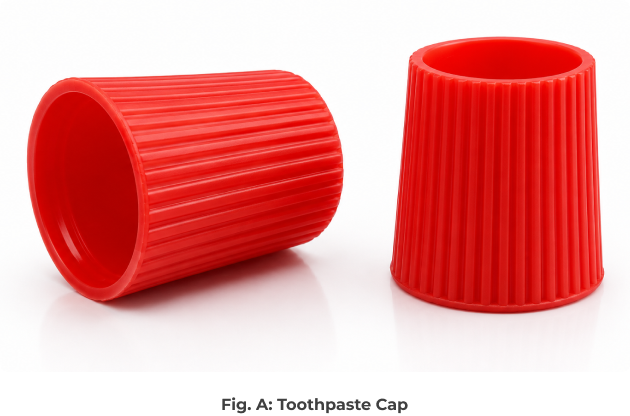
In this article we will discuss the packaging development for toothpaste (refer to Fig. A). The peculiarity of this project was the demand to downsize the package to suit a small toothpaste. The bottom OD of the Cap is approx. 10.0mm and the top OD is approx. 8.0mm. Injection begins at a depth of 5.0 mm from top of the Cap.
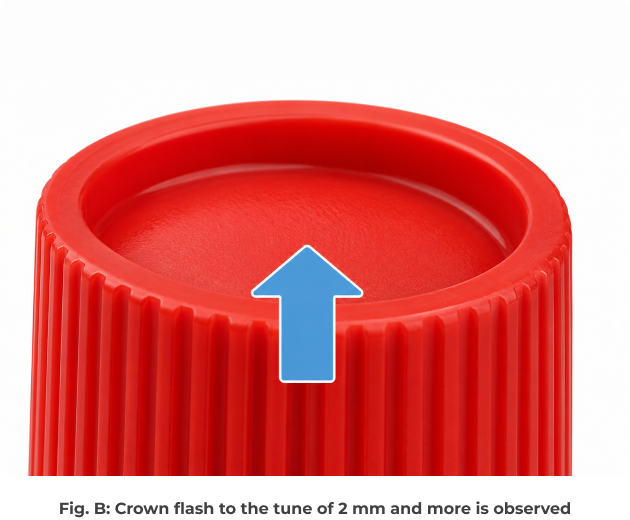
Since this was an innovation project (being developed for the first time) we needed to validate the concept on 4 cavity Pilot Mould and then cascade the learnings to 48 cavity commercial tool. In development of commercial tool one of the major challenges that we faced in cap tool was “Gate Crowning” (refer Fig. B)
Analysis- Firstly, we decided to physically check the entire gating system to ensure that it is designed fundamentally correct. We found that the gate design was as per the guidelines; the steel clearance between gate diameter and pin diameter was within the design tolerances. Secondly, we tried to check the effect of change in the tip temperature (set Tip Temperature was 220°C) – increasing the tip temperature was going to add to the Gate Crowning so tried with reducing the tip temperatures. Reducing the tip temperatures up to 190°C was appreciably helpful but at the cost of short-fill and sink marks on the Cap. Also, the bracket to manipulate the tip temperature (without short fill or sink marks) was quite narrow i.e. between 205°C to 220°C. After the samples were reviewed for the cosmetics, we found that there is no appreciably evident difference in the Gate Crowning between samples at 205°C and 220°C. Thus, the tip temperature was not changed from 220°C.
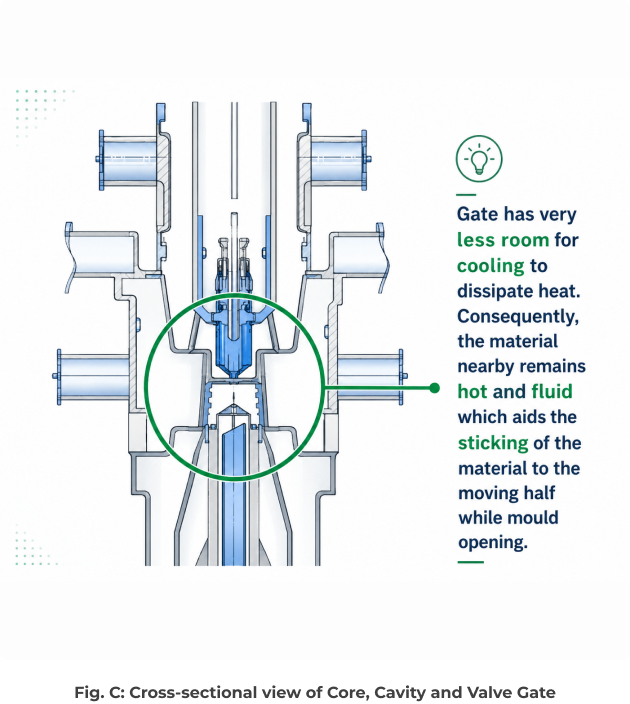
Another aspect is the “Process Parameter” which cannot be overlooked and after analysing the scenario in that direction we found a few notable concerns. Referring to the Fig. C, there is not enough room for the gate to dissipate heat and hence inefficient cooling is one of the major factors controlling the Gate Crowning. This led us to increasing the Hold Time as it was eventually giving the gate more time to dissipate heat and reduce its temperature after the Gate freeze is completed. Since the Gate Freeze happens at 1.00sec increasing the Hold Time further, was not going to affect the component dimensionally. Thus, increasing the Hold Time, we observed that at Hold Time of 1.25 sec and above, Gate Crowning reduces but not up to the acceptable level. However, increasing the Hold Time was also affecting the Cycle Time (targeted Cycle Time is 8.1 sec). Though increase in Cycle Time was helping us resolve this issue, we did not resort to that as we had to achieve the target of producing 350K caps in a day.
So far, we have analysed the scenario from HRS and Process POV but not from the part design perspective.
Inference- In this case, initially the cavity surface was glossy because of which the material (PP) used to stick on the cavity surface. even valve pin temperature was around 230°C (above PP processing temperature), at this temperature material become sticky and adheres to the hot surface i.e. valve pin. during mould opening, due to above mention reasons cavity surface and valve pin’s tip created a counter pulling and resulting in gate crowning.
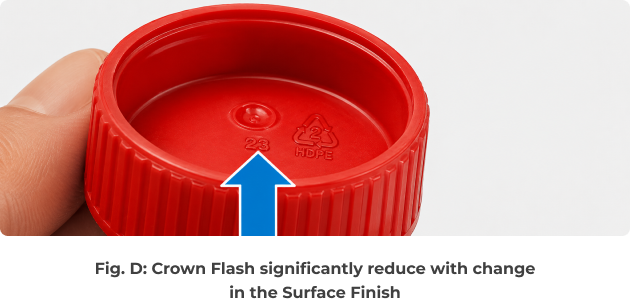
To avoid this adhesion to cavity surface micro blasting was carried out on the surface. This helped tremendously while releasing component from cavity surface and valve pin tip. After changing the gloss finish to Micro-blast finish, we observed that the crown flash was reduced significantly without any need to change the process parameters thus Cycle Time.
Troubleshooting is not only about following a celebrated or proven approach. It is mainly about using your prudence to analyse the factors that are hinging the problem.
By Efficient Innovations
Hrushikesh Pujari is a technical consultant in the field of injection moulding for last 3 years.
Disclaimer
This is a technical article based on case specific experience of the writer. The verbiage used in the article is specific to this case. Request the readers to not generalize the context without the discretion of the problem at.
By Efficient Innovations
Hrushikesh Pujari is a technical consultant in the field of injection moulding for last 3 years.
Disclaimer
This is a technical article based on case specific experience of the writer. The verbiage used in the article is specific to this case. Request the readers to not generalize the context without the discretion of the problem at.
Clients We Work With
We collaborate with forward-thinking clients across industries.
Together, we turn ideas into measurable results.