Key Takeaways
- The decision between hot runner vs cold runner systems is not just technical. It directly impacts efficiency, cost, scalability, and long-term production success.
- Each system solves a different manufacturing challenge, with one prioritizing precision and material efficiency while the other focuses on flexibility and cost control.
- The best choice depends on how well the runner system aligns with your production volume, material characteristics, and overall business objectives.
At a glance, injection molding can seem like a straightforward process. Plastic is melted, injected into a mould, cooled, and ejected as a finished part. However, anyone with experience in manufacturing knows that the real complexity lies in the details. Every design choice, every parameter, and every component of the mould has a direct impact on production efficiency, cost, and part quality.
Among these decisions, one stands out as particularly influential: the choice between hot runner vs cold runner systems.
This is not a minor tooling preference. It is a strategic decision that affects everything from cycle time and material usage to maintenance requirements and long-term return on investment. Whether you are designing a new mould, scaling production, or optimizing an existing process, understanding this choice is essential.
In this guide, we will break down both systems in detail, explore their advantages and trade-offs, and help you evaluate which option makes the most sense for your application.
What Are Hot Runner and Cold Runner Systems?
Before diving into comparisons, it is important to understand what runner systems actually do.
In injection molding, the runner system is the network of channels that transports molten plastic from the injection machine nozzle into the mould cavities. While this may sound simple, the way this system is designed has far-reaching consequences.
The two most widely used approaches are hot runner systems and cold runner injection molding systems. Each represents a fundamentally different way of managing material flow and temperature.
Hot Runner Systems
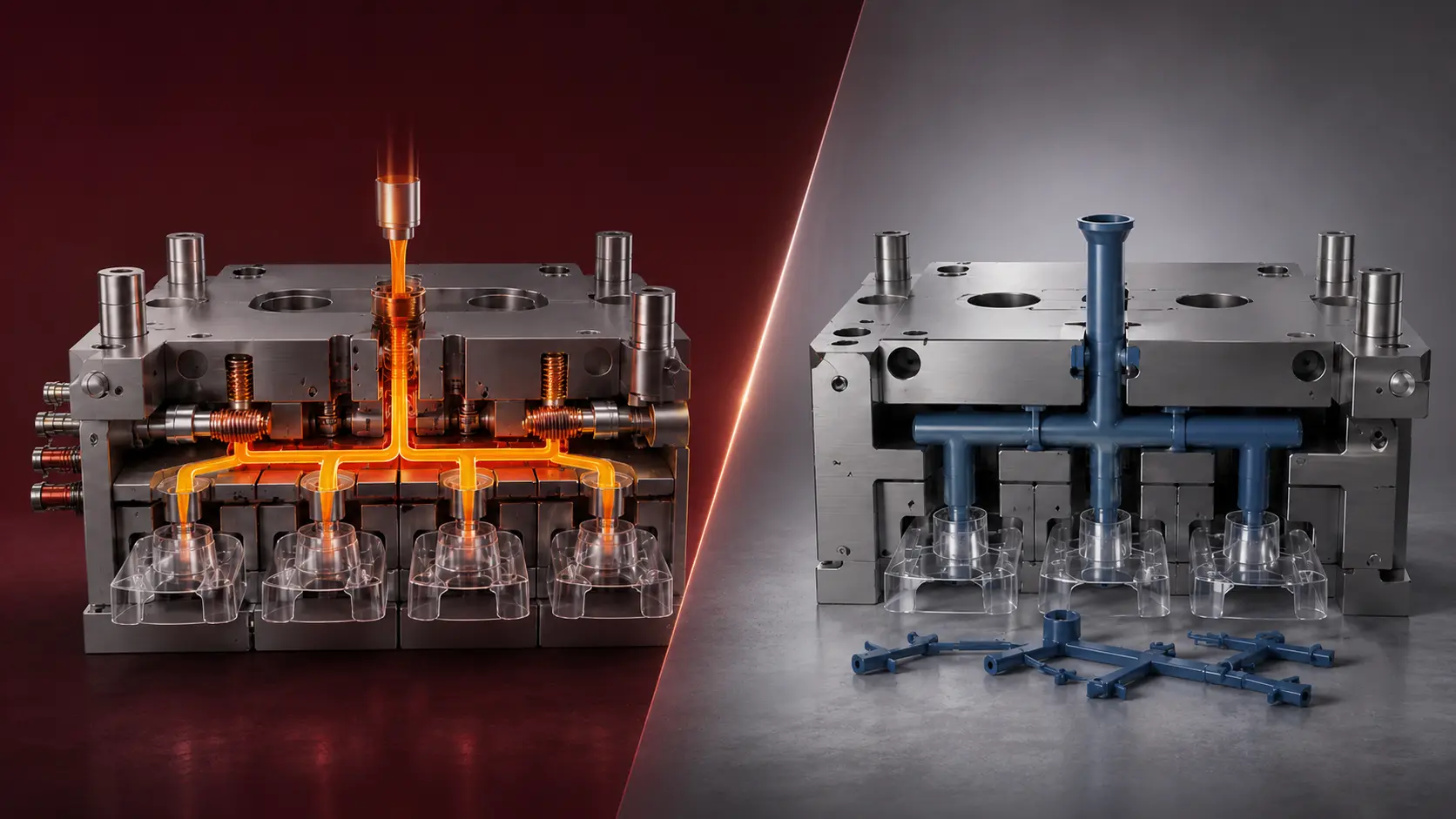
A hot runner injection molding system keeps the plastic inside the runner channels in a molten state throughout the entire molding cycle. This is achieved through a network of heated manifolds and nozzles that maintain precise temperature control.
What makes this system particularly effective is its ability to eliminate runner solidification altogether. Instead of forming waste material, the molten plastic flows directly into the cavities and becomes part of the final product.
From an operational perspective, this translates into:
- Reduced material waste since there are no solid runners
- Improved cycle times due to less cooling demand
- Better consistency in melt flow across multiple cavities
- Higher tooling complexity that requires precise engineering
The hot runner injection molding process is widely adopted in industries where production volumes are high and efficiency gains can significantly impact profitability. Automotive, packaging, and consumer electronics sectors are common examples.
Cold Runner Systems
In contrast, cold runner injection molding relies on unheated channels to deliver molten plastic into the mould cavities. Once injected, both the part and the runner material cool and solidify together.
After each cycle, the runner must be separated from the molded part. Depending on the application, this material may either be discarded or reground and reused.
Key characteristics include:
- Simpler mould construction with no heating elements
- Lower initial tooling costs
- Additional post-processing for runner removal
- Increased material usage due to runner waste
Cold runner systems are often the preferred choice for low to medium production volumes, prototyping, or applications where cost sensitivity is a major concern.
Understanding Hot Runner Injection Molding Systems
To fully appreciate the benefits of a hot runner system, it is helpful to look at how the hot runner injection molding process works in practice.
Process Flow Explained
The process begins with molten plastic entering a heated manifold. This manifold is carefully designed to distribute material evenly across all cavities. From there, temperature-controlled nozzles deliver the melt directly into the mould.
Because the system maintains consistent temperature throughout, the plastic never solidifies within the runner. Only the final part cools and solidifies during the cycle.
This creates a more streamlined process:
- Molten plastic enters the heated system
- The manifold distributes material evenly
- Nozzles inject directly into cavities
- Parts fill without runner formation
- Finished parts cool and are ejected
Engineering Considerations
Hot runner systems require careful design and precise control. Several key elements must work together seamlessly.
Temperature Control
Maintaining uniform temperature is critical. Even small variations can affect flow consistency and part quality.
Flow Balancing
Each cavity must receive material at the same rate and pressure. Poor balance can lead to defects or inconsistencies.
Material Compatibility
Not all polymers behave the same under prolonged heat exposure. Material selection plays a crucial role in system performance.
Because of these factors, hot runner systems demand a higher level of expertise during both design and operation. However, when executed correctly, they offer unmatched efficiency and consistency.
Understanding Cold Runner Injection Molding Systems
Cold runner systems, while simpler, are far from basic. Their design still requires thoughtful engineering to ensure efficient material flow and consistent part quality.
Process Flow Explained
The process begins similarly, with molten plastic entering the runner system. However, since there is no heating mechanism, the material begins to cool as it travels through the mould.
Both the part and the runner solidify during the cooling phase. Once ejected, the runner must be separated from the part, either manually or automatically.
Typical steps include:
- Injection of molten plastic into the runner
- Flow through unheated channels
- Filling of mould cavities
- Cooling and solidification of both part and runner
- Ejection and separation
Practical Advantages
Cold runner systems offer several practical benefits that make them attractive in certain scenarios.
Lower Tooling Cost
Without the need for heated components, initial investment is significantly reduced.
Simplified Maintenance
Fewer components mean fewer potential points of failure.
Design Flexibility
Options such as three plate moulds allow for more versatile gate placement.
These advantages make cold runner injection molding particularly suitable for projects with tight budgets or shorter production runs.
Hot Runner vs Cold Runner: A Detailed Comparison
When evaluating hot runner vs cold runner, the decision should be based on a combination of technical and economic factors.
Cost Considerations Beyond the Surface
It is tempting to focus only on initial tooling cost, but experienced manufacturers know that total cost of ownership tells a more accurate story.
Hot runner systems require a higher upfront investment due to their complexity. However, they often deliver long-term savings through reduced material waste and improved efficiency.
Cold runner systems, while cheaper to build, can incur higher operational costs over time due to material loss and additional handling requirements.
In high-volume production, even small savings per cycle can translate into significant financial benefits over time.
Production Efficiency and Throughput
Efficiency is where hot runner systems truly stand out.
Because there is no need to cool runner material, cycle times are generally shorter. This leads to higher throughput and better machine utilization.
Cold runner systems, on the other hand, require additional cooling time and often involve post-processing steps. While this may not be critical for small batches, it becomes increasingly important at scale.
Part Quality and Consistency
Consistency is critical in injection molding, especially for industries with strict quality requirements.
Hot runner systems provide more uniform temperature control, which helps maintain consistent material flow. This often results in better surface finish, tighter tolerances, and reduced defects.
Cold runner systems can still achieve high quality results, but they require careful process control and may be more sensitive to variations.
Waste and Sustainability
Material efficiency is another key factor in the hot runner vs cold runner comparison.
Hot runner systems generate little to no runner waste, making them highly efficient from a material usage perspective.
Cold runner systems produce solidified runners with every cycle. While regrinding can help recover some of this material, it introduces additional processing steps and may not always be suitable depending on quality requirements.
From a sustainability standpoint, reducing waste not only lowers costs but also aligns with modern manufacturing goals.
Choosing the Right System for Your Application
There is no universal answer when it comes to selecting between hot runner vs cold runner systems. The right choice depends on a combination of factors.
Production Volume
High volume production favors hot runner systems due to efficiency gains.
Material Behavior
Heat-sensitive materials may perform better in cold runner systems.
Budget Constraints
Cold runner systems offer a lower barrier to entry.
Product Complexity
More complex parts may benefit from the precision of hot runner systems.
Long-Term Strategy
Consider not just current needs, but future scalability and cost optimization.
The most successful manufacturers evaluate these factors holistically rather than focusing on a single metric.
Conclusion
The choice between hot runner vs cold runner systems is a defining factor in injection molding success. It influences not only how efficiently a part is produced, but also how sustainable, scalable, and cost-effective the process becomes over time.
Hot runner systems bring clear advantages in high-volume production environments where consistency, speed, and material savings are critical. Cold runner injection molding remains a valuable option for applications that prioritize simplicity, flexibility, and lower initial investment.
Ultimately, the best decision comes from understanding your production requirements in depth and aligning them with the strengths of each system. When approached thoughtfully, this choice can significantly enhance both operational performance and long-term business outcomes.
FAQs
How often does a hot runner system require maintenance, and what does it cost?
Maintenance frequency depends on material, cycle counts, and operating conditions. Routine inspections are recommended during scheduled mould servicing. Costs usually involve heater elements, thermocouples, and occasional nozzle maintenance.
What materials can’t be used in hot runner systems?
Heat sensitive materials such as PVC, certain flame retardant compounds, and some thermally unstable polymers may degrade in hot runner systems if temperature control is inadequate. Material compatibility should always be reviewed during tooling design.
What’s the real waste cost difference between hot and cold runner systems?
Hot runner systems produce minimal runner waste, improving material utilization. In cold runner injection molding, runners solidify each cycle and must be reground or discarded, which increases material usage and handling costs.
How does runner system choice affect mould qualification timeline?
Hot runner systems may require additional setup and validation due to temperature control and flow balancing. Cold runner moulds are typically faster to qualify, making them useful for shorter project timelines.
Can we change color mid production with each system?
Color changes are generally simpler with cold runner injection molding because runners are ejected and replaced each cycle. Hot runner systems may require purge cycles and cleaning to remove residual material.