Key Takeaways
- The decision between hot runner vs cold runner systems is not just about tooling but about aligning production efficiency, cost, and long-term scalability.
- Factors like material behavior, tolerance expectations, and production volume often influence outcomes more than the runner system itself.
- A structured evaluation approach helps uncover the right balance between performance, flexibility, and total cost of ownership.
Injection molding may appear simple at first glance. Plastic is melted, injected into a mould, cooled, and ejected as a finished part. However, the reality is far more complex. Each decision in the process influences efficiency, cost, and product quality. Among these decisions, choosing between hot runner vs cold runner systems is one of the most critical.
Runner systems determine how molten plastic travels from the injection unit into the mould cavities. This flow behavior directly impacts cycle time, material consumption, tooling complexity, and long-term operational costs. For manufacturers and engineers, the choice between a hot runner injection molding system and cold runner injection molding is not simply a technical preference but a strategic decision.
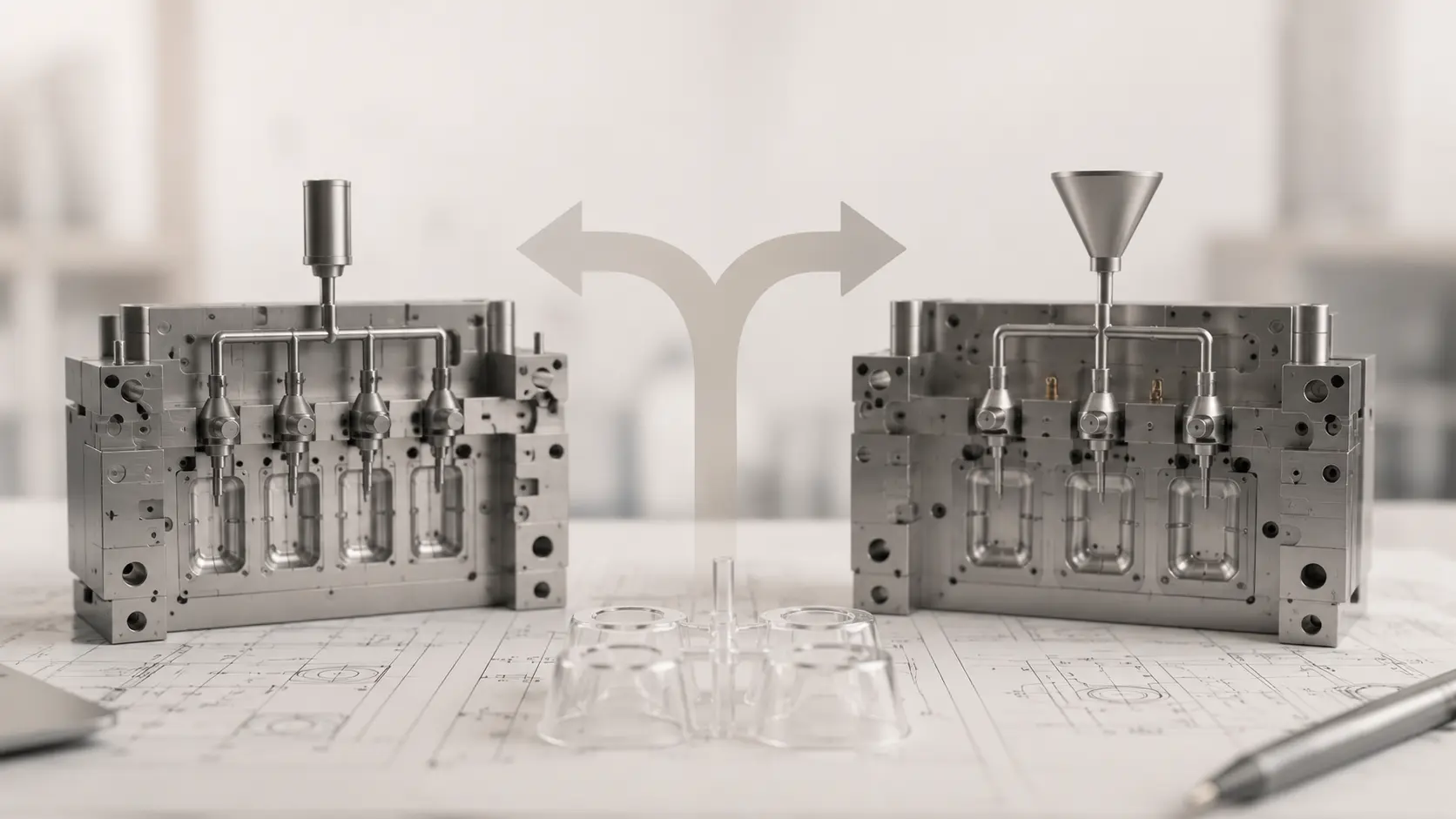
A hot runner injection molding process keeps plastic molten within heated manifolds and nozzles, allowing it to flow directly into cavities without creating solid runner waste. In contrast, cold runner injection molding allows the runner material to cool and solidify with each cycle, requiring removal and potential recycling.
Understanding these systems at a deeper level helps manufacturers make informed decisions that align with both technical requirements and business goals.
The Real Decision Framework: 5 Factors That Matter
Choosing between hot runner vs cold runner systems requires evaluating a combination of engineering, operational, and financial factors. Experienced manufacturers rarely rely on a single variable. Instead, they assess how multiple parameters interact over the lifecycle of a project.
Production Volume Requirements
Production volume is often the most influential factor in determining whether a hot runner injection molding system or cold runner injection molding is more suitable.
For low-volume production, cold runner systems are generally more economical due to their lower tooling cost. The material waste generated per cycle does not significantly impact overall costs when production quantities are limited.
As production scales, the advantages of the hot runner injection molding process become more apparent. Eliminating runner waste reduces material usage, and shorter cycle times improve machine efficiency. Over thousands or millions of cycles, these benefits accumulate into significant cost savings.
Typical industry guidelines suggest:
- Low volume production below 50,000 units favors cold runner systems
- Medium volume production requires evaluation based on material and cycle time
- High volume production above 250,000 units strongly favors hot runner systems
Another important aspect is demand stability. Long-term, stable production programs justify the investment in hot runner systems, while projects with fluctuating demand may benefit from the flexibility of cold runner injection molding.
Material Selection and Thermal Sensitivity
Material behavior is a critical factor when comparing hot runner vs cold runner systems.
In a hot runner injection molding process, material remains molten inside the runner channels for extended periods. This makes thermal stability an important consideration. Some polymers can degrade if exposed to heat for too long, leading to discoloration, reduced mechanical strength, or processing issues.
Key factors to evaluate include:
- Thermal stability of the polymer
- Sensitivity to prolonged heat exposure
- Melt viscosity and flow characteristics
- Ability to reuse regrind material
Below is a simplified compatibility table for common thermoplastics:
Material | Hot Runner Compatibility | Cold Runner Compatibility | Notes |
ABS | Excellent | Excellent | Widely used in both systems |
Polypropylene (PP) | Excellent | Excellent | Highly versatile polymer |
Polyethylene (PE) | Very good | Very good | Common in packaging |
Nylon (PA) | Good | Good | Requires moisture control |
Polycarbonate (PC) | Good | Good | Sensitive to thermal degradation |
PVC | Limited | Preferred | Heat sensitivity favors cold runner |
This table highlights an important point. Material selection should often be the starting point in deciding between hot runner vs cold runner systems. A mismatch between material and runner design can lead to long-term production challenges.
Tolerance and Part Quality Needs
Tolerance requirements play a major role in determining the appropriate runner system.
A hot runner injection molding system offers improved control over melt temperature and flow consistency. This results in better dimensional stability, especially in multi-cavity moulds where uniformity is critical.
Applications that typically benefit from hot runner systems include:
- High precision components
- Products with strict cosmetic requirements
- Multi-cavity production with tight consistency needs
However, it is important to note that cold runner injection molding can also achieve high quality results when properly designed. For many consumer products, the tolerance requirements can be met without the added complexity of a hot runner system.
Over-specifying tolerance requirements is a common issue. It often leads to unnecessary tooling costs without delivering meaningful performance improvements.
Budget and Total Cost of Ownership
Budget considerations extend beyond initial tooling costs. The real comparison between hot runner vs cold runner systems lies in total cost of ownership.
A cold runner mould typically has a lower upfront cost. This makes it attractive for short production runs or projects with limited budgets.
A hot runner system, on the other hand, involves higher initial investment due to components such as heated manifolds, temperature controllers, and precision nozzles. However, it offers long-term savings through:
- Reduced material waste
- Faster cycle times
- Lower post-processing requirements
A proper cost evaluation should include:
- Initial tooling investment
- Annual production volume
- Material cost and waste ratio
- Maintenance and downtime
- Production efficiency
When viewed holistically, many high-volume programs find that the hot runner injection molding process delivers better long-term value.
Design Flexibility and Color Change Requirements
Flexibility is another key factor that often influences the decision.
Cold runner injection molding provides greater flexibility when frequent color changes or material swaps are required. Since runners are ejected in each cycle, switching materials is relatively straightforward.
In contrast, hot runner systems require purging and cleaning when changing materials or colors. This can lead to downtime and additional material usage during transitions.
Applications that benefit from cold runner flexibility include:
- Short production runs
- Frequent design iterations
- Multi-color production scenarios
On the other hand, hot runner systems are better suited for stable production environments where changes are minimal.
Common Mistakes to Avoid
Selecting between hot runner vs cold runner systems requires careful evaluation. However, several common mistakes can lead to suboptimal decisions.
Underestimating True Cost of Ownership
One of the most common mistakes in the hot runner vs cold runner decision is focusing only on the initial tooling cost while ignoring the broader financial implications over time. While cold runner injection molding may appear more affordable upfront, this perspective often overlooks several ongoing operational expenses.
In practice, cold runner systems introduce hidden and recurring costs such as:
- Material waste per cycle due to solidified runners that are not part of the final product
- Regrinding and recycling costs, including equipment, energy, and quality control considerations
- Additional labor or automation needs for runner separation and handling
- Longer cycle times, which can reduce overall production efficiency
Over time, these factors can significantly increase the total cost of production, especially in medium to high-volume programs.
In contrast, a hot runner injection molding system requires a higher initial investment, but it is engineered to reduce many of these recurring expenses. The hot runner injection molding process improves efficiency by:
- Eliminating runner waste and improving material utilization
- Reducing or removing secondary operations like trimming and recycling
- Supporting faster cycle times, leading to higher throughput
- Minimizing manual intervention in post-processing
To make a well-informed decision, manufacturers should adopt a Total Cost of Ownership (TCO) approach. This involves evaluating:
- Initial tooling investment
- Expected production volume over time
- Material cost and waste ratio
- Maintenance requirements and downtime risks
- Cycle time and overall process efficiency
When these factors are assessed together, it becomes clear that the true cost difference between hot runner vs cold runner systems extends far beyond upfront tooling. A lifecycle-based evaluation ensures that the chosen system aligns with both technical requirements and long-term financial performance.
Overlooking Material Thermal Sensitivity
Material compatibility is sometimes underestimated, particularly when transitioning to a hot runner injection molding process.
Certain materials may degrade under prolonged heat exposure, leading to:
- Discoloration
- Reduced mechanical strength
- Processing instability
Careful material evaluation is essential to avoid these issues.
Miscalculating Tolerance Requirements
Another common mistake in the hot runner vs cold runner decision is overestimating the need for extremely tight tolerances without fully evaluating the functional requirements of the product.
While a hot runner injection molding system offers superior control over melt temperature and flow consistency, not every application requires that level of precision. Assuming that tighter tolerances automatically lead to better performance can result in unnecessary complexity and cost.
Over-specifying tolerances can lead to several avoidable challenges:
- Higher tooling costs due to more complex mould design and tighter machining requirements
- Increased development time for validation, testing, and process optimization
- Greater sensitivity in production, requiring stricter process control and monitoring
- Diminishing returns, where the added precision does not improve actual product performance
In many cases, cold runner injection molding can achieve acceptable tolerances when supported by well-designed tooling and stable process parameters. For products such as consumer goods or non-critical components, the difference in precision may not justify the added investment in a hot runner system.
A more effective approach is to align tolerance requirements with the product’s actual functional needs. This involves:
- Identifying critical dimensions that truly impact performance
- Differentiating between cosmetic and functional tolerances
- Avoiding overengineering beyond necessary specifications
By taking a balanced and application-focused approach, manufacturers can select between hot runner vs cold runner systems more effectively, ensuring that performance expectations are met without incurring unnecessary costs.
Conclusion
Choosing between hot runner vs cold runner systems is a critical decision that influences the entire injection molding process. It affects not only production efficiency and cost but also product quality and long-term scalability.
Hot runner systems offer clear advantages in high-volume production where material savings, faster cycles, and consistent quality are essential. Cold runner injection molding remains a practical and flexible option for lower production volumes, budget-sensitive projects, and applications requiring frequent changes.
The most effective approach is to evaluate all relevant factors together. Production volume, material behavior, tolerance requirements, cost considerations, and flexibility must be aligned to select the right system.
By taking a structured and informed approach, manufacturers can ensure that their chosen runner system supports both immediate production goals and long-term success.
FAQs
How often does a hot runner system require maintenance, and what does it cost?
Maintenance frequency depends on material, cycle counts, and operating conditions. Routine inspections are recommended during scheduled mould servicing. Costs usually involve heater elements, thermocouples, and occasional nozzle maintenance.
What materials can’t be used in hot runner systems?
Heat sensitive materials such as PVC, certain flame retardant compounds, and some thermally unstable polymers may degrade in hot runner systems if temperature control is inadequate. Material compatibility should always be reviewed during tooling design.
What’s the real waste cost difference between hot and cold runner systems?
Hot runner systems produce minimal runner waste, improving material utilization. In cold runner injection molding, runners solidify each cycle and must be reground or discarded, which increases material usage and handling costs.
How does runner system choice affect mould qualification timeline?
Hot runner systems may require additional setup and validation due to temperature control and flow balancing. Cold runner moulds are typically faster to qualify, making them useful for shorter project timelines.
Can we change color mid production with each system?
Color changes are generally simpler with cold runner injection molding because runners are ejected and replaced each cycle. Hot runner systems may require purge cycles and cleaning to remove residual material.