Key Takeaways
- Not all moulding processes are created equal. This blog unpacks how different technologies shape the performance and efficiency of FMCG packaging materials in ways most teams overlook.
- From precision-driven components to high-volume containers, discover how the right process can quietly transform the cost, quality, and scalability of your packaging materials.
- The real advantage lies in knowing which process fits where. Explore the hidden trade-offs that influence packaging success across injection, blow, thermoforming, and beyond
In the fast-paced FMCG landscape, choosing the right moulding process is critical to how effectively FMCG packaging materials perform in terms of cost, scalability, and product protection. From precision-driven injection moulding to high-volume blow moulding and flexible thermoforming, each method plays a distinct role in shaping modern packaging materials.
This guide breaks down the core moulding technologies used across FMCG, helping you understand how each process impacts production efficiency, material performance, and overall packaging success.
Why Moulding Process Selection Matters for FMCG Success
Choosing the correct moulding process is not just a technical decision—it is a strategic business decision that affects nearly every stage of FMCG product development and distribution.
When the wrong process is selected, manufacturers often encounter:
- Higher production costs due to inefficient tooling or material usage
- Quality inconsistencies that affect packaging integrity and shelf appeal
- Compliance challenges with food safety and packaging regulations
- Production delays that slow down product launches
Conversely, selecting the right moulding technology enables FMCG companies to align their FMCG packaging materials with operational and commercial objectives.
Key business benefits include:
- Faster production cycles that support high-volume product demand
- Lower per-unit manufacturing costs through optimised tooling and processes
- Reduced material waste, improving sustainability and cost efficiency
- Consistent packaging quality, strengthening brand reputation and consumer trust
- Streamlined regulatory compliance for food, personal care, and household products
For FMCG brands competing in global markets, the correct moulding process ensures that packaging materials not only protect the product but also support scalability, profitability, and long-term market leadership.
Understanding Core FMCG Packaging Challenges
FMCG brands operate in one of the most demanding manufacturing environments. Packaging must be produced at extremely high volumes while maintaining strict quality, safety, and cost standards. The selection of the right moulding process becomes critical because it directly influences how effectively FMCG packaging materials can meet these pressures.
Some of the most significant challenges include:
- High-Volume Production Requirements
FMCG products often require millions of units per production cycle. The moulding process must support rapid throughput while maintaining consistent performance across all packaging materials. - Strict Cost-Per-Unit Targets
Packaging represents a significant portion of product cost. Manufacturers must select processes that optimize material usage, tooling efficiency, and cycle time to keep unit costs competitive. - Shelf-Life and Barrier Performance
Many FMCG products—especially food, beverages, and personal care items—require packaging that protects against moisture, oxygen, light, and contamination. The moulding process must support materials capable of delivering these barrier properties. - Regulatory Compliance
Packaging must comply with global regulatory frameworks such as FDA requirements, EU packaging directives, and food-contact safety standards. Process selection plays a critical role in ensuring material compatibility and production traceability. - Sustainability Mandates
Increasing pressure from regulators and consumers is driving demand for recyclable and lightweight FMCG packaging materials. Manufacturers must choose processes that minimize waste and support sustainable packaging design. - Rapid Market Responsiveness
FMCG markets evolve quickly. Packaging production systems must allow brands to launch new products, redesign packaging, or adjust volumes without excessive tooling delays. - Aesthetic and Branding Expectations
Packaging is often the first point of consumer interaction with a product. The moulding process must enable consistent surface finishes, precise shapes, and visually appealing designs that reinforce brand identity.
Because these challenges occur simultaneously, moulding process selection becomes a strategic tool rather than a purely technical choice. The right process enables manufacturers to balance cost efficiency, production scalability, product protection, regulatory compliance, and brand presentation, all while ensuring the performance of their packaging materials in competitive FMCG markets.
Overview of Primary Moulding Processes
To manufacture high-performance FMCG packaging materials, manufacturers rely on several specialised moulding technologies. Each process is designed to handle different product shapes, material characteristics, production volumes, and performance requirements. Understanding the strengths of each method helps businesses choose the most efficient approach for their packaging applications.
The most widely used moulding processes for packaging materials in the FMCG sector include:
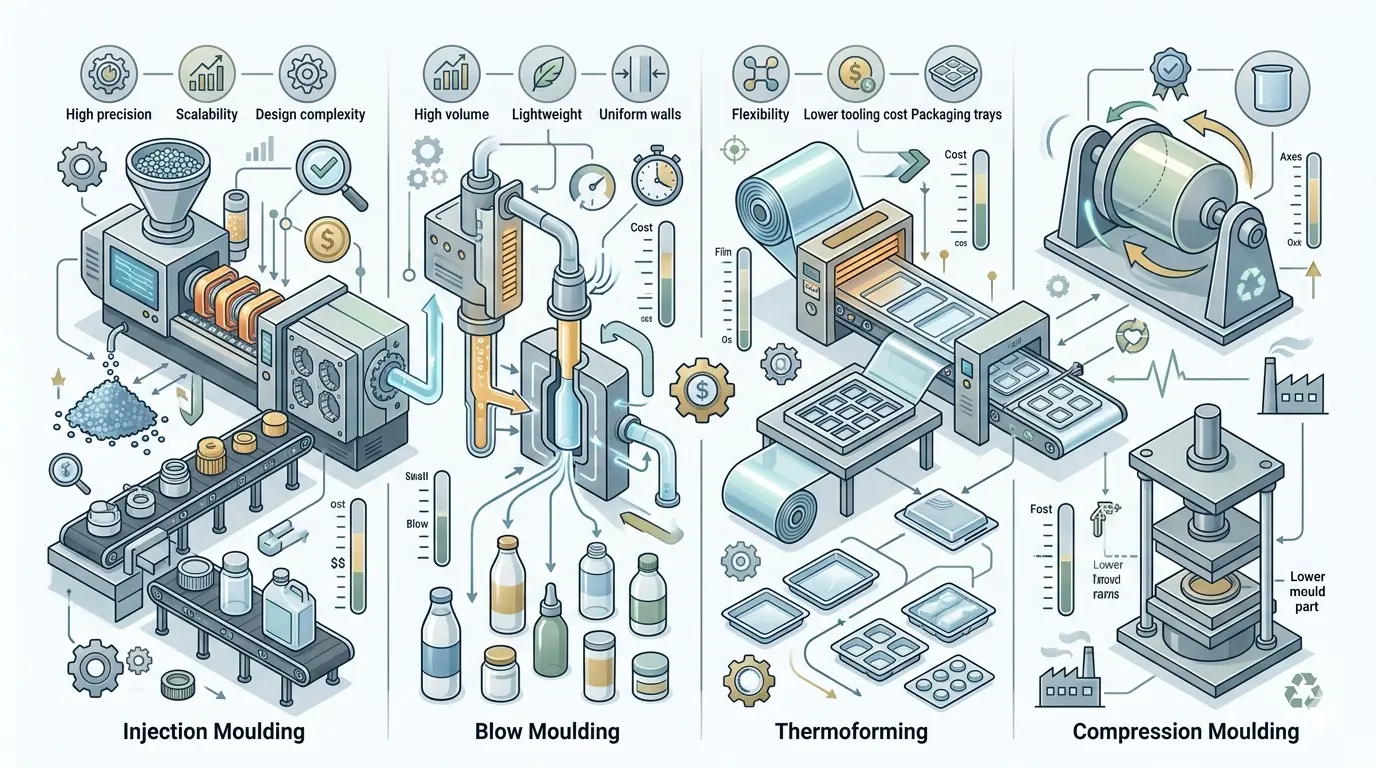
- Injection Moulding
One of the most common processes for FMCG packaging, injection moulding is used to produce high-precision components such as caps, closures, containers, and rigid packaging parts. It offers excellent dimensional accuracy and is well-suited for high-volume production. - Blow Moulding
Blow moulding is widely used for hollow packaging products such as bottles, containers, and jerry cans. The process is particularly effective for lightweight plastic packaging used in beverages, personal care, and household products. - Thermoforming
Thermoforming involves heating plastic sheets and shaping them over moulds. It is commonly used for packaging trays, clamshell packaging, and blister packs, offering flexibility and relatively lower tooling costs. - Rotational Moulding
Rotational moulding is used for producing large hollow products with uniform wall thickness. While less common in typical FMCG packaging, it can be used for specialised containers or bulk storage applications. - Compression Moulding
Compression moulding is typically used for thermoset materials, rubber components, and certain packaging applications requiring durability and heat resistance.
Each of these processes serves different segments of FMCG packaging materials, depending on factors such as product geometry, barrier performance, production scale, and cost efficiency.
With expertise across all major moulding technologies, Efficient Innovations helps manufacturers evaluate these options and select the most suitable process for their specific packaging requirements. This cross-process knowledge ensures that each project benefits from the right balance of performance, scalability, and manufacturing efficiency.
Overview of Primary Moulding Processes
Producing reliable and scalable FMCG packaging materials requires selecting the right moulding technology for each packaging format. Different processes are optimised for specific shapes, materials, production volumes, and performance requirements. Understanding these options allows manufacturers to align packaging design with manufacturing efficiency and market demands.
The primary moulding processes used for packaging materials in the FMCG industry include:
- Injection Moulding
- Blow Moulding
- Thermoforming
- Rotational Moulding
- Compression Moulding
Each process serves distinct product categories—from precision closures and containers to lightweight bottles and thermoformed trays. Choosing the right technology ensures that packaging performs reliably while meeting cost targets, regulatory requirements, and sustainability goals.
With experience across all major moulding technologies, Efficient Innovations helps FMCG brands evaluate process suitability and select the optimal manufacturing method for each project.
Injection Moulding for FMCG Packaging
Injection moulding is widely considered the most versatile manufacturing method for FMCG packaging materials. It offers exceptional precision, scalability, and the ability to produce complex geometries at high production speeds.
Key advantages include:
- High precision and dimensional consistency for intricate packaging components
- Wide material compatibility, including polypropylene (PP), polyethylene (PE), PET, and engineering polymers
- Efficient cycle times, enabling high-volume production
- Scalability for mass production, often reaching millions of units per mould
- Design flexibility, allowing complex shapes, snap-fit features, and integrated closures
Because of these capabilities, injection moulding is ideal for producing:
- Caps and closures
- Cosmetic containers
- Food storage containers
- Pump dispensers and applicators
- Intricate packaging components
Efficient Innovations supports injection moulding with advanced manufacturing systems, material expertise, and strict quality control processes. Their capabilities include rapid prototyping, high-precision tooling, and consistent production quality for demanding FMCG applications.
Blow Moulding for Bottles and Flexible Packaging
Blow moulding is the preferred process for manufacturing hollow packaging products used throughout the FMCG sector. It is particularly effective for producing lightweight containers with controlled wall thickness and excellent material efficiency.
Major blow moulding variants include:
- Extrusion Blow Moulding (EBM) – used for containers such as detergent bottles and industrial packaging
- Injection Blow Moulding (IBM) – commonly used for small, high-precision containers
- Injection Stretch Blow Moulding (ISBM) – widely used for beverage bottles and PET packaging
Key advantages of blow moulding include:
- Cost-effective production for large volumes
- Uniform wall thickness control
- Efficient material usage
- Good barrier properties for liquids and gases
Typical FMCG applications include:
- Beverage bottles
- Personal care containers
- Sauce and condiment bottles
- Household chemical packaging
Through process optimisation and material expertise, Efficient Innovations helps manufacturers achieve superior container performance, enhanced barrier properties, and improved sustainability through lightweight material design.
Thermoforming for Rigid and Flexible Applications
Thermoforming is a highly adaptable manufacturing process used to create shallow to medium-depth packaging products. The process involves heating plastic sheets and forming them over moulds to achieve the desired shape.
Thermoforming configurations include:
- Single-cavity thermoforming for specialised packaging
- Multi-cavity thermoforming systems for large-scale production
Advantages of thermoforming include:
- Lower tooling costs compared to injection moulding
- Rapid design iteration and prototyping
- Flexible material options such as PET, PVC, and PP
- Suitability for both rigid and semi-flexible packaging
Common FMCG packaging applications include:
- Hinged food containers
- Clamshell packaging
- Packaging trays
- Blister packs
Efficient Innovations helps FMCG companies leverage thermoforming for cost-effective packaging production while also optimising material selection to support sustainability goals and packaging performance.
Rotational Moulding for Large, Complex Shapes
Rotational moulding is used to produce large hollow components with seamless construction and uniform wall thickness. In this process, moulds are rotated while heated material coats the interior surfaces to form the final shape.
Key advantages include:
- Uniform wall thickness throughout the product
- Seamless construction without joints or weld lines
- High design flexibility for complex shapes
- Minimal material waste
However, rotational moulding typically has:
- Longer production cycles
- Lower suitability for extremely high production volumes
Typical FMCG-related applications include:
- Large storage containers
- Bulk packaging systems
- Industrial dispensers and speciality containers
In cases where packaging size and structural integrity are critical, rotational moulding can provide better economic value than other processes. Efficient Innovations helps manufacturers evaluate when this method offers the best balance between production efficiency and product performance.
Comparing Moulding Processes: A Decision Matrix
Selecting the right moulding process for FMCG packaging materials requires balancing multiple technical and commercial factors. Packaging teams must evaluate tooling investment, production efficiency, material compatibility, and scalability before committing to a manufacturing approach.
A practical way to approach this decision is through a structured comparison framework that evaluates each process across key operational dimensions. These include:
- Initial tooling cost
- Per-unit production cost at scale
- Production speed and cycle time
- Design complexity capability
- Material compatibility
- Precision and dimensional tolerance
- Surface finish quality
- Sustainability performance
- Scalability for high-volume production
Using these factors allows manufacturers to match the most appropriate moulding technology to their specific packaging materials and product requirements.
Decision Matrix: Major Moulding Processes for FMCG Packaging
Decision Factor | Injection Moulding | Blow Moulding | Thermoforming | Rotational Moulding | Compression Moulding |
Initial Tooling Cost | High | Medium | Low–Medium | Medium | Medium |
Per-Unit Cost (High Volume) | Very Low | Very Low | Low | Medium | Medium |
Production Speed | Very Fast | Fast | Fast | Slow | Moderate |
Design Complexity | Excellent | Moderate | Moderate | Good | Limited |
Material Options | Very Broad | Moderate | Broad | Limited | Moderate |
Precision/Tolerances | Excellent | Good | Moderate | Moderate | Good |
Surface Finish Quality | Excellent | Good | Good | Moderate | Good |
Sustainability Potential | High (lightweighting & recyclability) | High | Moderate–High | Moderate | Moderate |
Scalability | Excellent | Excellent | High | Limited | Moderate |
From this matrix, it becomes clear that injection moulding and blow moulding dominate high-volume FMCG packaging materials, while thermoforming and other processes offer cost advantages for specific product categories.
Industry Capabilities: Technology Providers
Across the packaging manufacturing ecosystem, several equipment and technology providers support these moulding processes. The following companies are widely recognized in industrial moulding infrastructure:
- Husky Technologies
- Milacron
- Engel
- Sumitomo (SHI) Demag
- Arburg
- Nissei
- BEMA
- Demag
- Brückner
These companies contribute machinery, processing technology, and automation solutions that enable the production of advanced packaging materials.
Where Efficient Innovations Differentiates
While machinery providers focus on equipment platforms, Efficient Innovations differentiates itself through integrated engineering expertise across multiple moulding technologies.
Key strengths include:
- Cross-process engineering knowledge spanning injection, blow moulding, thermoforming, and compression moulding
- Material optimization expertise for sustainable FMCG packaging materials
- End-to-end project support, from design validation to production scaling
- Process selection advisory, helping manufacturers choose the most efficient moulding approach for their specific packaging application
This holistic capability enables Efficient Innovations to serve as a strategic partner rather than simply a technology supplier, ensuring FMCG companies implement the moulding process that best aligns with product performance, production efficiency, and long-term business objectives.
Conclusion
Choosing the right moulding process is a defining factor in how effectively FMCG packaging materials perform across cost, quality, and scalability. Each process, whether injection, blow, thermoforming, or others, brings its own strengths and trade-offs that directly influence how packaging materials behave in real-world production and market conditions.
The key lies in aligning the moulding technology with product requirements, material properties, and production goals. When done right, this alignment not only improves manufacturing efficiency but also enhances packaging performance, sustainability, and brand consistency.
For FMCG manufacturers operating in competitive markets, understanding these processes is not just technical knowledge. It is a strategic advantage that ensures packaging materials deliver both operational efficiency and long-term value.
Frequently Asked Questions
What’s the difference between injection moulding and blow moulding for FMCG packaging?
Injection moulding produces solid or complex components such as caps, closures, and containers with high precision. Blow moulding creates hollow packaging like bottles and jars. Injection moulding excels in design complexity and tolerances, while blow moulding is ideal for lightweight, high-volume bottle production.
Which moulding process offers the best sustainability profile?
Sustainability depends on design and material choice. Injection moulding enables thin-wall designs that reduce material use. Blow moulding supports lightweight bottle production, while thermoforming can improve recyclability with mono-material packaging structures.
What are the typical tooling costs for each moulding process?
Tooling costs vary significantly. Thermoforming tools may start around $10,000–$30,000, while injection moulding tools can range from $50,000 to $500,000+ depending on complexity. Blow moulding tooling typically falls between these ranges.
How does process selection affect product quality and consistency?
Different moulding processes offer different levels of precision and repeatability. Injection moulding typically provides the highest dimensional accuracy and consistency, while blow moulding and thermoforming offer reliable performance for container packaging with moderate tolerances.
What’s the typical timeline from process selection to full production launch?
Timelines vary depending on tooling complexity and product validation requirements. On average, projects move from process selection to production launch within 12–24 weeks, including design optimization, tooling development, prototyping, and regulatory testing.