Key Takeaways
- Mould development failures rarely happen suddenly. They build quietly through missed design, material, and process decisions that only surface later when costs are highest.
- Behind successful tooling lies a structured consulting process, from early discovery to production launch, where each phase removes risk before it becomes a problem.
- The real advantage is not just expertise, but timing. Early technical consulting turns complexity into control, enabling faster, more reliable, and scalable mould development.
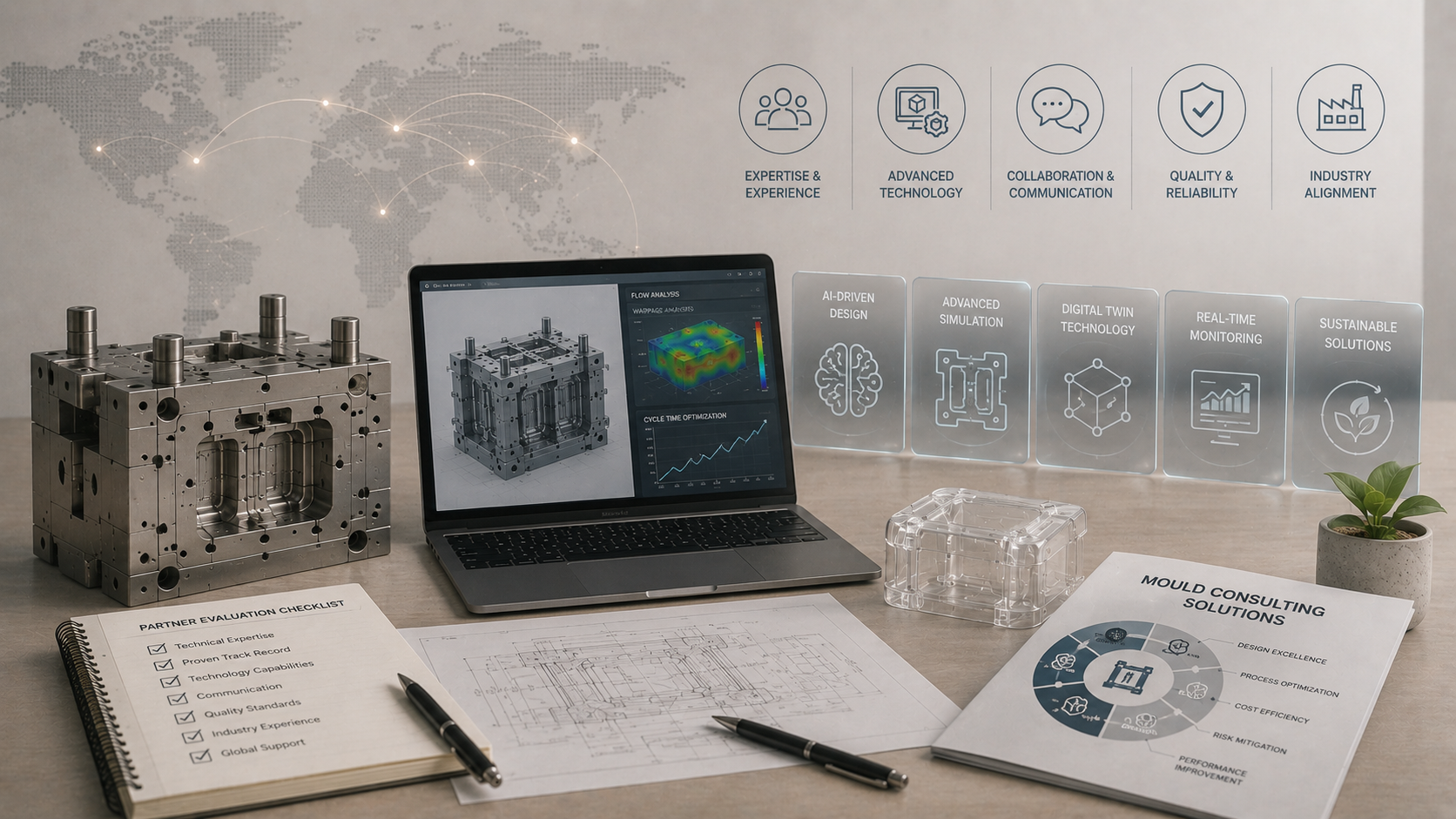
Choosing the right mould technical consulting partner is a critical decision that directly impacts cost, quality, and time-to-market. In a landscape defined by tighter tolerances, faster product cycles, and rising complexity, the right partner ensures moulds are designed, validated, and scaled without costly rework or delays.
This blog breaks down how to evaluate a technical consulting partner, from expertise and tools to collaboration and industry fit. It also explores emerging trends such as AI-driven design, advanced simulation, and real-time monitoring that are reshaping mould development.
Whether you are starting a new project or optimizing existing tooling, this guide will help you make informed decisions and leverage technical consulting as a strategic advantage.
The Technical Consulting Process: What to Expect
For manufacturers considering expert support, understanding the consulting workflow removes uncertainty and helps set realistic expectations. A structured consulting process ensures that mould development progresses systematically, from concept to stable production, while minimising risks, delays, and costly redesigns. Most professional engagements follow a phased approach designed to deliver measurable results at each stage of the project lifecycle.
Phase 1: Discovery and Requirements Analysis
This foundational stage establishes clarity before any design work begins. Consultants work closely with stakeholders to understand technical requirements, business objectives, constraints, and success criteria. Skipping this step often leads to misalignment and expensive corrections later.
Key activities typically include:
- Initial technical consultation and project briefing
- Definition of product specifications and performance requirements
- Assessment of current mould development capabilities and gaps
- Identification of regulatory or industry constraints
- Establishment of success metrics, timelines, and budget boundaries
- Risk assessment and feasibility analysis
A thorough discovery phase ensures that the mould development effort is grounded in real-world requirements rather than assumptions.
Phase 2: Design and Optimisation
Once requirements are clear, the focus shifts to creating and refining the mould design. This phase combines engineering expertise with advanced simulation tools to optimise performance, manufacturability, and cost-efficiency before physical production begins.
Core activities include:
- Detailed CAD modelling of mould components
- Design for Manufacturability (DFM) reviews
- Thermal, flow, and structural simulations
- Optimisation of gating, cooling channels, and part geometry
- Iterative refinements based on analysis results
- Stakeholder design reviews and approvals
By resolving potential issues virtually, this phase significantly reduces trial-and-error during tooling fabrication.
Phase 3: Prototyping and Testing
With an optimised design in place, consultants support the creation of prototypes or pilot tooling to validate real-world performance. This stage bridges theory and practice, ensuring the mould performs as expected under production conditions.
Typical validation steps include:
- Prototype or trial mould fabrication
- Functional testing of mould operation
- Evaluation of part quality, dimensional accuracy, and consistency
- Identification of defects such as warping, sink marks, or flow issues
- Iterative refinements based on test results
- Verification against defined specifications and performance targets
Effective prototyping prevents large-scale production problems and builds confidence before full investment.
Phase 4: Production Launch Support
The final phase focuses on transitioning from development to stable manufacturing. Even well-designed moulds may require fine-tuning during ramp-up, and expert guidance ensures issues are resolved quickly without disrupting schedules.
Support activities often include:
- On-site or remote assistance during initial production runs
- Process parameter optimisation for cycle time and quality
- Troubleshooting unexpected defects or performance issues
- Establishment of quality monitoring systems
- Documentation of best practices for operators and maintenance teams
- Recommendations for ongoing mould care and performance tracking
This phase ensures the mould delivers consistent results at scale and continues to perform reliably over its operational life.
Common Challenges in Mould Development and How Consulting Solves Them
Mould development projects rarely fail because of a single issue. More often, delays, cost overruns, and quality problems arise from a combination of technical gaps, late discoveries, and scaling challenges. These mould challenges can derail product launches and erode profitability if not addressed proactively. Technical consulting provides structured problem-solving, expert foresight, and proven methodologies to prevent issues before they escalate.
Challenge: Design Flaws Discovered Late in Development
Design issues identified after tooling fabrication are among the most expensive problems in mould development. Errors such as incorrect gate placement, insufficient draft angles, poor venting, or uneven wall thickness may only become apparent during trial runs, when changes are difficult and costly.
Consequences typically include:
- Tool rework or partial rebuilds
- Extended development timelines
- Increased scrap during trials
- Delayed product launches
- Escalating project costs
Early expert reviews using DFM analysis and simulation tools can identify up to 90% of potential issues before manufacturing begins. Consulting teams validate designs from both performance and manufacturability perspectives, preventing costly late-stage corrections.
Challenge: Thermal Management Issues
Inefficient cooling is a leading cause of mould defects and productivity losses. Poor thermal design can result in warping, sink marks, uneven shrinkage, long cycle times, and premature mould wear. In high-volume production, even small thermal inefficiencies compound into major operational costs.
Technical consulting addresses this through:
- Advanced thermal and flow simulations
- Optimized cooling channel layouts
- Uniform temperature distribution strategies
- Cycle time optimization
- Prevention of hot spots and thermal stress
By engineering thermal performance early, consultants ensure stable part quality and efficient production from day one.
Challenge: Material Performance Failures
Selecting the wrong material, for either the mould or the moulded part, can lead to premature wear, corrosion, dimensional instability, or product failure. Issues may include incompatibility with operating temperatures, chemical degradation, or insufficient mechanical strength.
Common consequences include:
- Reduced mould lifespan
- Surface damage and corrosion
- Inconsistent part quality
- Increased maintenance requirements
- Product performance failures in the field
Mould experts evaluate material properties, operating conditions, and lifecycle requirements to recommend optimal steel grades, coatings, and processing parameters. This ensures long-term durability and reliable performance.
Challenge: Production Scaling Issues
Many moulds perform adequately during prototype trials but encounter problems when transitioning to full-scale production. Increased cycle frequency, thermal load, and operational variability can expose weaknesses that were not evident at lower volumes.
Typical scaling challenges include:
- Reduced dimensional consistency
- Increased defect rates
- Equipment compatibility issues
- Unexpected wear patterns
- Inability to meet throughput targets
Consulting support during scale-up ensures the mould, process parameters, and production systems are aligned for high-volume manufacturing. Experts refine operating windows, validate robustness, and implement controls to maintain quality at scale.
Challenge: Meeting Tight Deadlines
Modern product development cycles demand rapid time-to-market without sacrificing quality. However, compressed schedules often lead to rushed decisions, inadequate testing, and overlooked risks, ultimately causing delays rather than preventing them.
Structured consulting accelerates development by:
- Applying proven methodologies instead of trial-and-error
- Coordinating parallel engineering activities
- Identifying risks early
- Streamlining decision-making
- Reducing rework cycles
With expert guidance, manufacturers can move faster with confidence, achieving aggressive timelines while maintaining technical rigour and product reliability.
Best Practices for Selecting a Technical Consulting Partner
Choosing the right technical consulting partner can determine whether your mould development project achieves manufacturing excellence or struggles with delays, rework, and escalating costs. Not all mould experts offer the same depth of capability, industry knowledge, or collaborative approach. A structured evaluation helps ensure the selected partner brings not only technical consulting expertise, but also strategic value across the entire mould lifecycle.
Proven Track Record and Case Studies
A consultant’s past performance is one of the most reliable indicators of future success. Organisations with a strong portfolio of completed projects demonstrate their ability to solve complex challenges, deliver measurable outcomes, and adapt to diverse manufacturing environments. Documented success reduces risk and builds confidence that the consultant can handle your specific requirements.
Key indicators to evaluate include:
- Detailed case studies showing before-and-after improvements
- Experience delivering projects of similar scale and complexity
- Client testimonials and repeat engagements
- Industry awards or recognition
- Quantifiable results such as cycle time reduction or defect improvement
A credible consulting partner should be able to provide evidence, not just claims, of their impact.
Expertise in Your Specific Industry/Material
Mould development requirements vary significantly across industries and materials. Medical devices demand strict compliance and traceability, automotive components require durability and precision, while consumer products often prioritise cost efficiency and aesthetics. Similarly, processing engineering-grade polymers differs greatly from commodity plastics.
Ensure the consultant has direct experience with:
- Your product category and performance requirements
- Relevant material families (e.g., ABS, PC, Nylon, PEEK, composites)
- Industry-specific regulations and standards
- Similar production volumes and operating conditions
Specialised knowledge allows mould experts to anticipate challenges early and recommend proven solutions rather than generic approaches.
Advanced Tools and Technology Access
Modern mould development relies heavily on sophisticated mould technology. Consultants equipped with advanced tools can simulate performance, validate designs, and optimize processes before physical tooling begins, dramatically reducing risk and development time.
Critical technological capabilities include:
- Advanced CAD/CAM software for precision design
- Flow, thermal, and structural simulation tools
- Finite Element Analysis (FEA) capabilities
- Rapid prototyping technologies
- Material testing and validation equipment
- Data analytics for process optimization
Access to cutting-edge technology enables deeper insights, faster iterations, and more reliable outcomes.
Communication and Collaboration Approach
Technical excellence alone is not enough. Successful projects depend on clear communication, alignment with stakeholders, and a collaborative partnership mindset. Poor communication can lead to misunderstandings, missed requirements, and costly changes later in the project.
Look for consultants who demonstrate:
- Transparent reporting and milestone updates
- Clearly defined communication channels
- Responsiveness to questions and concerns
- Willingness to collaborate with internal teams and suppliers
- Structured review meetings and decision checkpoints
An effective consulting partner functions as an extension of your engineering team rather than an external vendor.
Certifications and Industry Standards Compliance
Certifications and adherence to recognised quality standards provide assurance that the consultant operates within established best practices. This is particularly important in regulated industries where documentation, traceability, and validation are mandatory.
Important credentials to verify include:
- ISO certifications (e.g., ISO 9001, ISO 13485, where applicable)
- Industry-specific standards compliance
- Professional engineering qualifications
- Membership in relevant technical bodies or associations
- Documented quality management systems
Selecting a partner committed to compliance and quality standards reduces regulatory risk and ensures outputs meet global expectations.
Emerging Trends in Technical Consulting for Mould Development
As manufacturing enters the Industry 4.0 era, technical consulting for mould development is rapidly evolving beyond traditional design reviews. Today’s mould experts leverage advanced digital tools, intelligent systems, and sustainable engineering approaches to deliver faster, smarter, and more resilient tooling solutions. Organizations that adopt these innovations gain a measurable competitive edge in cost, quality, and speed to market.
AI-Driven Design Optimization
Artificial intelligence and machine learning are transforming how moulds are designed and validated. Instead of relying solely on manual iterations, AI-enabled tools analyse vast datasets from previous projects to recommend optimal geometries and process conditions.
Key capabilities include:
- Predicting fill patterns, pressure distribution, and defect risks before tooling is built
- Automatically optimising gate locations, runner balance, and cooling layouts
- Accelerating design cycles by reducing trial-and-error iterations
- Identifying subtle performance issues that humans may overlook
By integrating AI into mould development workflows, consultants can significantly shorten development timelines while improving robustness and manufacturability.
Additive Manufacturing for Mould Components
Additive manufacturing (3D printing) is revolutionising mould innovation, particularly for complex internal features that are impossible with conventional machining. Technical consultants increasingly recommend hybrid tooling strategies that combine traditional machining with additively manufactured inserts.
Key applications include:
- Conformal cooling channels that follow part geometry for uniform heat removal
- Lightweight yet strong mould components with optimized internal structures
- Rapid prototyping of inserts for functional testing before full tooling investment
- Production of highly complex geometries that improve part quality
These advances reduce cycle times, minimize warpage, and enhance thermal efficiency, delivering both quality improvements and long-term cost savings.
IoT and Real-Time Monitoring Solutions
Smart moulds equipped with sensors and connectivity are enabling data-driven production environments. IoT-based mould monitoring provides continuous visibility into tool performance, allowing issues to be detected long before they cause downtime or defects.
Modern monitoring systems can track:
- Cavity temperature and thermal stability
- Injection pressure and cycle consistency
- Wear indicators for critical components
- Production counts and utilization metrics
This real-time data supports predictive maintenance strategies, reducing unplanned shutdowns and extending mould lifespan. For manufacturers operating high-volume programs, such mould monitoring capabilities are becoming essential rather than optional.
Conclusion
Effective technical consulting brings structure and clarity to mould development, helping identify risks early and ensure smoother execution from design to production.
By aligning design, materials, and process decisions upfront, it reduces delays, controls costs, and improves overall quality and reliability.
For manufacturers, early expert involvement is a clear advantage, enabling faster, more predictable, and scalable mould development.
Frequently Asked Questions
What’s the difference between hiring a mould expert consultant vs. building an in-house team?
Consultants offer deep, cross-industry expertise, advanced tools, and immediate capability without long-term payroll or training costs. In-house teams provide continuity but may lack specialized knowledge for complex or novel projects.
How long does the technical consulting process typically take?
It depends on project scope. Early design reviews may take days to weeks, while full development support can span several months, from concept validation through production launch assistance.
What certifications and qualifications should I look for in a mould expert consultant?
Look for engineering credentials, ISO-aligned quality experience, industry certifications, proven project history, and expertise in relevant materials and manufacturing processes.
What happens if a mould fails during production? Can consultants help minimize impact?
Yes. Experts can perform rapid root-cause analysis, recommend temporary process adjustments, and design permanent corrective solutions to restore production quickly while preventing recurrence.
How do I measure the success of a technical consulting engagement?
Key indicators include reduced defects, faster development timelines, lower total costs, improved cycle time, higher production consistency, and extended mould lifespan relative to baseline expectations.