Key Takeaways
- Choosing the right moulding process is not just a technical step. It quietly determines how FMCG packaging materials perform across cost, quality, and scalability.
- From production volume and material compatibility to compliance and sustainability, discover the hidden factors that shape how packaging materials succeed in real-world manufacturing.
- The real advantage lies in following a structured approach. Learn how the right decisions early on can prevent costly mistakes and unlock efficient, future-ready packaging production
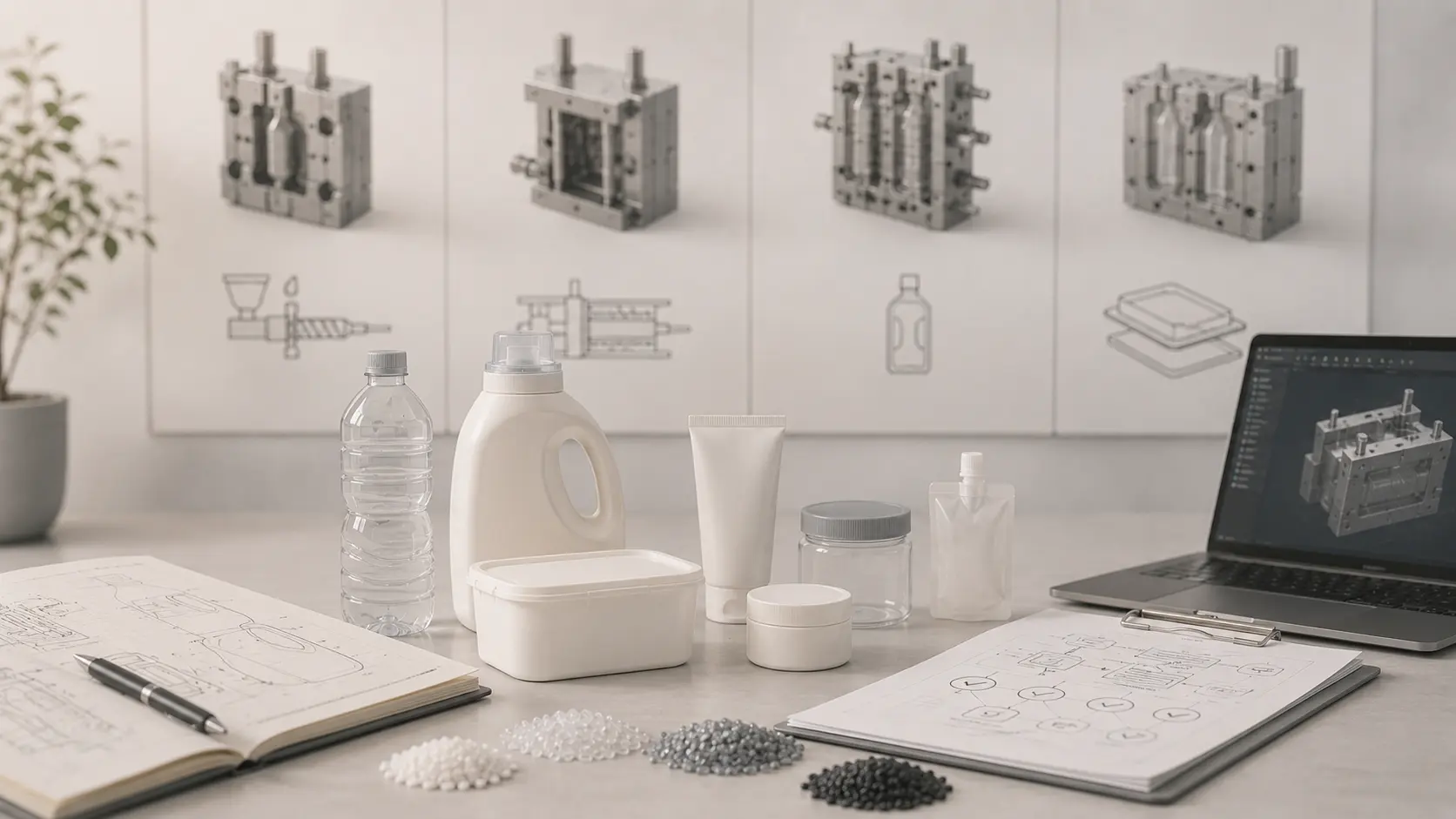
In FMCG, packaging is a key driver of product safety, brand value, and efficiency. Choosing the right moulding process directly shapes how FMCG packaging materials perform.
It impacts cost, speed, durability, and scalability, while also influencing sustainability and compliance. The wrong choice can lead to inefficiencies, quality issues, and delays.
With multiple processes suited to different packaging materials and applications, understanding their fit is essential for achieving both performance and efficiency.
Moulding Process Selection Criteria
Choosing the right moulding process for FMCG packaging materials requires a structured approach that balances technical, economic, and regulatory factors. Rather than relying on familiarity, leading manufacturers evaluate processes against clear business and product needs.
A practical framework includes:
- Define product requirements
Strength, barrier performance, durability, and visual appeal - Assess production volume and timelines
Ensure the process supports demand and speed to market - Evaluate cost structure
Consider both tooling investment and per-unit cost - Review design complexity and tolerances
Match process capability with geometry and precision needs - Align material and sustainability goals
Ensure compatibility with performance and environmental targets - Check regulatory compliance
Meet food safety, pharmaceutical, or regional standards - Plan for scalability
Support future growth and product expansion
Applying this structured approach ensures that packaging materials manufacturing aligns with both operational efficiency and long-term business goals.
Production Volume Considerations
Production volume is often the key factor in selecting the right moulding process for FMCG packaging materials.
General guidelines:
- Low volumes
Thermoforming or compression moulding offers lower tooling costs and faster setup - Medium volumes
Injection moulding becomes cost-effective with better efficiency and consistency - High volumes
Blow moulding and automated injection systems deliver the lowest per-unit cost at scale
Typical scenarios:
- Short-run or seasonal packaging favors thermoforming
- Mid-volume, design-focused products suit injection moulding
- High-volume items like bottles rely on blow moulding
A scalable approach ensures that packaging materials production can adapt as demand grows.
Material Selection and Process Compatibility
Material and process selection are closely linked in the production of FMCG packaging materials, as each moulding method works best with specific polymers.
Common pairings include:
- PP for injection moulding of caps and containers
- PE / HDPE for blow moulded bottles
- PET for stretch blow moulding in beverage packaging
- ABS, PC, PA for precision or specialized applications
The chosen process directly influences key material properties such as:
- Crystallinity and molecular orientation
- Barrier performance and durability
- Surface finish and appearance
Aligning material with the right process ensures consistent, high-performance packaging materials while optimizing production efficiency.
Cost Structure Analysis: Tooling vs. Per-Unit Costs
Cost decisions for FMCG packaging materials hinge on balancing upfront tooling with long-term production efficiency.
- Tooling cost
~$10,000 for thermoforming to $500,000+ for injection moulding - Per-unit cost
Drops with higher volumes due to automation and faster cycles - Break-even point
Defines when higher tooling investment becomes viable
Use cases:
- Low volume favors low tooling cost
- High volume favors injection or blow moulding
- Mid-volume balances cost and design quality
Efficient Innovations enables smarter decisions with early-stage cost modeling, reducing risk and avoiding costly process changes.
Design Complexity and Tolerance Requirements
Design complexity plays a key role in selecting the right process for FMCG packaging materials.
- Injection moulding delivers high precision, with tolerances up to ±0.01 mm
- Blow moulding and thermoforming operate with broader tolerances
Key design factors:
- Complex geometries and undercuts
- Thin-wall structures
- Snap-fits and integrated features
- Surface finish and branding needs
Injection moulding suits high-precision, complex packaging materials, while blow moulding and thermoforming are more efficient for simpler forms.
Efficient Innovations supports design optimisation to simplify structures, reduce costs, and improve manufacturability without compromising performance.
Sustainability and Material Optimisation
Sustainability is now a key driver in developing FMCG packaging materials, driven by regulations and brand commitments.
Key requirements include:
- Recyclability and recycled content
- Reduced carbon footprint
- Minimised material waste
Process impact:
- Injection moulding enables thin-wall designs and precise material use
- Thermoforming supports recyclable mono-material structures
- Blow moulding allows lightweight packaging that lowers transport emissions
With evolving regulations such as the EU Single-Use Plastics Directive, aligning process and material is critical.
Efficient Innovations combines material science and process expertise to deliver sustainable packaging materials without compromising efficiency.
Regulatory Compliance and Certification
FMCG packaging operates under strict regulations where safety, traceability, and sustainability are essential. For FMCG packaging materials, compliance ensures both product integrity and market access.
Key requirements include:
- FDA compliance for food and personal care packaging
- EU directives on recyclability, waste reduction, and material safety
- Migration limits to prevent chemical transfer into products
- Accurate labelling and traceability for transparency
- Recycled content validation to support sustainability claims
Meeting these standards is critical to ensuring that packaging materials perform safely and comply across global markets.
How Moulding Process Selection Impacts Compliance
The moulding process directly influences how FMCG packaging materials meet regulatory standards.
- Injection moulding offers high control and traceability, ideal for food-grade applications
- Blow moulding delivers strong barrier properties for contamination protection
- Thermoforming supports recyclable mono-material designs for sustainability compliance
Choosing the right process ensures packaging meets safety, quality, and regulatory requirements without compromising efficiency.
With deep expertise, Efficient Innovations helps FMCG companies achieve faster compliance, reduce risk, and deliver high-performance packaging materials aligned with global standards.
Step-by-Step: Selecting the Right Moulding Process
Choosing the right moulding technology for FMCG packaging materials can be simplified through a structured decision process. By following a clear step-by-step framework, manufacturers can align packaging design, cost targets, regulatory requirements, and production scalability before committing to tooling or production.
A practical selection workflow includes:
Step 1 – Define Product Specifications
Start by documenting the packaging requirements:
- Dimensions and geometry
- Material type (PP, PET, HDPE, etc.)
- Performance requirements (strength, barrier properties, shelf life)
- Expected production volume
These factors directly influence which moulding processes are technically viable for the chosen packaging materials.
Step 2 – Identify Regulatory Requirements
Determine applicable compliance standards such as:
- FDA food-contact regulations
- EU packaging directives
- Migration limits for food and beverage packaging
- Labelling and traceability requirements
Certain moulding processes better support certified food-grade materials and traceability documentation.
Step 3 – Analyse Cost Targets and Business Case
Evaluate both tooling investment and long-term production costs:
- Initial mould development cost
- Per-unit manufacturing cost
- Break-even volume thresholds
- Project lifecycle economics
This analysis helps determine whether higher tooling investment (such as injection moulding) is justified for large production runs.
Step 4 – Evaluate Design Complexity
Consider whether the packaging design requires:
- Thin walls
- Integrated features such as snap fits or hinges
- High precision tolerances
- Complex geometries
More complex designs often favour injection moulding, while simpler shapes may be produced efficiently through thermoforming or blow moulding.
Step 5 – Consider Sustainability Mandates
Assess environmental requirements such as:
- Recyclability of FMCG packaging materials
- Recycled content requirements
- Lightweighting targets
- Carbon footprint reduction goals
The moulding process can significantly influence material efficiency and sustainability outcomes.
Step 6 – Consult with Efficient Innovations’ Engineering Team
At this stage, a Design for Manufacturability (DFM) review becomes critical. Engineering experts evaluate:
- Process feasibility
- Material-process compatibility
- Cost optimization opportunities
- Manufacturing risk factors
Efficient Innovations provides expert consultation to recommend the most suitable moulding process based on both technical and commercial considerations.
Step 7 – Prototype and Validate
Prototype development allows manufacturers to:
- Validate packaging functionality
- Test material performance
- Verify regulatory compliance
- Refine design before large-scale tooling investment
Step 8 – Optimize for Production Scale
Once validation is complete, the process can be optimized for high-volume manufacturing by refining:
- Cycle times
- Material usage
- tooling design
- automation integration
This ensures consistent production of high-quality packaging materials at scale.
TOOL: Process Selection Checklist & Cost Calculator
To support manufacturers in selecting the most suitable moulding process for FMCG packaging materials, Efficient Innovations provides a practical evaluation toolkit designed to simplify the decision-making process.
The tool includes:
- Product Specifications Worksheet
- Packaging dimensions
- Product category
- Required material type
- Performance requirements
- Production Volume and Timeline Inputs
- Estimated annual production volume
- Target production start date
- Production ramp-up expectations
- Regulatory Requirements Checklist
- Food-contact certification requirements
- Market-specific compliance (FDA, EU, etc.)
- Labeling and traceability considerations
- Sustainability Mandate Assessment
- Recycled material targets
- Recyclability requirements
- Environmental compliance objectives
- Cost Estimation Calculator
Provides rough cost modeling for each moulding process including:
- Estimated tooling investment
- Approximate per-unit production cost
- Break-even production volumes
- Design for Manufacturability (DFM) Considerations
- Geometry complexity
- Tolerance requirements
- Material-process compatibility
- Process Recommendation Engine
Based on the provided inputs, the tool generates a recommended moulding process along with guidance on optimizing the selected process.
By combining structured evaluation with engineering expertise, Efficient Innovations helps FMCG manufacturers confidently select the right manufacturing approach for their packaging materials, reducing risk while accelerating product development and market launch.
Best Practices for Moulding Process Implementation
Successfully producing FMCG packaging materials requires more than selecting a process. It demands a structured approach that aligns design, materials, production, and compliance from the outset.
Key best practices:
- Apply DFM early
Ensure designs align with the chosen moulding process - Collaborate early with experts
Partners like Efficient Innovations help identify risks and optimize production - Prototype before tooling
Validate design, material, and performance early - Define material requirements clearly
Align strength, barrier, and compliance needs with packaging materials - Plan for sustainability
Integrate recyclability and lightweighting from the start - Align quality expectations
Match tolerances, finish, and durability with process capability - Design for scalability
Ensure production can grow without bottlenecks - Maintain traceability
Support compliance and quality control
Following these practices reduces risk, improves efficiency, and ensures scalable, high-quality packaging materials production.
Common Mistakes in Moulding Process Selection
Selecting the wrong process for FMCG packaging materials often leads to higher costs, delays, and performance issues.
Common mistakes include:
- Choosing a process before defining requirements
Leads to redesigns and limitations - Focusing only on per-unit cost
Ignores tooling investment and long-term economics - Ignoring design complexity
Results in tooling changes or compromised designs - Delaying regulatory considerations
Increases compliance risks and rework - Overlooking sustainability goals
Forces costly redesigns later - Underestimating quality needs
Misaligns tolerances, finish, and durability with process capability - Relying on familiarity over data
Limits optimal decision-making
With a structured approach combining DFM, material expertise, cost modeling, and regulatory insight, Efficient Innovations helps ensure the right moulding process is selected from the start, reducing risk and improving efficiency for packaging materials production.
Conclusion
Choosing the right moulding process is key to how FMCG packaging materials perform in cost, quality, and scalability. A structured, informed approach ensures packaging materials meet performance, compliance, and sustainability goals while avoiding costly mistakes.
Frequently Asked Questions
How do I calculate the break-even volume for different moulding processes?
Break-even volume is determined by comparing tooling investment with per-unit production cost. Divide the difference in tooling cost between two processes by the per-unit savings. This identifies the production volume where a higher tooling investment becomes economically advantageous.
Can I switch moulding processes later if my volume requirements change?
In many cases, switching processes is possible but may require redesigning the product and developing new tooling. Planning for scalability during the design phase helps reduce the cost and complexity of transitioning between moulding processes later.
What regulatory compliance considerations should drive moulding process selection?
Processes must support approved food-grade materials, traceability requirements, and migration limits. For FMCG packaging, compliance with FDA food contact regulations, EU packaging directives, and labeling requirements should be evaluated during process selection.
How do I balance cost optimization with quality and sustainability goals in moulding process selection?
The best approach combines lifecycle cost analysis with material and design optimization. Evaluating tooling investment, production efficiency, recyclability, and material reduction strategies helps achieve the right balance between cost, performance, and sustainability.