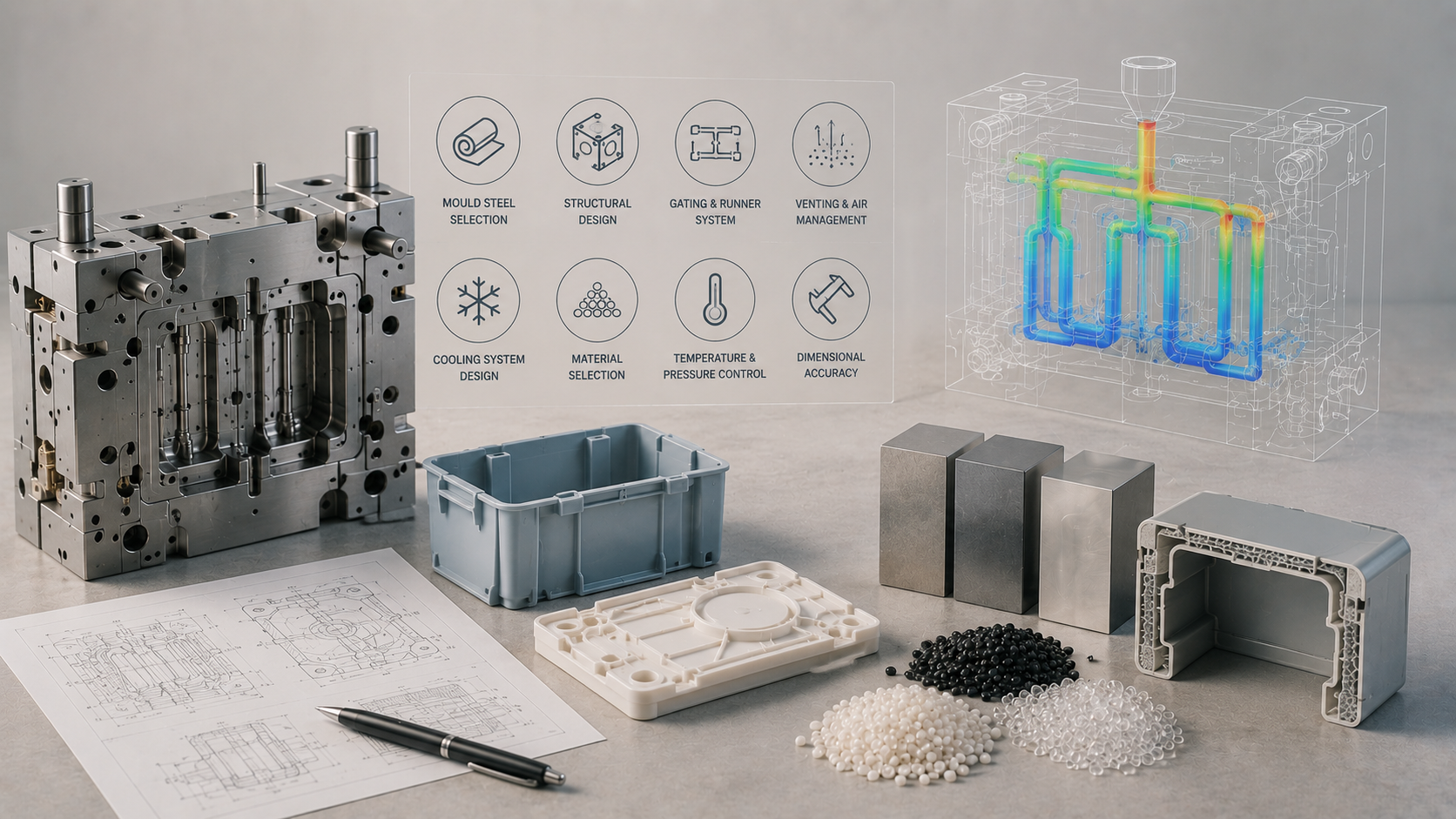
Key Takeaways
- Quality injection molding is influenced by far more than machine settings. Hidden factors in mould design, steel selection, and cooling systems often determine whether production stays stable or fails under scale.
- From runner system design to raw material behavior, discover how small engineering decisions quietly impact part consistency, defect rates, and long-term mould performance.
- The real advantage lies in process control and optimization, where advanced engineering, simulation, and data-driven analysis transform injection moulding from reactive troubleshooting into predictable manufacturing excellence.
Achieving consistent quality injection molding is not the result of a single parameter or decision. It is the outcome of multiple interconnected factors, spanning mould design, material selection, process control, and production engineering. In modern manufacturing environments, where tolerances are tighter and production volumes are higher, even small deviations in these variables can lead to defects, inefficiencies, and increased costs.
At the core of quality injection molding lies a fundamental principle: every stage of the process must be engineered with precision and aligned with the final product requirements. From selecting the right mould steel and optimizing cavity design to controlling temperature, pressure, and cooling cycles, each element plays a critical role in determining part quality, dimensional accuracy, and production stability.
This blog provides a structured breakdown of the most critical factors that influence injection moulding quality. It explores how mould material selection impacts durability and consistency, how design elements such as gating and venting affect flow behavior, and how process variables like temperature and pressure must be tightly controlled to avoid defects. It also examines the role of raw material quality, runner system design, and cooling efficiency in achieving stable and repeatable production outcomes.
In addition, the blog highlights how advanced engineering practices, simulation tools, and data-driven optimization are transforming traditional moulding approaches. You will also gain insight into how leading manufacturers improve performance by integrating mould health analysis, process monitoring, and continuous improvement strategies into their operations.
Whether you are new to injection moulding or looking to refine existing processes, this guide offers a clear and practical understanding of what drives quality injection molding and how to systematically improve it for reliable, high-performance results.
Impact of Mould Steel & Material Selection
The foundation of quality injection molding begins with the right mould steel. The steel grade determines the mould’s durability, dimensional stability, and ability to maintain consistent part quality over long production runs.
Commonly used mould steels include:
- H13 Tool Steel – High hardness and excellent resistance to thermal fatigue cycles, making it ideal for high-volume and high-temperature applications.
- P20 Steel – Widely used for general moulds due to its good machinability and balanced toughness.
- NAK80 Steel – Known for superior polishability and corrosion resistance, often used for optical or high-appearance components.
Key performance factors influenced by steel selection include:
- Hardness and wear resistance – Determines mould longevity and resistance to abrasion from reinforced plastics.
- Thermal conductivity – Impacts cooling efficiency and cycle stability.
- Corrosion resistance – Critical when processing moisture-sensitive or chemically aggressive resins.
Poor steel selection can lead to premature mould wear, inconsistent cavity performance, and dimensional variation. To prevent this, Efficient Innovations follows a rigorous material vetting process aligned with ISO quality standards, ensuring mould materials match production volume, resin characteristics, and performance requirements.
Mould Structural Design & Optimization
Mould design plays a decisive role in determining the outcome of quality injection molding. Even with the best materials and machines, poor structural design can introduce defects that affect product performance and appearance.
Critical design factors include:
- Gate placement – Determines how molten plastic flows into the cavity. Incorrect placement can cause weld lines or uneven filling.
- Sprue and runner design – Ensures consistent material distribution across cavities.
- Venting strategy – Allows trapped air to escape, preventing burns and incomplete fills.
- Wall thickness uniformity – Reduces the risk of shrinkage variation and internal stresses.
Common defects caused by poor mould design include:
- Flash formation
- Sink marks
- Warping and distortion
- Internal voids
Modern CAD and simulation tools enable engineers to predict these issues before manufacturing begins. Through detailed DFM (Design for Manufacturability) reviews, Efficient Innovations helps manufacturers optimize mould designs, reducing production defects by up to 20% while improving process stability.
Temperature & Pressure Control: The Process Variables
Precise control of processing parameters is essential for maintaining quality injection molding. Two of the most critical variables are melt temperature and injection pressure.
Typical ranges include:
- Melt temperature: 200–300°C depending on polymer type
- Injection pressure: 50–150 MPa depending on part geometry and material viscosity
Incorrect settings can quickly lead to quality issues. For example:
- Excessive temperature may cause material degradation or discoloration.
- Low temperature can result in poor flow and incomplete filling.
- Incorrect pressure settings can create internal stresses or dimensional variation.
Another important factor is cooling time, which must be optimized to balance part stability with production efficiency. Studies show that optimized temperature and pressure parameters can reduce cycle times by 10–15% while maintaining consistent quality.
Through advanced process analysis and monitoring, Efficient Innovations provides parameter optimization services that help manufacturers achieve stable, repeatable molding cycles.
Raw Material Quality & Resin Selection
The choice and quality of raw materials significantly influence quality injection molding outcomes. Different polymers offer distinct mechanical, thermal, and processing characteristics.
Common materials include:
- ABS – Good strength and surface finish, widely used for consumer products.
- PC (Polycarbonate) – High impact resistance and optical clarity.
- HDPE – Excellent chemical resistance, often used in packaging.
- PP (Polypropylene) – Lightweight and cost-effective for high-volume applications.
- PA (Nylon) – High strength and wear resistance for engineering components.
Several factors affect material performance:
- Virgin vs. recycled content ratios
- Moisture content, particularly for hygroscopic materials like nylon
- Material certification and traceability
Improper storage conditions can introduce moisture, leading to defects such as bubbles or reduced mechanical strength. Manufacturers must therefore follow strict material data sheet (MDS) guidelines and controlled storage procedures.
To ensure consistent production quality, Efficient Innovations audits supplier quality, validates material specifications, and verifies storage protocols, minimizing variability in molding operations.
Runner System Design: Hot vs. Cold Runners
Runner systems play a key role in material flow, production efficiency, and waste management in quality injection molding.
Two primary systems are used:
Hot Runner Systems
- Heated manifolds keep plastic molten within the runner channels.
- Material waste is minimal (around 2–5%).
- Faster cycle times and improved consistency.
Cold Runner Systems
- Unheated channels allow plastic to solidify with each cycle.
- Higher scrap rates (8–15%) due to runner waste.
- May require secondary grinding and recycling.
Although hot runners involve higher initial tooling costs, they often deliver better long-term efficiency and material savings in high-volume production.
Through advanced engineering analysis, Efficient Innovations optimizes runner system design, achieving average material waste reductions of around 12% while improving production consistency.
Cooling System Effectiveness & Temperature Management
Cooling is one of the most critical stages in the quality injection molding process. Poor cooling design can lead to uneven temperature distribution, resulting in defects such as warping, shrinkage variation, or surface imperfections.
Key aspects of cooling system design include:
- Cooling channel placement and geometry
- Coolant circulation rates
- Coolant quality and filtration
- Mould temperature controller (MTC) performance
Thermal gradients inside the mould cavity can cause differential shrinkage, affecting dimensional accuracy and visual quality.
When optimized correctly, cooling systems can reduce defect rates by up to 18% while also shortening cycle times.
Engineering teams at Efficient Innovations evaluate mould cooling systems against industry standards such as ISO 1043, ensuring stable temperature control and consistent part quality.
Efficient Innovations vs. Leading Competitors: A Quality Approach Comparison
When it comes to quality injection molding, not all service providers take the same approach. Some focus primarily on production output, while others integrate engineering, process control, and advanced diagnostics to ensure long-term quality consistency.
The table below highlights how Efficient Innovations compares with leading industry players in delivering comprehensive quality-focused injection molding solutions.
Company | Factors Covered in Quality Control | Depth of Analysis | Innovation in Methods | Support & Consultation | Quality Guarantees |
Efficient Innovations | Comprehensive (10+ process factors) | Advanced engineering analysis | High – data-driven optimization & mould diagnostics | Extensive consultation & process improvement support | Strong focus on measurable quality outcomes |
R.D. Plast | Basic process parameters | Moderate | Limited | Standard technical support | Limited guarantees |
Richfields | Process + tooling control | Moderate | Moderate | Production-focused support | Standard quality checks |
Husky Technologies | Advanced tooling systems | High | High | Equipment-focused consulting | Equipment performance guarantees |
Milacron | Process optimization tools | Moderate | Moderate | Technical support | Process-based assurances |
Engel | Machine-level quality control | High | High | Engineering consultation | Equipment reliability guarantees |
Arburg | Machine precision systems | High | High | Technical assistance | Equipment-focused guarantees |
Nissei | Machine performance optimization | Moderate | Moderate | Service support | Limited quality guarantees |
Sumitomo Demag | Process and machine control | High | High | Technical consultation | Process reliability focus |
BEMA | Production-oriented molding services | Moderate | Low–Moderate | Limited engineering consultation | Standard QC practices |
Key Insight:
While many companies excel in equipment manufacturing or production services, Efficient Innovations distinguishes itself by focusing on holistic injection molding quality improvement, combining mould health analysis, process optimization, and strategic engineering consultation to ensure consistent part quality across production cycles.
In the following sections, we will break down the most critical factors influencing quality injection molding and explain how manufacturers can systematically improve them to achieve reliable, high-performance results.
Conclusion
Achieving consistent quality injection molding requires more than advanced machinery. It depends on how effectively mould design, material selection, process parameters, and cooling systems work together throughout production.
From mould steel selection and runner system design to temperature control and raw material quality, every variable directly influences part consistency, defect rates, and long-term manufacturing stability. Small improvements in these areas can significantly enhance efficiency, reduce waste, and improve product performance.
As manufacturing standards continue to evolve, companies that invest in engineering-driven optimization and process control will be better positioned to achieve reliable, scalable, and high-performance quality injection molding outcomes.
Frequently Asked Questions
What are the most critical factors affecting injection moulding quality?
The most important factors influencing quality injection molding include mould design, steel selection, raw material quality, temperature and pressure control, runner system design, cooling efficiency, and machine parameter optimization. Proper maintenance and real-time process monitoring are also essential for maintaining consistent part quality.
What is the difference between hot and cold runner systems in terms of quality?
Hot runner systems maintain molten plastic inside heated runners, improving consistency and reducing material waste. Cold runners allow plastic to solidify and must be removed after each cycle. Hot runners generally provide better uniformity and shorter cycles, while cold runners are simpler but may produce more scrap.
How does mould steel grade impact product quality?
Mould steel grades such as H13, P20, and NAK80 influence durability, wear resistance, and thermal conductivity. Higher-quality steel maintains cavity precision longer, ensuring consistent dimensions and surface finish across production cycles, key factors for reliable quality injection molding.
What role does cooling system design play in injection moulding quality?
Cooling system design controls how evenly heat is removed from the mould. Poor cooling causes warping, shrinkage variation, and surface defects. Optimized cooling channels and proper coolant circulation improve part consistency and can significantly reduce defect rates.
How does raw material quality affect the final injection moulded product?
Material quality impacts mechanical strength, surface finish, and dimensional stability. Moisture contamination, inconsistent resin batches, or improper storage can cause defects such as bubbles, brittleness, or discoloration in molded parts.