

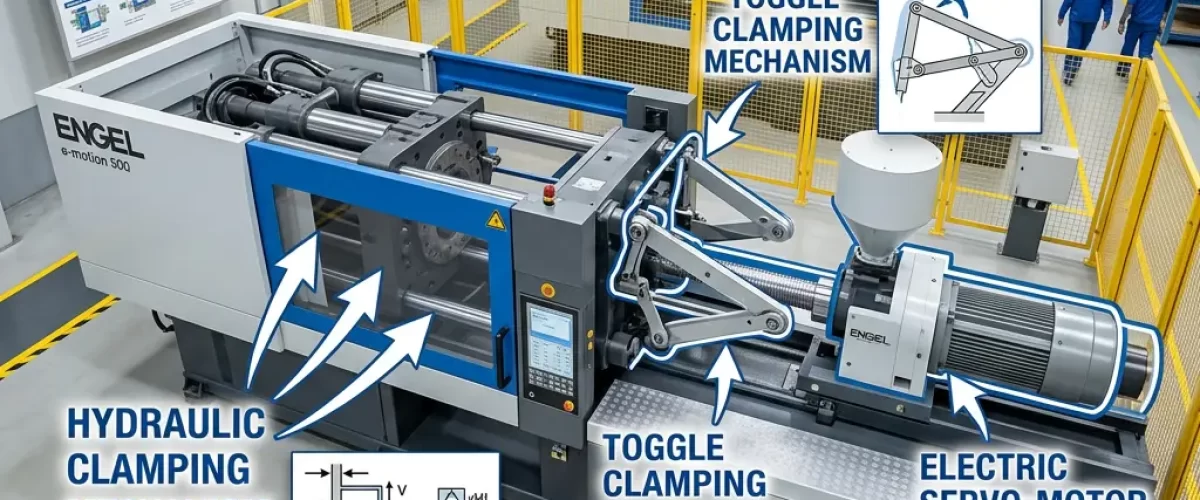
What Is Clamping Force in Injection Moulding?
Injection moulding is a plastic manufacturing process that creates high pressure (injection and holding pressure) to mould plastic parts. Clamping force is the force applied by the machine to keep the mould closed during injection, preventing separation of mould halves under high internal cavity pressure.
Clamping force is typically specified in tons. For example, a 180T injection moulding machine produces a maximum clamping force of 180 tons (1800 kN).
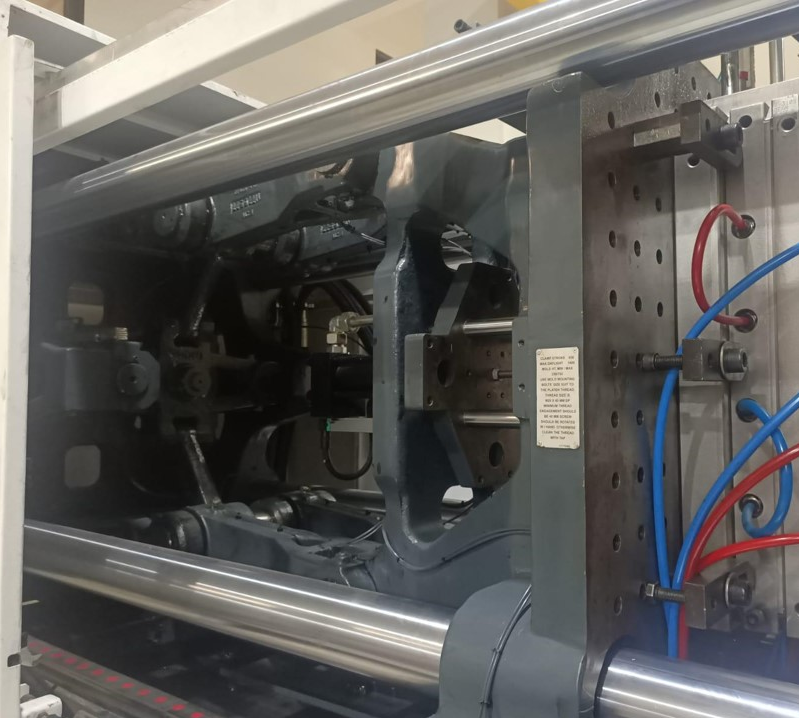
Injection Unit vs Clamping Unit in an Injection Moulding Machine
An injection moulding machine has two main units:
Injection Unit:
Polymer granules are heated and plasticized inside the barrel. The molten material flows through the nozzle, runner, and gate into the cavity. During the shift from velocity to pressure phase (packing and holding), additional material is pushed into the cavity to minimize sinks and dimensional variation.
Clamping Unit:
The clamping unit brings together the core and cavity of the mould. It applies sufficient force to prevent separation of the mould halves when molten plastic is injected at high pressure.
Successful moulding depends on:
- Tonnage applied
- Location of force
- Type of clamping mechanism
- Size of the mould base
Why Correct Clamping Force Is Critical for Part Quality and Tool Life
The correct clamping force ensures:
- Proper part filling and packing
- Dimensional stability
- Protection of mould components
- Prevention of flash and mould separation
Too little force leads to flash and part defects. Excessive force damages moulds and machines while increasing operational costs.
Key Factors Affecting Clamping Force Requirements
The magnitude of clamping force depends on cavity pressure and projected area. Key influencing variables include:
- Material properties (MFI)
- Depth of component (flow length)
- Part thickness
- Type of runner system
- Gate size and number of gates
A larger gate area reduces required injection pressure. Multiple gates or sequential filling can reduce required injection pressure and corresponding clamp tonnage.
Materials with low viscosity (high MFI) generally require lower clamping force compared to high-viscosity materials.
How to Calculate Clamping Force in Injection Moulding
The calculation involves:
- Determining projected surface area of the part
- Multiplying by number of cavities
- Applying cavity pressure (tonnage factor)
- Adjusting for runner system
- Adding safety factor
If the mould has a cold runner, add 10% of projected area. A 10% safety factor is also applied to the final result.
Clamping Force Formula Explained
Clamping force is calculated as:
Clamping Force = {(Surface Area × Number of Cavities) × Cavity Pressure} × 1.1 (Safety Factor)

Cavity pressure typically ranges from 2 to 10 tons/in² depending on material and geometry.
For example:
- PP: 1.5–3.5 tons/in²
- PET: 2–6 tons/in²
If part depth exceeds 1 inch, additional force (e.g., 10%) may be considered.
Example: Clamping Tonnage Calculation for a Plastic Part
Consider a rectangular part of 2 × 4 inches:
- Projected area = 8 in²
- Cored-out area = 3 in²
- Final projected area = 5 in²
For a two-cavity mould and cavity pressure of 3 tons/in²:
Clamping force = [{(5 × 2) × 3} × 10% (depth adjustment)] × 10% safety factor = 36.3T
This determines the appropriate machine tonnage selection.
Problems Caused by Incorrect Clamping Force Settings
Excessive Clamping Force:
- Rolled parting lines
- Blocked vents
- Cracked core inserts or cavity blocks
- Mould top plate damage
- Burn marks, glossy surface, short shots, air bubbles
- Machine plate deformation
- Increased operating cost
Insufficient Clamping Force:
- Flash formation
- Dimensional instability
- Mould separation
Higher tonnage machines also increase energy consumption and overall job cost.
Clamping Force as a Key Process Variable in Injection Moulding
An experiment revealed that modifying clamp force altered:
- Shot weight
- Cavity pressure
- Pack rate
- Cooling rate
Traditionally, engineers considered four variables affecting part dimensions:
- Heat
- Flow
- Pressure
- Cooling
Clamping force emerged as the fifth critical variable influencing moulding outcomes.
Practical Methods to Optimize Clamping Force
By Part Weight:
Run the mould at higher clamp tonnage to achieve full packing. Reduce clamp tonnage gradually by 5–10% while recording part weight. Separation begins when part weight rises. This method prevents over-clamping and saves energy.
Mould Deflection Sensor:
Measures core deflection during injection, indicating mould separation and helping optimize clamp force.
Dimensional Measurement:
Measure length, width, and thickness at different clamp settings to observe dimensional variation and determine optimal tonnage.
Best Practices for Machine Selection and Clamp Optimization
Calculate clamping force at the beginning of the project. This forms the basis for selecting the correct machine.
Once production begins, optimize clamp tonnage to:
- Achieve desirable part quality
- Minimize operational cost
- Prevent mould and machine damage
Efficient Innovations brings 15+ years of expertise in plastic injection moulding. Don’t rely on rule of thumb for clamping force calculations.
FAQs
- What is the optimal clamping force in injection moulding?
The optimal clamping force is the minimum force required to keep the mould halves closed during injection without causing flash, mould separation, or tool damage. It ensures dimensional stability, part quality, and machine efficiency while avoiding unnecessary energy consumption. - How is clamping force calculated in injection moulding?
Clamping force is calculated by multiplying the projected area of the part (including cavities) by the cavity pressure, then adding adjustments for runners and a safety factor. Material type, part geometry, and depth also influence the final tonnage requirement. - What happens if clamping force is too low?
Insufficient clamping force can cause mould separation during injection, leading to flash formation, dimensional variation, poor surface finish, and inconsistent part quality. It may also compromise process stability and increase rejection rates. - Can excessive clamping force damage the mould?
Yes. Excessive clamping force can roll parting lines, block vents, crack inserts, deform plates, and strain machine components. Over time, it reduces mould life, increases maintenance costs, and negatively impacts process economics. - How does material MFI affect clamping force?
Material Melt Flow Index (MFI) reflects viscosity. High MFI (low viscosity) materials flow easily and generally require lower clamping force. Low MFI materials need higher injection pressure, which increases required clamping tonnage. - Do gate size and runner type affect clamping force?
Yes. Larger gate areas reduce required injection pressure, lowering clamp tonnage. Multiple gates or sequential filling can also reduce pressure requirements. Cold runner systems may increase projected area considerations in clamping force calculations. - Why is a safety factor added to clamping force calculations?
A safety factor, typically around 10%, accounts for process variations, material behavior, and unforeseen pressure spikes. It ensures reliable mould closure under real production conditions without operating at the machine’s maximum capacity. - How can clamping force be optimized during production?
Clamping force can be optimized by gradually reducing tonnage while monitoring part weight, dimensional stability, and mould separation. Tools such as mould deflection sensors and dimensional measurement help establish the lowest effective clamp setting.