
Key Takeaways
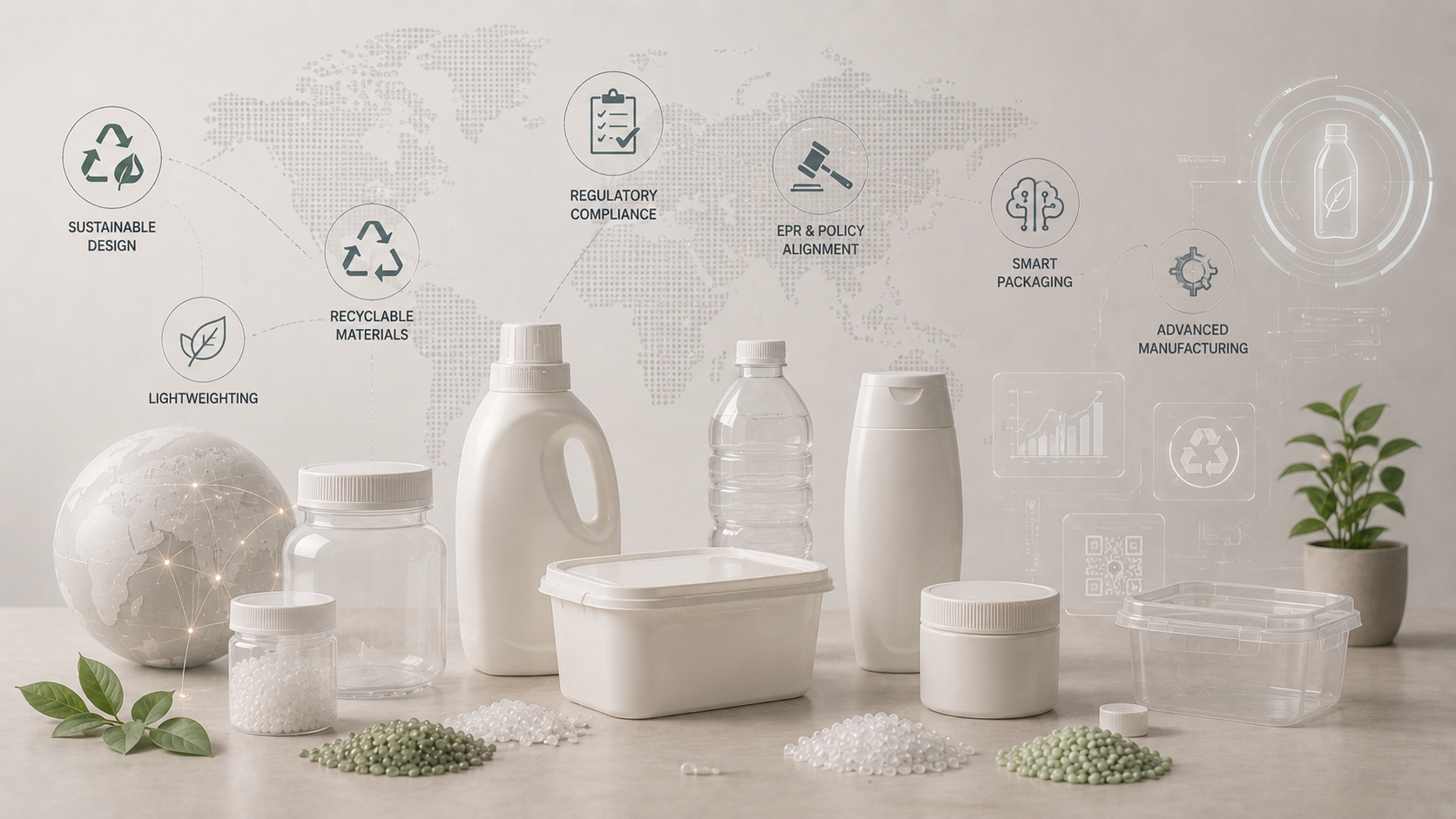
- Rigid plastic packaging is no longer just about durability. It is becoming a strategic lever where sustainability, compliance, and performance intersect in the evolving plastic packaging market.
- From lightweighting and recyclability to regulatory shifts like EPR, discover the hidden forces quietly reshaping rigid plastic packaging trends across global FMCG operations.
- The real transformation lies in technology and design thinking, where AI, smart packaging, and advanced manufacturing are redefining how packaging is created, used, and optimized.
Rigid plastic packaging remains a core part of the FMCG supply chain, widely used for beverages, food, personal care, and household products due to its strength, durability, and scalability.
However, the landscape is shifting. Brands must now balance performance with sustainability, regulatory compliance, and evolving consumer expectations. Packaging has moved beyond function to become a strategic tool for brand positioning and environmental responsibility.
As a result, rigid plastic packaging trends are moving toward lightweight designs, recyclable materials, and smarter manufacturing. This guide explores the key design factors, market shifts, and compliance requirements shaping the plastic packaging market, along with how companies like Efficient Innovations stay ahead.
The Rigid Packaging Challenge: Why FMCG Brands Are Reimagining Their Strategies
The plastic packaging market is facing a major transition as FMCG brands respond to sustainability commitments, regulatory pressure, and evolving consumer expectations.
Three key forces are driving this shift:
- Sustainability Targets Approaching
Many brands have pledged to make packaging recyclable, reusable, or compostable by 2025, pushing companies to redesign traditional rigid plastic packaging and reduce material usage. - Tightening Regulations Worldwide
Governments are introducing stricter plastic policies. Today, 400+ municipalities globally have restrictions on certain single-use plastics, accelerating the need for compliant packaging solutions. - Consumer Demand for Transparency and Convenience
Consumers increasingly prefer packaging that is recyclable, clearly labeled, and easy to use.
While these pressures are significant, they also create opportunities for innovation. Companies that adapt quickly can turn emerging rigid plastic packaging trends into competitive advantages in the evolving plastic packaging market.
Trend 1: Sustainable Design & Material Innovation
One of the most significant rigid plastic packaging trends is the shift from incremental improvements to full-scale redesign. FMCG brands are rethinking how rigid plastic packaging is designed, produced, and recovered to meet sustainability demands in the evolving plastic packaging market.
Key approaches include:
- Lightweighting to reduce material without compromising performance
- Designing for recyclability by eliminating complex materials
- Using alternative structures to lower environmental impact
- Integrating post-consumer recycled (PCR) content
Sustainability is no longer optional. It is a baseline expectation driven by regulators, retailers, and consumers.
Emerging solutions:
- Replacing glass with lightweight plastic alternatives
- Advanced polymers that deliver strength with less material
- Compostable and bio-based materials for select use cases
With strong engineering and material expertise, Efficient Innovations helps FMCG brands develop sustainable rigid plastic packaging that balances performance, compliance, and environmental responsibility.
Understanding Lightweighting Without Compromising Protection
Lightweighting is a key innovation in modern rigid plastic packaging trends, focused on reducing material usage without compromising performance in the plastic packaging market.
Advances in material science and design now enable thinner, more efficient structures while maintaining durability.
Key strategies include:
- Advanced resin formulations for improved strength and flexibility
- Optimized structural design for better load distribution
- Multi-layer constructions to retain barrier properties
These ensure packaging continues to deliver:
- Moisture and oxygen protection
- Structural stability during transport
- Extended shelf life
Lightweighting is not about reducing quality. It is about smarter engineering to achieve the same performance with less material.
Examples include:
- Yogurt containers reducing plastic use by up to 30% through design optimization
- Lightweight PET bottles maintaining carbonation strength
- Reinforced dairy packaging structures with lower material usage
These innovations highlight how intelligent design can balance sustainability with performance in rigid plastic packaging.
Recyclability as a Design Principle
A major shift in rigid plastic packaging trends is the move toward designing packaging for recyclability from the outset, rather than treating it as an afterthought.
Modern plastic packaging market expectations are driving designs that prioritize:
- Single-material structures for easier recycling
- Removal of incompatible additives and coatings
- Clear labeling to support sorting and recovery
- Alignment with existing recycling infrastructure
This approach supports a circular economy, where materials are reused rather than discarded.
In contrast, mixed materials and non-recyclable elements are becoming liabilities, increasing both environmental impact and regulatory risk.
Companies that embed recyclability into early design stages are better positioned to meet evolving sustainability and compliance demands in rigid plastic packaging.
Post-Consumer Recycled (PCR) Content Integration
The integration of post-consumer recycled (PCR) materials is quickly becoming a defining factor in sustainable rigid plastic packaging.
Major retailers and consumer goods companies are setting minimum PCR content requirements as part of their sustainability commitments.
However, incorporating PCR materials introduces several technical and operational challenges:
- Supply availability and sourcing stability
- Material quality consistency
- Performance characteristics compared with virgin plastics
- Cost considerations and market pricing fluctuations
Regulatory frameworks are also accelerating this trend. For example:
- The European Union’s Extended Producer Responsibility (EPR) policies encourage the use of recycled content in packaging systems.
- Many global retailers now require packaging suppliers to demonstrate measurable recycled content levels.
Ensuring reliable PCR integration requires robust quality assurance processes, supplier partnerships, and advanced material testing.
Companies like Efficient Innovations help FMCG brands address these challenges by optimizing packaging designs and supply chains to support consistent PCR usage while maintaining product safety and packaging performance.
Trend 2: Regulatory Compliance & Market Adaptation
Regulatory changes are a major driver of evolving rigid plastic packaging trends, with governments worldwide introducing stricter environmental policies. This is forcing FMCG brands to rethink how rigid plastic packaging is designed, sourced, and managed across markets.
Regulations vary by region. Europe leads with aggressive sustainability mandates, while U.S. states like California are advancing localized policies. Emerging markets are also adopting similar frameworks as global pressure for responsible packaging increases.
Forward-looking companies are treating compliance as a strategic advantage. Early adaptation helps strengthen retailer relationships, build consumer trust, and reduce future redesign costs.
A key influence in the plastic packaging market is Extended Producer Responsibility (EPR), which shifts lifecycle responsibility onto manufacturers and brands.
Companies that align packaging design with evolving regulations early are better positioned to stay competitive while ensuring operational continuity across global markets.
Navigating Regional Regulatory Differences
For FMCG companies operating internationally, regulatory fragmentation presents a major operational challenge. Packaging that meets requirements in one region may not comply with rules in another.
For example:
- European Union regulations include strict recyclability targets, recycled content mandates, and bans on certain single-use plastics.
- United States regulations are largely state-driven, with states like California implementing advanced recycling and waste reduction policies.
- Emerging markets are increasingly introducing packaging restrictions and environmental standards as global sustainability initiatives expand.
These differences mean that a single global packaging design is often no longer viable.
To manage this complexity, many companies adopt strategies such as:
- Dual-sourcing packaging materials to meet regional requirements
- Regional packaging customization aligned with local compliance frameworks
- Future-proofing packaging designs to meet upcoming regulatory standards
Most importantly, regulatory compliance must be treated as an ongoing process, not a one-time certification exercise. Continuous monitoring of policy developments is essential to maintaining market access and avoiding costly packaging redesigns.
Extended Producer Responsibility (EPR) & Producer Obligations
A major regulatory shift shaping rigid plastic packaging trends is the expansion of Extended Producer Responsibility (EPR), where accountability for packaging waste moves from consumers to producers.
This has direct implications for the plastic packaging market:
- Packaging design now impacts waste management costs
- Companies must track and report packaging usage
- Producers contribute to recycling and collection systems
For FMCG brands, EPR requires both design and operational changes:
- Designing recyclable, infrastructure-compatible packaging
- Participating in Producer Responsibility Organizations (PROs)
- Implementing systems for data tracking and compliance reporting
While EPR increases responsibility, it also creates opportunity. Early alignment helps optimize packaging, reduce long-term costs, and strengthen sustainability positioning.
As environmental accountability becomes central to business strategy, EPR is emerging as a key driver of innovation in rigid plastic packaging.
Trend 3: Advanced Technology Integration in Packaging Design & Supply Chain
A key shift in rigid plastic packaging trends is the growing integration of advanced technologies across design and manufacturing. The plastic packaging market is no longer purely physical. It is becoming increasingly digital and data-driven.
Technologies such as AI-assisted design, smart packaging, and automated production systems are transforming how rigid plastic packaging is developed and managed.
Key benefits include:
- Faster innovation and development cycles
- Reduced material waste during design and prototyping
- Improved manufacturing precision and consistency
- Greater supply chain traceability and transparency
- Stronger alignment with sustainability and compliance goals
For FMCG companies, technology is no longer optional. It is a critical enabler for delivering faster, smarter, and more sustainable packaging solutions.
AI-Powered Packaging Design: Faster Iteration, Better Sustainability
Artificial intelligence is reshaping packaging design by enabling faster, data-driven decisions in the plastic packaging market. AI tools allow engineers to evaluate multiple design variations simultaneously, optimizing performance while reducing material use.
Key applications include:
- Structural optimization for lightweight, durable packaging
- Material efficiency modeling to minimize plastic usage
- Performance prediction for strength, barrier properties, and durability
- Early-stage cost optimization
AI can simulate thousands of design scenarios to identify structures that maintain strength with reduced thickness, supporting advanced lightweight rigid plastic packaging solutions.
Rather than replacing designers, AI enhances their capabilities, enabling faster iteration and more informed decisions. The result is smarter lightweighting and improved sustainability outcomes across rigid plastic packaging.
Smart Packaging Technology: RFID, QR Codes, and Track-and-Trace Solutions
A growing trend in rigid plastic packaging is the integration of smart technologies that turn packaging into a digital interface within the plastic packaging market.
Technologies such as RFID, QR codes, and traceability systems enable real-time data exchange across the supply chain.
Key applications include:
- RFID-based inventory and logistics tracking
- QR codes for product details, recycling guidance, and consumer engagement
- Anti-counterfeiting and product authentication
- End-to-end supply chain traceability
- Improved recycling through digital identification
Smart packaging also enhances transparency by providing clear sustainability information to consumers.
However, implementation requires balance, considering cost, data privacy, and avoiding unnecessary complexity.
When used strategically, smart technologies connect physical packaging with digital systems, improving traceability, efficiency, and consumer trust.
Automation & Precision Manufacturing in Rigid Packaging Production
Automation is another major driver shaping the future of rigid plastic packaging production. Advanced manufacturing technologies are enabling higher precision, improved consistency, and greater efficiency across packaging operations.
Key benefits include:
- Reduced manufacturing defects through automated quality inspection systems
- Higher production consistency across large-scale packaging runs
- Flexible manufacturing systems capable of adapting to different packaging formats
- Lower operational costs through optimized production workflows
Industry 4.0 technologies are also enabling more intelligent production environments.
Examples include:
- Predictive maintenance systems that detect equipment issues before failures occur
- Real-time quality monitoring using sensor-driven inspection systems
- Data-driven process optimization that improves cycle times and material efficiency
These innovations allow manufacturers to produce rigid plastic packaging with greater accuracy while reducing waste and improving operational performance.
In an increasingly competitive plastic packaging market, advanced manufacturing technologies are becoming a critical lever for achieving both cost efficiency and sustainability goals.
Conclusion
Rigid plastic packaging is evolving beyond function, requiring a balance of performance, sustainability, and compliance across the plastic packaging market.
As rigid plastic packaging trends shift toward lightweighting, recyclability, and advanced technologies, companies must adopt smarter, more integrated design approaches.
Those who adapt early will be better positioned to stay compliant, improve efficiency, and maintain a competitive edge in a rapidly changing market.
Frequently Asked Questions
What Are the Key Trends in Rigid Plastic Packaging for FMCG in 2026?
Key rigid plastic packaging trends include lightweighting, higher use of post-consumer recycled (PCR) materials, improved recyclability, smart packaging technologies, and greater transparency through on-pack communication. These trends are driven by sustainability goals, regulatory changes, and evolving consumer expectations in the global plastic packaging market.
What Regulations Will Impact Our Rigid Packaging in the Next 12–24 Months?
Upcoming regulations include stricter recyclability requirements, increased Extended Producer Responsibility (EPR) obligations, recycled content mandates, and regional restrictions on certain plastic formats. These rules are evolving globally and will significantly influence design decisions in the plastic packaging market.
Is Switching to Recycled Content Feasible for Our Current Packaging?
In many cases, yes. Integrating PCR into rigid plastic packaging is increasingly feasible with improved material quality and supply chains. However, companies must evaluate material performance, regulatory compliance for food-contact applications, and sourcing consistency before transitioning.
What’s the ROI of Investing in Smart Packaging Technology?
Smart packaging can improve supply chain visibility, reduce counterfeiting risks, enhance consumer engagement, and support recycling systems. While initial costs exist, many companies see returns through improved logistics efficiency, stronger brand loyalty, and better data-driven decision-making.
How Do We Future-Proof Our Packaging Strategy Against Changing Regulations?
Future-proof strategies include designing for recyclability, integrating PCR materials where possible, monitoring global regulatory trends, and adopting modular packaging systems that can be adapted quickly as regulations evolve in the plastic packaging market.