Key Takeaways
- Most manufacturers think they know where their moulds are, until they don’t. This blog uncovers how mould asset tracking and a robust mould monitoring system bring hidden visibility into tooling performance and lifecycle.
- It is not just about tracking location. Discover how injection mould tracking combined with advanced condition monitoring reveals patterns that directly impact downtime, quality, and cost.
- The real shift lies in moving from static records to real-time asset management, where data, sensors, and analytics quietly transform moulds into fully visible, intelligently managed production assets.
In modern manufacturing, moulds are critical yet often poorly managed assets, still tracked through fragmented records or manual systems.
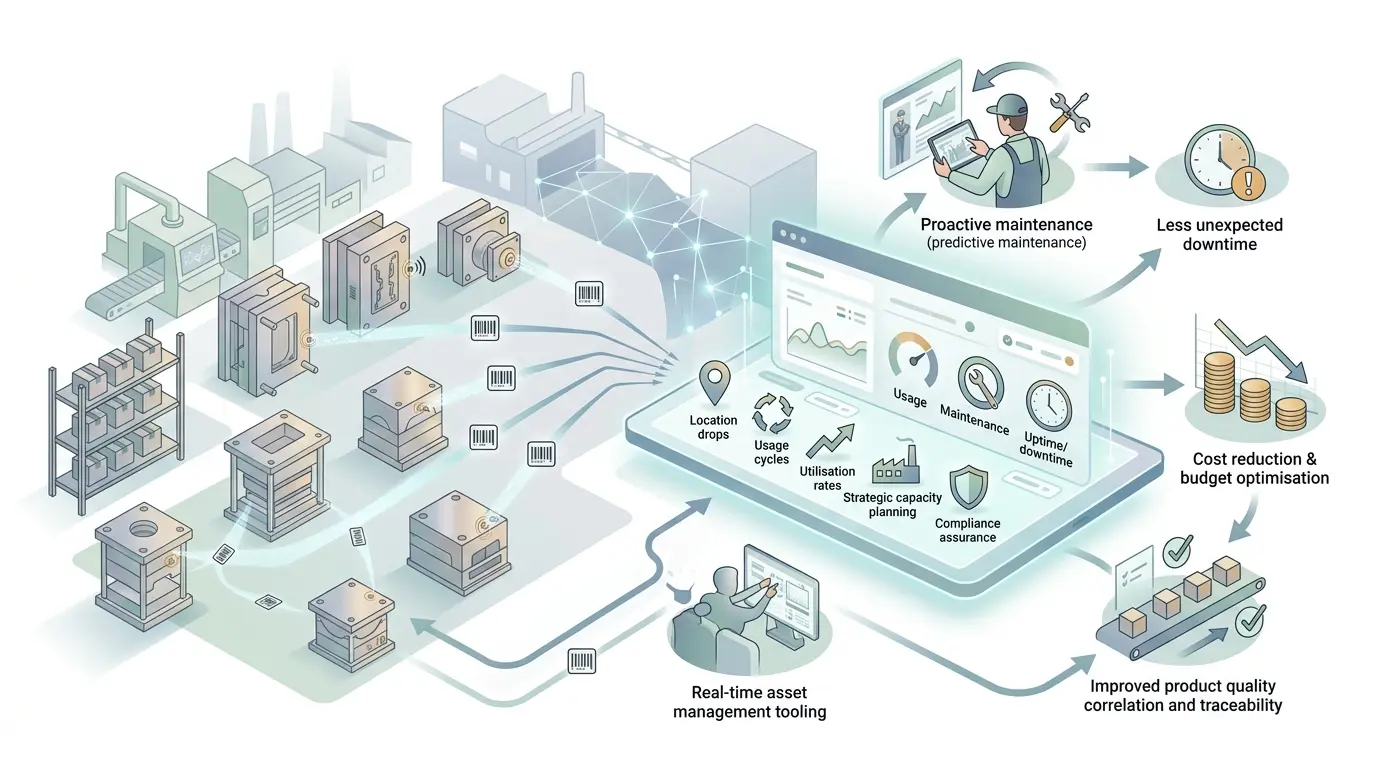
Mould asset tracking addresses this gap by enabling a centralised mould monitoring system that provides real-time visibility into location, usage, and performance. With rising regulatory and efficiency demands, this visibility is essential.
By combining injection mould tracking, continuous condition monitoring, and real-time asset management, manufacturers can reduce downtime, improve uptime, and extend mould life, turning tooling into a fully controlled production asset.
Understanding Mould Asset Tracking: Definition & Scope
Mould asset tracking refers to the systematic process of monitoring, documenting, and managing mould tooling throughout its operational lifecycle. This includes tracking not only where a mould is located but also how it is performing, how often it is used, and when it requires maintenance or refurbishment.
In manufacturing environments, mould assets typically include:
- Injection moulds used for thermoplastic component production
- Compression dies used in rubber, thermoset, or composite moulding
- Blow moulds used in bottle and container manufacturing
- Thermoforming tools used in packaging and sheet forming applications
A comprehensive mould monitoring system goes beyond simple inventory management. It integrates multiple data points to provide complete visibility into the asset’s lifecycle.
Key elements tracked in modern mould asset tracking systems include:
- Location tracking – identifying which plant, production line, or toolroom currently holds the mould
- Operational condition monitoring – tracking wear indicators, cycle counts, and performance metrics
- Maintenance history – documenting cleaning, repairs, and refurbishment activities
- Utilisation rates – understanding how frequently a mould is used across production schedules
- Asset value and depreciation – tracking capital value throughout the mould lifecycle
Together, these elements create a structured framework for condition monitoring and real-time asset management, enabling manufacturers to maintain control over complex tooling inventories while improving productivity and compliance across their operations.
Key Components of an Effective Mould Tracking System
An effective mould asset tracking framework relies on a combination of hardware, software, and analytics tools that work together to provide full lifecycle visibility. A modern mould monitoring system does more than track mould location—it captures performance data, predicts maintenance needs, and supports data-driven operational decisions.
Core components typically include:
- RFID and barcode identification systems for instant mould recognition
- IoT-based condition monitoring sensors for real-time health tracking
- Asset management software platforms that store and manage mould lifecycle data
- Real-time dashboards and analytics tools that transform raw data into actionable insights
- Integration capabilities connecting mould tracking systems with ERP, MES, and maintenance platforms
Together, these technologies enable accurate injection mould tracking, strengthen condition monitoring, and support effective real-time asset management across production facilities.
RFID & Barcode Technology for Mould Identification
RFID tags and barcode systems form the foundation of reliable mould asset tracking by enabling fast and accurate identification of tooling assets throughout the manufacturing environment.
Key benefits include:
- Instant mould identification during installation, removal, or maintenance
- Location mapping across production lines, warehouses, and toolrooms
- Automated history tracking for maintenance, repairs, and usage cycles
Two primary RFID types are used in manufacturing:
- Passive RFID tags
- No internal power source
- Lower cost and longer lifespan
- Suitable for most mould identification applications
- Active RFID tags
- Contain internal batteries
- Provide longer read ranges and continuous broadcasting
- Often used for large-scale facility tracking
Because production floors expose tooling to heat, oil, and vibration, RFID tags and barcode labels must meet durability requirements such as:
- Heat-resistant housings
- Chemical-resistant coatings
- Protection from mechanical damage
Implementation best practices include:
- Positioning tags where scanners can easily read them without interfering with mould operation
- Integrating RFID scanning with production and maintenance workflows
- Linking identification codes directly to asset databases within the mould monitoring system
IoT Sensors: Condition Monitoring for Mould Health
Beyond identification, modern systems incorporate IoT sensors to support continuous condition monitoring of mould performance.
These sensors provide real-time insights into mould behaviour during production.
Common sensor types include:
- Temperature sensors to monitor mould cavity and cooling performance
- Vibration sensors that detect abnormal mechanical movement or imbalance
- Cycle counters that track production usage and wear patterns
- Wear detection sensors that monitor tool degradation over time
- Material stress indicators that signal excessive pressure or structural strain
By collecting real-time operational data, these sensors allow manufacturers to identify early warning signs of failure.
Benefits include:
- Predicting maintenance needs before breakdown occurs
- Preventing unexpected production downtime
- Extending mould lifespan through proactive servicing
This approach transforms mould monitoring systems into predictive maintenance tools rather than reactive maintenance trackers.
Asset Management Software: The Tracking Backbone
While hardware gathers data, asset management software acts as the central platform that organizes and interprets it.
These systems typically function as part of broader enterprise solutions such as:
- CMMS (Computerized Maintenance Management Systems)
- EAM (Enterprise Asset Management) platforms
- Asset lifecycle management software
Key capabilities include:
- Centralized asset databases storing mould specifications, history, and performance records
- Integration with ERP systems for procurement, production planning, and financial tracking
- Mobile accessibility for technicians performing maintenance or inspections
- Maintenance scheduling tools that trigger service intervals based on cycle counts or usage data
- Customizable reporting dashboards for engineering and management teams
Platforms such as those implemented by Efficient Innovations offer flexibility to integrate mould tracking with broader production systems, supporting comprehensive real-time asset management across manufacturing environments.
Real-Time Dashboards & Analytics
Data becomes valuable only when it is visible and actionable. Real-time dashboards allow engineering and operations teams to monitor tooling performance at a glance.
A modern mould monitoring system may provide:
- Asset location heat maps showing where moulds are deployed across facilities
- Utilization metrics identifying underused or overused tools
- Maintenance schedule alerts to prevent overdue servicing
- Cost tracking reports tied to repair and maintenance history
- Predictive alerts based on sensor data trends
These visualization tools help decision-makers quickly identify issues such as:
- Moulds approaching maintenance thresholds
- Imbalanced production utilization
- Rising maintenance costs for specific tools
By converting raw data into clear insights, dashboards enable faster operational decisions and strengthen the effectiveness of mould asset tracking strategies across complex manufacturing operations.
Types of Moulds & Unique Tracking Requirements
Not all moulds behave the same in production. Different tooling categories experience varying levels of thermal stress, cycle frequency, maintenance complexity, and operational risk. For this reason, an effective mould asset tracking strategy must account for the specific requirements of each mould type.
A well-designed mould monitoring system adapts tracking parameters, such as cycle counting, condition monitoring thresholds, and maintenance schedules, based on the characteristics of the tooling involved.
Below are the primary mould categories and their unique tracking needs.
Injection Moulds
Injection moulds are among the most complex tooling assets in manufacturing, often operating under high cycle frequencies and tight tolerance requirements.
Tracking priorities typically include:
- Cycle count monitoring to predict wear and maintenance intervals
- Cavity balance and temperature monitoring for consistent part quality
- Ejector system tracking due to high mechanical movement
- Cooling channel performance monitoring to prevent warpage or dimensional variation
Because injection moulds may run millions of cycles over their lifecycle, precise injection mould tracking and real-time condition monitoring are essential to maintain production stability and tool longevity.
Compression Dies
Compression moulding tools are commonly used for thermosets, rubber, and composite materials. Compared to injection moulds, they typically operate with longer cycle times and higher mechanical loads.
Tracking requirements often focus on:
- Press cycle tracking and force monitoring
- Die surface wear and alignment checks
- Temperature consistency across heated platens
- Maintenance history tracking for polishing and refurbishment
A structured mould monitoring system helps ensure these dies maintain proper alignment and surface integrity throughout their service life.
Blow Moulds
Blow moulds are widely used in packaging industries for producing bottles, containers, and hollow parts. These moulds operate in high-volume environments where cooling efficiency and dimensional consistency are critical.
Tracking priorities include:
- Cooling performance monitoring for cycle time optimization
- Wear tracking on mould cavities due to repeated expansion pressure
- Cycle count monitoring for maintenance planning
- Production utilization tracking across multiple mould sets
Effective real-time asset management helps manufacturers optimize blow mould usage across production lines while maintaining consistent product quality.
Thermoforming Tools
Thermoforming moulds are commonly used in packaging, medical trays, and consumer product applications. These tools rely on heated plastic sheets formed over mould surfaces.
Monitoring typically focuses on:
- Heating and forming cycle tracking
- Surface condition monitoring to prevent defects in formed products
- Tool alignment and clamping performance
- Usage tracking across multiple production runs
Because thermoforming tools may be used across multiple production lines, accurate mould asset tracking ensures proper scheduling, storage, and maintenance management.
Custom Tooling & Specialized Moulds
Many manufacturing environments also operate specialized tooling designed for unique applications, including multi-process moulds, prototype tooling, or hybrid production tools.
These assets often require:
- Customized monitoring parameters tailored to the production process
- Flexible tracking configurations within the mould monitoring system
- Lifecycle tracking across development and production phases
- Enhanced documentation for regulatory or customer compliance
By tailoring condition monitoring and real-time asset management strategies to each tooling category, manufacturers can ensure that every mould asset, regardless of complexity, remains fully visible, properly maintained, and optimised for long-term performance.
Benefits of Modern Mould Asset Tracking
Implementing a modern mould asset tracking framework delivers measurable operational and financial benefits across manufacturing environments. By combining mould monitoring systems, condition monitoring, and real-time asset management, organizations gain visibility into tooling performance, maintenance needs, and lifecycle costs.
Key advantages include:
- Downtime reduction (typically 15–30%) through proactive maintenance insights
- Maintenance cost savings (20–35%) by optimizing service intervals and preventing emergency repairs
- Extended mould lifespan through timely servicing and wear monitoring
- Compliance assurance for regulated industries such as pharmaceutical and medical manufacturing
- Improved product quality correlation through mould performance tracking
- Better inventory management of tooling assets across facilities
- Strategic capacity planning using accurate utilization data
- Accurate depreciation tracking for financial and capital planning
Together, these benefits transform moulds from passive tooling assets into actively managed production resources that support efficiency, reliability, and long-term profitability.
Downtime Prevention Through Predictive Maintenance
One of the most valuable outcomes of mould asset tracking is the ability to shift from reactive maintenance to predictive maintenance.
By collecting operational data through condition monitoring, manufacturers can detect early indicators of wear, imbalance, or abnormal operating conditions before failures occur.
Predictive maintenance enables:
- Fewer unplanned shutdowns during production runs
- Optimized maintenance scheduling based on actual usage cycles
- Reduced emergency repair events and associated downtime
- Improved production planning with predictable service windows
In many manufacturing environments, companies implementing structured mould monitoring systems report:
- 15–30% reduction in unexpected downtime
- 20–25% reduction in emergency maintenance interventions
For high-volume injection mould tracking, even small improvements in uptime can significantly increase annual production output.
Cost Reduction & Budget Optimization
Beyond operational benefits, mould asset tracking helps manufacturers gain better financial control over tooling investments.
With clear visibility into mould lifecycle performance, organizations can:
- Track tool replacement cycles based on real wear patterns rather than assumptions
- Reduce obsolete or underutilized tooling inventory
- Optimize maintenance budgets by focusing resources on high-value assets
- Improve capital allocation decisions when planning new tooling investments
A well-implemented mould monitoring system allows engineering, maintenance, and finance teams to align tooling decisions with long-term operational strategy.
This improves budgeting accuracy and ensures capital is deployed where it generates the greatest production value.
Quality Improvement & Traceability
Mould condition directly influences product quality. When tooling wear or imbalance goes undetected, defects such as dimensional variation, flash, or surface imperfections can occur.
Modern injection mould tracking systems allow manufacturers to link mould performance data with product quality metrics.
This enables:
- Correlation between mould condition and product defects
- Faster root cause analysis during quality investigations
- Improved quality assurance processes across production lines
- Full traceability of mould usage in regulated environments such as pharmaceutical or medical device manufacturing
By integrating condition monitoring with quality data, organizations can strengthen Six Sigma initiatives, support continuous improvement programs, and ensure compliance with strict regulatory requirements.
Conclusion
In today’s manufacturing environment, relying on fragmented records or manual tracking is no longer sustainable. A structured approach to mould asset tracking, supported by a robust mould monitoring system, brings the visibility needed to manage tooling with precision and confidence.
By combining injection mould tracking, advanced condition monitoring, and integrated real-time asset management, manufacturers can move beyond reactive decisions and gain full control over mould performance, utilization, and lifecycle. The result is not just better maintenance, but smarter operations, improved quality, and stronger long-term efficiency.
Frequently Asked Questions
What is mould asset tracking and why does my manufacturing facility need it?
Mould asset tracking is the process of monitoring mould location, usage, maintenance history, and performance throughout its lifecycle. It helps manufacturers reduce downtime, improve maintenance planning, ensure compliance, and extend mould lifespan through better condition monitoring and real-time asset management.
How much can we save annually by implementing a mould tracking system?
Manufacturers typically see 20–35% maintenance cost reduction and 15–30% less unplanned downtime. Savings depend on production volume, tooling complexity, and how effectively the mould monitoring system supports predictive maintenance.
What technology is best for tracking moulds: RFID, barcodes, or IoT sensors?
The best solution often combines technologies. RFID and barcodes support mould identification and location tracking, while IoT sensors enable condition monitoring such as cycle counts, temperature, and vibration analysis.
What compliance requirements does mould tracking address?
Mould tracking supports compliance in regulated industries by ensuring traceability, maintenance documentation, and audit-ready records, particularly in pharmaceutical, medical device, and precision manufacturing environments.
Can mould tracking improve product quality and traceability?
Yes. Injection mould tracking helps correlate mould condition with product quality data, enabling faster root cause analysis and improved quality assurance processes.