Key Takeaways
- A comprehensive packaging audit is far more than a routine inspection. It is a structured evaluation that uncovers hidden risks in mould condition, process stability, compliance, and operational efficiency before they escalate.
- From on-site assessments and defect analysis to cost benchmarking and predictive maintenance insights, discover how modern onsite packaging operation audits reveal opportunities most manufacturers overlook.
- The real value of a mould audit lies beyond defect detection, where data-driven recommendations, monitoring systems, and long-term optimization strategies strengthen reliability, reduce risk, and improve overall production performance.
A packaging audit focused on moulds is a structured, end-to-end evaluation of tooling condition, process performance, and output quality. It examines whether your moulds consistently produce parts that meet design, safety, and regulatory requirements, at the required cost and cycle time. Far from being a fault-finding exercise, it is a systematic health check of one of your most critical production assets.
This guide walks you through the entire journey, from pre-audit planning and data collection to on-floor inspection, reporting, and implementation. Understanding what happens during onsite packaging operation audits removes uncertainty, builds stakeholder confidence, and ensures teams cooperate rather than resist. When done properly, a mould audit becomes a strategic investment that strengthens reliability, quality, and long-term competitiveness.
Why Mould Audits Matter: The Strategic Importance
For packaging manufacturers and supply-chain leaders, mould performance directly determines product integrity, customer satisfaction, and cost control. Yet many organisations operate with limited visibility into tooling conditions until a failure occurs. Regular audits transform this reactive approach into proactive control.
Common pain points that audits uncover include:
- Product damage during transit due to dimensional drift or weak parts
- Regulatory risks from non-compliant packaging specifications
- Quality inconsistencies across batches or production sites
- Inefficient cycle times and energy overuse
- Hidden costs from scrap, rework, and unplanned downtime
Industry insights suggest that over 60% of packaging defects originate upstream in tooling or process issues, many of which remain invisible without formal evaluation. As quality expectations tighten and regulations evolve, companies without routine audits face significantly higher defect rates and operational risk.
A comprehensive packaging audit provides the missing visibility, identifying root causes, quantifying risks, and prioritising corrective actions before problems escalate.
How Mould Audits Protect Your Brand & Operations
Beyond operational metrics, mould health directly influences brand reputation and market trust. Packaging failures are highly visible to customers and regulators alike, making prevention far more valuable than remediation.
Key strategic protections include:
- Brand reputation protection — Prevents defective packaging from reaching the market
- Customer satisfaction — Ensures consistent product performance and appearance
- Compliance confidence — Supports adherence to ISO standards, FDA requirements, and local regulations
- Reduced liability exposure — Minimises risk of recalls, claims, or penalties
- Operational predictability — Enables stable production planning and delivery commitments
Consider the real-world impact: a single undetected mould defect can trigger large-scale scrap, shipment delays, or even product recalls. Conversely, organisations that conduct regular onsite packaging operation audits report fewer surprises, faster troubleshooting, and stronger supplier relationships.
In essence, mould audits are not just technical exercises; they are risk-management tools that safeguard both operational continuity and brand equity.
The Core Steps in Conducting a Comprehensive Mould Audit
A thorough packaging audit follows a structured, phased approach to ensure nothing critical is overlooked. Rather than a disruptive inspection, it is a methodical evaluation that builds understanding step by step, from preparation to sustained improvement.
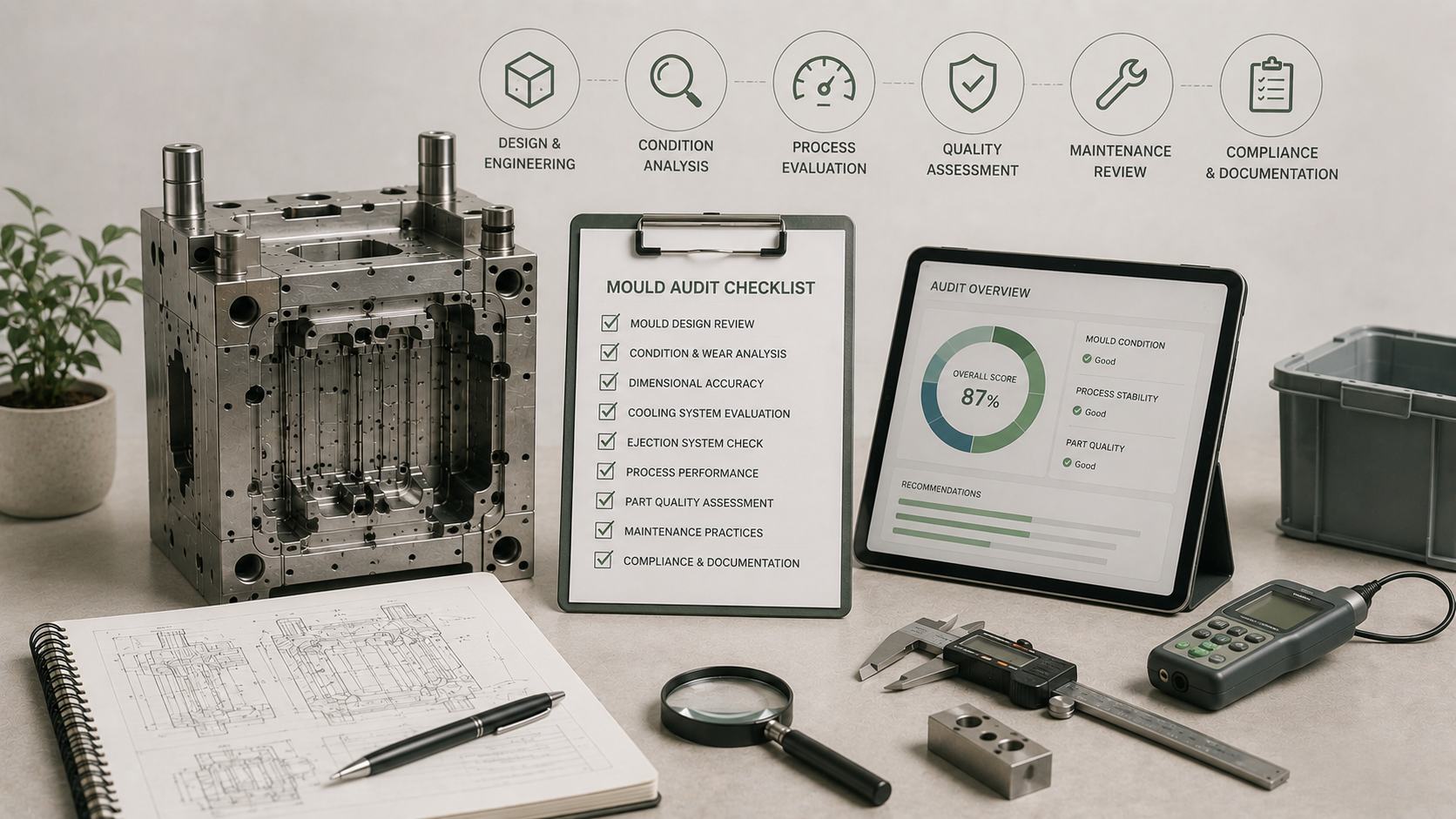
Most on-site packaging operation audits unfold across five key phases:
- Pre-Audit Planning & Scope Definition
- On-Site Assessment & Data Collection
- Data Analysis & Gap Identification
- Reporting & Actionable Recommendations
- Implementation & Ongoing Monitoring
Understanding this roadmap helps teams prepare confidently, cooperate effectively, and extract maximum value from the audit.
Phase 1: Pre-Audit Planning & Scope Definition
Preparation determines the depth and efficiency of the audit. At this stage, objectives are clarified, boundaries are defined, and expectations are aligned across stakeholders.
Key activities include:
- Defining audit goals (quality improvement, compliance check, cost reduction, etc.)
- Establishing success metrics and key performance indicators
- Setting timelines and access requirements
- Identifying responsible contacts across departments
- Reviewing applicable regulatory or customer standards
What you should have ready before auditors arrive:
- Product specifications and drawings
- Historical quality and defect data
- Production records and cycle-time reports
- Previous audit findings and corrective actions
- Facility layouts and mould inventories
- Regulatory and certification documentation
Strong preparation leads to faster, deeper insights and minimises disruption to daily operations.
Phase 2: On-Site Assessment & Data Collection
This is the most visible stage of the packaging audit. Auditors evaluate real conditions on the production floor to understand how moulds perform in practice, not just on paper.
Typical activities include:
- Facility walkthroughs and process observation
- Inspection of moulds, presses, and auxiliary equipment
- Dimensional checks and sample evaluation
- Surface and structural integrity assessment
- Review of maintenance practices and storage conditions
- Interviews with operators, engineers, and quality staff
- Examination of documentation and records
Key focus areas:
- Mould condition and wear patterns
- Material compatibility and processing parameters
- Part accuracy and consistency
- Cooling performance and cycle efficiency
- Signs of contamination or damage
Audits are designed to be systematic and minimally disruptive. Depending on facility size and complexity, this phase typically takes several hours to a few days. Auditors will require access to production areas, maintenance records, and relevant personnel.
Phase 3: Data Analysis & Gap Identification
After data collection, auditors translate observations into meaningful insights. This phase separates symptoms from root causes.
Activities include:
- Comparing current performance against industry standards and best practices
- Identifying trends across production runs or mould families
- Conducting root cause analysis for recurring issues
- Evaluating efficiency and risk levels
- Mapping compliance gaps
In simple terms: your current state is measured against where you should ideally be.
Common analytical tools:
- Measurement datasets and statistical comparisons
- Performance benchmarks
- Risk matrices and prioritisation frameworks
- Failure mode assessments
The outcome is a clear picture of strengths, weaknesses, and hidden vulnerabilities.
Phase 4: Comprehensive Reporting & Recommendations
The audit culminates in a structured report designed to inform both technical teams and senior decision-makers.
A high-quality report typically includes:
- Executive summary for leadership
- Detailed findings by area or mould system
- Risk assessment with severity rankings
- Cost-impact analysis of identified issues
- Prioritised improvement recommendations
- Implementation roadmap with timelines
- Visual dashboards and comparative charts
Effective reports translate technical observations into business implications, highlighting ROI, risk reduction, and operational gains. Clear visuals and structured recommendations make it easier to move from insight to action.
Phase 5: Implementation & Ongoing Monitoring
A mould audit delivers value only when recommendations are executed and sustained. This phase turns findings into measurable improvements.
Post-audit support often includes:
- Phased corrective action plans
- Team training on new procedures
- Process adjustments and optimisation
- Verification inspections or follow-up audits
- KPI tracking to measure improvement
Ongoing monitoring may involve:
- Regular performance reviews
- Preventive maintenance schedules
- Updated documentation practices
- Continuous improvement cycles
Rather than a one-time event, a comprehensive audit becomes the foundation of a long-term partnership focused on reliability, efficiency, and risk control.
Key Focus Areas During a Mould Audit
A comprehensive packaging audit goes far beyond a surface inspection. Auditors evaluate the technical, operational, and compliance aspects that directly influence product quality, production reliability, and cost efficiency.
In most onsite packaging operation audits, 5–7 critical domains are examined in detail. These areas reveal not only current performance but also hidden risks and improvement opportunities.
Mould Condition & Maintenance Assessment
This is the foundation of the audit. Even minor degradation in mould condition can cascade into quality issues, downtime, and safety risks.
Auditors typically evaluate:
- Cavity and core condition (wear, corrosion, pitting)
- Surface finish integrity and contamination build-up
- Dimensional stability and drift over time
- Cooling channel performance and blockages
- Parting line wear and flash indicators
- Ejector system condition and alignment
- Maintenance history and service intervals
They also look for predictive warning signs of failure, such as uneven wear patterns or thermal fatigue cracks.
Real-world insight:
A cavity showing advanced edge wear may begin producing out-of-tolerance parts within months. Proactive refurbishment at this stage can extend mould life by 30–50% and prevent sudden production stops.
Material Quality & Specifications Review
Even a perfectly maintained mould cannot deliver consistent results with poor or incompatible materials. This section verifies that inputs match design intent and regulatory requirements.
Key checks include:
- Material certifications and traceability
- Supplier consistency and quality controls
- Resin properties vs. product requirements
- Batch-to-batch variation
- Storage conditions (temperature, humidity, contamination)
- Compatibility with processing conditions
Auditors confirm that materials align with performance, safety, and compliance expectations, especially critical for food, pharmaceutical, and high-reliability applications.
In simple terms: the audit verifies that what goes into the process can deliver what comes out.
Production Efficiency & Process Optimisation
Mould performance directly influences operational efficiency and cost per unit. This section examines how effectively the production system is running.
Typical evaluation points:
- Actual vs. theoretical cycle times
- Scrap and rework rates
- Process stability and repeatability
- Changeover efficiency
- Operator adherence to procedures
- Documentation accuracy
- Skill or training gaps
Auditors often benchmark performance against industry norms.
For example:
- Current efficiency: 72%
- Industry benchmark: 85–90%
- Improvement potential: significant
Improving mould performance often delivers downstream savings in packaging, logistics, and customer service.
Regulatory Compliance & Standards Alignment
Compliance is a critical risk domain, particularly in regulated industries. Auditors verify that operations meet applicable standards and documentation requirements.
Areas reviewed may include:
- FDA or food-contact compliance (if applicable)
- ISO quality and environmental standards
- Regional packaging regulations
- Material safety certifications
- Traceability systems
- Labeling and documentation completeness
Non-compliance can lead to severe consequences:
- Production shutdowns
- Regulatory penalties
- Product recalls
- Loss of customer trust
- Long-term brand damage
Regular audits help ensure readiness for external inspections and certifications.
Cost Structure & Hidden Inefficiencies
Many organizations underestimate how much mould issues inflate operating costs. This section uncovers both visible and hidden expenses.
Auditors analyze:
- Material waste and scrap disposal costs
- Energy consumption per unit produced
- Maintenance spending patterns
- Labor utilization
- Downtime losses
- Quality-related costs (inspection, rework, returns)
- Cost trends over time
A structured view separates:
Direct costs — materials, labor, energy
Hidden costs — inefficiency, downtime, quality failures
It is common for companies to discover 15–25% cost-reduction opportunities once inefficiencies are quantified.
A well-executed mould audit connects these technical findings to business outcomes, showing not just what is wrong, but where the greatest value lies in fixing it.
Conclusion
A comprehensive packaging audit is not just a technical review. It is a strategic tool that helps manufacturers improve mould reliability, reduce operational risk, and strengthen long-term production performance. By identifying hidden inefficiencies across tooling, materials, maintenance, compliance, and process stability, onsite packaging operation audits provide the visibility needed to move from reactive problem-solving to proactive control.
As packaging requirements become more demanding, regular mould audits are becoming essential for maintaining quality, compliance, and cost efficiency. Companies that invest in structured packaging audit frameworks and continuous monitoring are better positioned to reduce downtime, improve consistency, and build more resilient manufacturing operations.
Frequently Asked Questions
How Long Does a Comprehensive Mould Audit Typically Take?
Most audits take 1–3 days on-site for small to mid-size operations, plus 1–2 weeks for analysis and reporting. Larger facilities or multi-line operations may require longer. Preparation quality significantly affects timeline.
Will an Audit Disrupt Our Production Schedule?
A well-planned audit is designed to be non-disruptive. Auditors work around active production whenever possible, using observation, sampling, and scheduled checks to minimize downtime. Coordination during planning ensures continuity.
How Do Audit Recommendations Account for Our Specific Industry & Regulations?
Recommendations are tailored to your sector, applicable standards, and customer requirements. Auditors map findings against relevant frameworks (e.g., ISO, FDA, packaging regulations) to ensure solutions are practical, compliant, and business-relevant.
Can Audits Be Conducted Remotely or Do They Require On-Site Visits?
Most comprehensive audits require on-site assessment for accurate inspection. However, preliminary reviews, documentation audits, and follow-ups can be performed remotely using digital collaboration tools and shared data.
How Do You Compare Us to Competitors Without Sharing Confidential Data?
Benchmarking uses anonymised industry data and best-practice standards, not proprietary information. Comparisons focus on performance ranges and maturity levels, ensuring confidentiality for all parties.