Key Takeaways
- Injection mould failures rarely happen without warning. Hidden issues in design, cooling, materials, and process control often build up long before defects become visible on the production floor.
- From warping and flash to air traps and thermal imbalance, discover the root causes behind the most common injection moulding defects and why traditional troubleshooting often misses them.
- The real advantage lies in early diagnosis and predictive control, where simulation, monitoring, and preventive strategies transform unstable moulding operations into reliable, high-efficiency production systems.
Injection moulding is designed to deliver precision, repeatability, and high-volume efficiency. Yet when mould failures occur, they can quickly disrupt production schedules, increase scrap rates, and compromise product quality. For manufacturers operating in competitive markets, even minor disruptions can translate into significant operational and financial setbacks.
The reality is that most injection moulding defects and mould failures are not random events. Studies across manufacturing operations show that over 85% of defects in injection moulding trace back to preventable root causes, such as design flaws, improper process parameters, inadequate maintenance, or material inconsistencies.
Understanding these injection moulding defects and causes is therefore essential for maintaining stable production and avoiding costly downtime. By identifying and correcting underlying issues early, manufacturers can dramatically reduce defects, improve process reliability, and extend mould life.
This guide explores the most common injection moulding defects and solutions, helping manufacturers diagnose failure points, implement corrective strategies, and build more resilient molding operations.
The Cost of Injection Mould Failure in Manufacturing
Injection mould failures carry far-reaching consequences across the production lifecycle. When mould performance deteriorates, manufacturers face not only defective parts but also operational disruptions that affect productivity and profitability.
The most significant cost impacts include:
- Production Downtime – Unplanned mould failures can halt production lines, costing manufacturers thousands of dollars per hour in lost output.
- Material Waste – Defective parts increase scrap rates, especially when defects go undetected during early production cycles.
- Quality Control Expenses – Additional inspections, rework, and testing raise operational costs.
- Missed Delivery Deadlines – Delayed shipments can damage supplier relationships and brand reputation.
Industry estimates suggest that mould-related quality issues account for up to 30–40% of production inefficiencies in injection moulding operations. However, companies that implement proactive monitoring and root-cause analysis can detect problems early and reduce potential losses by 40–60%.
Understanding the financial impact of defects in injection moulding highlights a key insight: preventing mould failures is not just a technical necessity, it is a strategic investment in operational efficiency.
In the next sections, we will examine the most common injection moulding defects and causes, along with practical engineering strategies that manufacturers use to eliminate them and maintain stable, high-quality production.
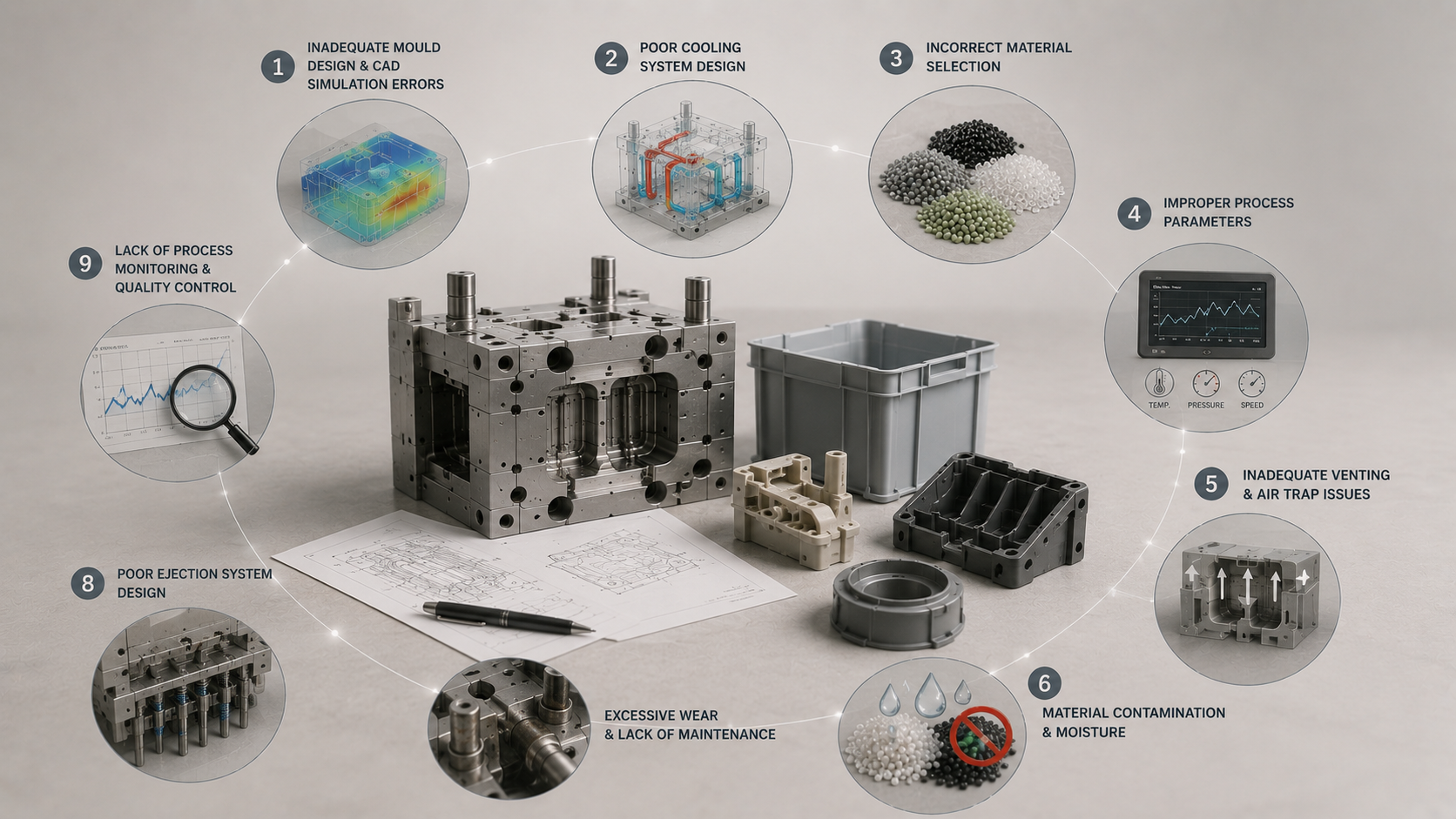
9 Root Causes of Injection Mould Failure
Most injection moulding defects do not originate from a single mistake but from underlying systemic issues in design, materials, process parameters, or monitoring. Identifying these root causes early is the most effective way to prevent production disruptions and extend mould lifespan.
Industry leaders approach this challenge differently. While many manufacturers focus on isolated process corrections, Efficient Innovations emphasizes holistic root-cause diagnostics, combining mould engineering, process optimization, and predictive monitoring to eliminate recurring defects in injection moulding.
Below is a comparison of how different industry players approach root-cause identification.
Company | Root Cause Coverage | Diagnostic Depth | Process Monitoring | Preventive Strategy |
Efficient Innovations | Comprehensive (Design + Process + Material + Monitoring) | Advanced engineering analysis | Real-time diagnostics | Predictive prevention approach |
RD Plast Mould | Tooling-focused | Moderate | Limited | Reactive troubleshooting |
Husky | Equipment-centric | High | Machine-level monitoring | Equipment optimization |
ENGEL | Process optimization | High | Advanced machine data | Process-focused improvement |
Milacron | Equipment + tooling | Moderate | Basic monitoring | Standard preventive programs |
Battenfeld | Machine performance | Moderate | Machine-level control | Equipment maintenance |
Sumitomo | Process stability | High | Sensor-based monitoring | Process optimization |
Niigata | Machine precision | Moderate | Equipment diagnostics | Maintenance-driven approach |
JSW | Production efficiency | Moderate | Machine-level analytics | Standard process control |
Nissei | Machine performance | Moderate | Limited monitoring | Reactive quality management |
The following sections explore the nine most common injection moulding defects and causes, along with practical injection moulding defects and solutions manufacturers use to prevent them.
1. Inadequate Mould Design & CAD Simulation Errors
Poor mould design is one of the leading contributors to injection moulding defects. Design flaws can introduce stress concentrations, uneven material flow, and inefficient cooling patterns that shorten mould life.
Key design issues include:
- Improper gate placement
- Uneven wall thickness
- Insufficient draft angles
- Poorly optimized cooling channels
Without simulation, these problems may only become visible during production. Modern CAD simulation tools can identify up to 90% of design flaws before manufacturing, preventing costly rework.
Efficient Innovations uses advanced DFM analysis and simulation-driven design validation, while many competitors rely primarily on standard tooling experience without comprehensive predictive modeling.
2. Material Degradation & Contamination Issues
Material quality directly affects the occurrence of defects in injection moulding. Moisture absorption, contamination, or thermal degradation can compromise resin performance during processing.
Common issues include:
- Moisture absorption in hygroscopic materials (e.g., nylon or PET)
- Thermal degradation caused by excessive processing temperatures
- Foreign particle contamination from improper material handling
- Poor regrind management practices
These problems can lead to:
- Surface defects
- Short shots
- Voids and bubbles
- Poor mechanical properties
Strict material drying protocols, humidity-controlled storage, and contamination monitoring are essential to prevent such issues.
3. Temperature Control & Processing Parameter Mismanagement
Precise temperature control is critical to maintaining consistent quality injection molding performance.
Key parameters include:
- Barrel temperature
- Nozzle temperature
- Mould temperature
Even small fluctuations can affect product quality. A ±5°C variation may cause:
- Warping
- Flow imbalance
- Inconsistent crystallization
Improper temperature control also increases thermal cycling stress, accelerating mould wear. Advanced process monitoring systems help maintain stable processing conditions.
4. Inadequate Cooling System Performance
Cooling system efficiency directly affects cycle time and part quality. Poor cooling design or maintenance can cause injection moulding defects and causes related to thermal imbalance.
Typical cooling issues include:
- Poorly designed cooling circuits
- Blocked water channels
- Insufficient coolant circulation
- Uneven heat dissipation
Consequences may include:
- Sink marks
- Warping
- Residual internal stress
Optimized cooling channel design and regular maintenance improve cooling efficiency metrics and stabilize part dimensions.
5. Worn Mould Components & Maintenance Neglect
Mould components experience gradual wear over time, especially in high-volume production environments.
Common wear points include:
- Cavity surfaces
- Core inserts
- Ejector pins
- Guide components
Without regular maintenance, these components degrade and cause injection moulding defects such as dimensional variation and flash.
Preventive maintenance programs—including scheduled inspections and component replacement—can extend mould life by 30–50%.
6. Injection Pressure & Speed Optimization Failures
Injection pressure and speed determine how molten plastic fills the mould cavity.
Improper settings may cause several injection moulding defects and solutions challenges.
Excessive pressure may lead to:
- Flash
- Surface burns
- Mould stress
Insufficient pressure may cause:
- Short shots
- Voids
- Weak weld lines
Optimizing pressure profiles and speed curves ensures stable cavity filling and consistent part quality.
7. Gate Design & Gating System Failures
Gate design significantly influences flow patterns inside the mould.
Poor gate sizing or placement can result in:
- Flow marks
- Weak weld lines
- Uneven cavity filling
- Stress concentration
Manufacturers must carefully evaluate:
- Gate type and size
- Runner system layout
- Venting strategy
Choosing between hot runner and cold runner systems also affects cycle time, material waste, and product consistency.
8. Venting & Air Trap Management
During injection, air trapped inside the mould must escape efficiently. Poor venting design leads to air traps, which cause several defects.
Common issues include:
- Burn marks
- Incomplete filling
- Surface imperfections
Proper vent placement, vent depth, and escape channel design allow air to exit the cavity smoothly. Effective venting also prevents pressure buildup that can damage mould surfaces.
9. Operator Error & Process Monitoring Gaps
Human factors remain a significant contributor to defects in injection moulding. Inconsistent parameter adjustments or insufficient monitoring can destabilize production processes.
Typical issues include:
- Inadequate operator training
- Poor documentation of process settings
- Reactive maintenance instead of preventive strategies
Modern smart manufacturing systems help reduce these risks. Real-time process monitoring and automated alerts can prevent up to 70% of operator-induced failures, ensuring stable production conditions.
Conclusion
Injection mould failures are rarely caused by a single issue. In most cases, they result from a combination of design flaws, material inconsistencies, process instability, inadequate cooling, or maintenance gaps that gradually weaken production performance over time. Understanding these injection moulding defects and causes is essential for manufacturers aiming to maintain stable operations, reduce downtime, and improve long-term mould reliability.
As this blog highlights, many common defects in injection moulding, such as flash, warping, voids, weld lines, and dimensional variation, can be prevented through a more structured and proactive engineering approach. Optimized mould design, proper material handling, balanced process parameters, effective venting, and preventive maintenance all play a critical role in reducing production risk and improving consistency.
At the same time, the industry is shifting toward smarter and more predictive manufacturing practices. Real-time monitoring, simulation-driven validation, and data-backed diagnostics are enabling manufacturers to identify potential failures earlier and implement more effective injection moulding defects and solutions before production is disrupted. This transition from reactive troubleshooting to predictive control is becoming a major competitive advantage in high-volume manufacturing environments.
Ultimately, reliable injection moulding performance depends on treating mould health, process stability, and quality control as interconnected systems rather than isolated tasks. Manufacturers that invest in root-cause analysis, preventive strategies, and continuous process optimization will be better positioned to reduce defects, extend mould life, and achieve more efficient, high-quality production outcomes.
Frequently Asked Questions
What is the most common cause of injection mould failure?
The most common cause of injection moulding defects and mould failure is poor mould design or improper processing parameters. Issues such as uneven cooling, incorrect gate placement, and excessive injection pressure can lead to stress, wear, and eventual mould degradation.
How long does an injection mould typically last before failure?
A well-designed and properly maintained injection mould can last hundreds of thousands to several million cycles depending on material type, mould steel grade, and operating conditions. Preventive maintenance significantly extends mould lifespan.
What role does material selection play in mould failure?
Material properties such as abrasiveness, melting temperature, and moisture sensitivity influence mould wear and process stability. Incorrect resin selection or poor material handling can accelerate mould damage and increase injection moulding defects and causes.
How do cooling system failures contribute to mould degradation?
Cooling system problems can cause uneven heat distribution, thermal stress, and material shrinkage variations. Over time, these conditions accelerate mould wear and contribute to defects in injection moulding such as warping and dimensional instability.
What are the signs that an injection mould is about to fail?
Common warning signs include increased defect rates, dimensional variation, flash formation, abnormal cycle times, cooling inefficiencies, and visible mould wear. Early detection allows manufacturers to address issues before major failures occur.