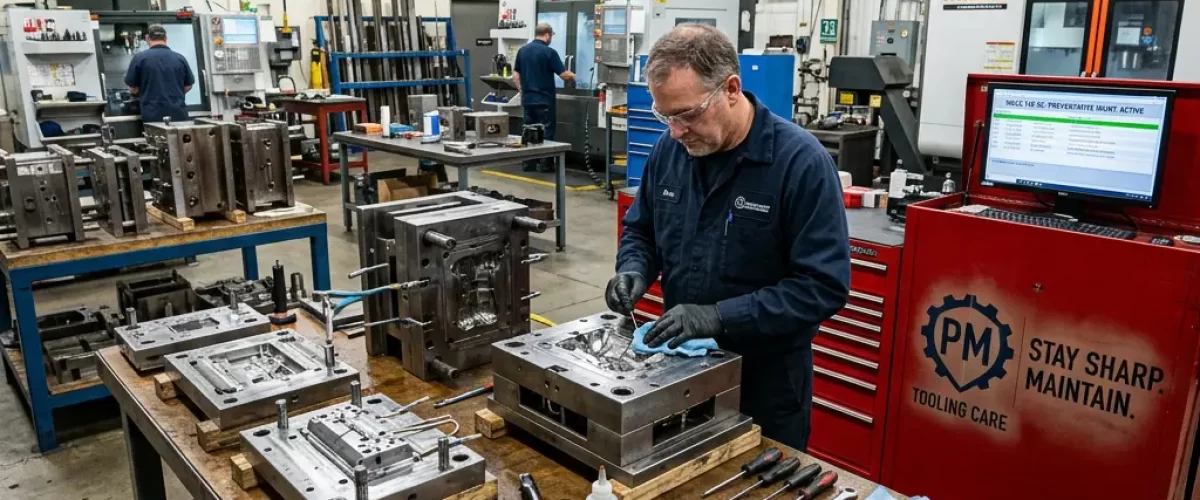
In theory, many things look possible. Practical application is a whole new ball game where things rarely play out to plan, the efficiency of your design notwithstanding. Similarly, corrective maintenance becomes necessary regardless of how efficiently you undertake preventive maintenance. The course of action during corrective maintenance is based on multiple factors.
When Corrective Action Becomes Necessary
In our previous article, we discussed how to avoid risk or damage to the mould. In case you missed this article, you can find it here: Mould Lifecycle Management (MLM)- Preventive Maintenance.
But then, there is a fatigue limit to everything, and issues do arise in the lifecycle of a product no matter how hard you try to prevent them.
What if a non-conformity is detected during a routine quality check of a plastic part? Or if the supplier delivers a mould with a blocked cavity? And what if during production, the situation suddenly worsens, forcing you to block multiple cavities, and your mould maintenance team requests you to buy a new mould?
As the mould owner, you are concerned about getting the mould back in production at the earliest possible. However, before making a hasty decision, you must assess if the mould requires replacement or refurbishment.
Options for Corrective Maintenance
You have a few choices to consider under corrective maintenance:
Repair
Repair is a corrective action that includes the repair of worn-out mould elements and the replacement of mould spares and consumables. It is generally suitable for minor interventions that restore the mould to functional condition without extensive rework.
Refurbishment
Refurbishment means taking the mould down for a major overhaul along with the replacement of its components and/or rework on mould steel to transform it into a production-ready state.
Replacement
Replacement involves building or deploying a new mould, especially when the existing mould is near the end of its service life or when the cost and downtime associated with repair or refurbishment are no longer viable.
Factors to Consider in Choosing the Corrective Path
Such a call can be tough and depends on several factors. We have devised a checklist you may refer to when deciding on the matter.
Structure Change / Future Production Needs
It is worth checking if you are expected to produce plastic parts from the mould in the future or if your customer is planning a new structure/product design change to replace the existing one. This will impact the course of action as it confirms the amount of time you would expect the mould to be in service.
- Repair: Recommended if the new structure/design change is expected within the next 2 years.
- Refurbish: Ideal if the change is expected after 3–4 years.
- Replace: Suggested if no new structure is expected for at least another 4 years or more.
Cost of Work
Cost is another important factor.
- Repair: Best suited for minor work that does not cost a substantial amount compared to the original mould cost.
- Refurbish: Recommended for intense work whose expenses can total up to 60% of the mould cost.
- Replace: Suggested if the repair or refurbishment cost exceeds 60% of the mould cost.
Mould Condition & Previous Refurbishments
Particularly the number of times the mould has already been refurbished.
- Repair: If the mould is relatively new and has less than 4MM shots.
- Refurbish: If the mould has run over 4MM shots and has been fully refurbished only once or never.
- Replace: If the mould has already been fully refurbished on two prior occasions.
Mould Change Parts
Refers to whether major mould parts have been replaced earlier.
- Repair: None of the major parts or components have been replaced earlier.
- Refurbish: Stacks (full cores and cavities) have been replaced along with other necessary changes.
- Replace: A completely new mould is built.
Mould Downtime
The duration for which the mould will be out of action also influences the decision.
- Repair: Can be conducted locally in your tool room, or by shipping components for rework.
- Refurbish: Takes the mould out of action for a significant duration (10–15 weeks), often requiring shipment back to the mould maker.
- Replace: Results in zero tool downtime if the new mould is immediately deployed for production.
After checking all five criteria, the path to follow will be clear.
Mould Qualification After Corrective Action
Based on the corrective action plan used, mould qualification varies and must be confirmed and approved by relevant stakeholders.
For a repeat mould, the qualification plan is similar to how a new mould is qualified. Refer to Mould Lifecycle Management (MLM)- Commissioning for more details.
In the case of refurbishment, full qualification may not always be required. If mould surfaces were reworked, validation must ensure plastic parts conform to specifications.
If plastic forming steel surfaces were not reworked, qualification may involve comparing aesthetic, dimensional, and functional aspects of the plastic component before and after refurbishment. The same approach may apply to certain repair cases, with inspection and stakeholder approval.
Best Practices for Managing Mould Refurbishment Projects
Corrective maintenance requires structured evaluation rather than reactive decision-making. Careful assessment of mould condition, production requirements, cost implications, downtime tolerance, and prior interventions ensures that decisions are technically sound and commercially viable.
Efficient delivers a unique and highly professional experience in managing mould refurbishment projects. To date, we have successfully managed countless moulds for our clients.
Conclusion: Making Informed Decisions for Corrective Maintenance
Even with strong preventive maintenance practices, corrective maintenance is sometimes unavoidable. The key lies in choosing wisely between repair, refurbishment, and replacement based on structured evaluation.
Making informed decisions ensures optimal lifecycle performance, controlled costs, minimal downtime, and sustained production efficiency.
FAQs
- What is corrective maintenance in mould lifecycle management?
Corrective maintenance refers to actions taken to restore a mould to functional condition after defects, wear, or failure are identified. It may involve repair, refurbishment, or full replacement, depending on the mould’s condition and future production requirements.
- Why does corrective maintenance become necessary even with good preventive maintenance?
Even with robust preventive maintenance, moulds have fatigue limits and natural wear over time. Unforeseen failures, production stresses, or quality non-conformities may still arise, making corrective intervention necessary to restore performance and maintain production continuity.
- How do you decide whether to repair, refurbish, or replace a mould during corrective maintenance?
The decision depends on production plans, mould condition, refurbishment history, cost comparison, and acceptable downtime. A structured evaluation of these criteria helps determine the most technically and commercially viable corrective path.
- What factors influence the choice between mould repair, refurbishment, and replacement?
Key factors include future product design changes, total cost of work, mould shot history, number of prior refurbishments, replacement of major components, and acceptable production downtime.
- How does mould condition and shot history affect corrective maintenance decisions?
Moulds with lower shot counts and minimal prior refurbishments are typically suitable for repair. High shot history or repeated refurbishments may indicate structural fatigue, making refurbishment or full replacement a more sustainable option.
- What role do cost considerations play in choosing corrective actions for a mould?
Cost is critical. Minor repairs are preferred when expenses are relatively low. If refurbishment approaches a significant percentage of the original mould cost, replacement may offer better long-term value and reduced risk.
- How much downtime is typically involved in mould refurbishment versus repair or replacement?
Repairs often involve minimal downtime and can be managed locally. Refurbishment may require 10–15 weeks if sent to the mould maker. Replacement can eliminate downtime if a new mould is ready for immediate deployment.
- What is involved in mould qualification after corrective maintenance?
Qualification depends on the scope of corrective work. It may include dimensional, aesthetic, and functional validation of plastic parts, along with stakeholder review and approval to confirm conformity with required specifications.
- When is re-qualification required after a mould refurbishment?
Re-qualification is required when forming steel surfaces or critical mould features are reworked. In such cases, validation ensures that plastic components meet defined quality and performance standards.
- How should stakeholders be involved in corrective maintenance decision-making?
Stakeholders should review mould condition, future production plans, cost implications, and downtime tolerance. Their alignment and approval ensure that corrective decisions are technically justified and commercially sound.