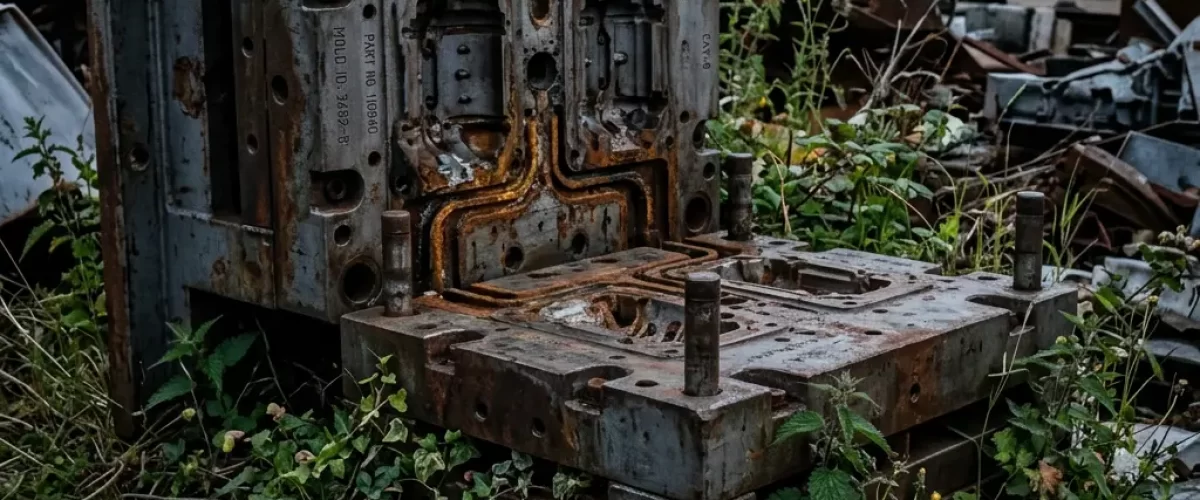
Much like outdated machinery, old moulds often linger in storage long after serving their purpose. Decommissioning them efficiently is becoming increasingly important, as they take up valuable space and incur unnecessary costs. A standardised decommissioning process aims to address this issue, ensuring that every step is handled with care and precision.
However, executing an effective decommissioning strategy can be complex due to the planning and coordination required. Despite these challenges, responsible mould decommissioning is essential for both the moulder and their business partners.
In our previous article titled “Part 4 – Is your Mould on the Right “Track”?”, we discussed how to track mould condition and implement strategies to it. This article covers the decommissioning of moulds and concludes our 5-part series on Mould Lifecycle Management (MLM).
Why Decommissioning Moulds Is Important
A mould, like another piece of machinery, has an end-of-life to it. It could be rendered obsolete due to several reasons.
In all such cases, the obsolete mould occupies space and incurs storage costs. Converters often find themselves lacking space to store moulds not in use. Hence, it is prudent to decommission these moulds safely and responsibly at the earliest.
Signs Your Mould Is Ready for Decommissioning
The mould life has elapsed: The mould has been used extensively, having undergone several maintenance and refurbishment activities. The elements of the mould have worn out to the extent that they must be replaced. Replacing all the worn-out elements would more or less amount to replacing all the mould elements.
Product relaunch or design change: A new product format has replaced the existing format produced from this mould; hence, the moulder has no volume demands from this mould.
Mould is no longer in use: The mould has been kept in storage for a very long duration.
Methods of Mould Decommissioning
Depending on the category and condition of the equipment, you can choose from different decommissioning methods.
Recycling or Cannibalising
Scavenge useful mould elements to use in a different mould. You can also scavenge useful elements of the cavity stack and use them in a copy mould with the same design.
A like-for-like replacement insert of a worn-out mould will not be always possible. Toolroom managers should assess the condition and usability of the insert before installing it in the copy mould.
Scrapping
Perhaps the easiest way to decommission the mould, scrapping entails selling it to a scrapyard agent, enabling the converter or OEM to recoup a small amount of money for the discarded metal. Depending on the volume of the mould steel to be scrapped, the recouped amount can be significant enough to perform maintenance of other active moulds.
Physical Destruction of Core and Cavity Inserts
If you have manufactured a mould to produce a proprietary plastic product for a client, the client often insists that the cores and cavities are damaged to an extent where they cannot be recovered at the end-of-life of the mould, thus maintaining the exclusivity of the client’s product design.
This mode of decommissioning requires you to generate a certificate of mould destruction and share it with your client. A third-party entity may also be involved to verify that the destruction has been done satisfactorily so that the mould cannot be used in whole or in part for its original purpose.
Step-by-Step Process for Decommissioning Moulds
The process for decommissioning the moulds should be as follows:
Confirm Remaining Mould Life
Check your quarterly/bi-annual mould tracking report to determine the current condition of the mould. You may refer to past tracking data from the time when the mould was last in production.
Connect with Stakeholders
Determine if the mould is ‘usable’ or ‘not usable’. If the mould is usable or if there are plans to use the mould again in the future, pack and store the mould at your storage facility or warehouse.
If the mould is not usable, connect with stakeholders and inform them about your plan to decommission the mould.
Plan Full Decommissioning
Create a network of the milestones – physical destruction of the core and cavities, collecting pictures, verification by a 3rd party auditor, generating a certificate of mould destruction, etc.
Physical Destruction
The physical destruction of the cavities can be done by: Welding torch & Angle grinder
Photograph and Document
Photograph the mould before the destruction, including the mould serial number. Then photograph each destroyed mould after the destruction, ensuring the serial number is visible.
Generate and Share Certificate
Generate a certificate of mould destruction using your company letterhead or that of the company destroying the mould.
Share the certificate of mould destruction with your client for record-keeping purposes.
Case Study / Series Reference: Mould Lifecycle Management (MLM)
With this, we have come to the end of our 5-part series on Mould Lifecycle Management (MLM). Throughout these five articles, we have delved into the planning and commissioning of the mould, preventive and corrective maintenance strategies, tracking mould performance, and the eventual decommissioning of the mould.
You can find the link to the articles here:
Mould Lifecycle Management: Part 1
Mould Lifecycle Management (MLM): Part 2
Mould Lifecycle Management (MLM): Part 3.1
Mould Lifecycle Management: Corrective Maintenance
Part 4 – Is your Mould on the Right “Track”?
Conclusion: Responsible Decommissioning for Cost Efficiency and Compliance
Old and obsolete moulds occupy valuable space and silently increase storage and operational costs. A structured, transparent, and well-documented decommissioning process ensures cost efficiency, compliance with client requirements, and protection of proprietary designs.
Efficient Innovations has been supporting its varied clients for over a decade, providing a single-stop solution for all their mould lifecycle management needs.
FAQs
- What is mould decommissioning in mould lifecycle management (MLM)?
Mould decommissioning is the structured process of safely retiring a mould at the end of its service life. It involves evaluation, stakeholder communication, physical disposition, and documentation to ensure cost efficiency, compliance, and protection of intellectual property.
- Why is mould decommissioning necessary at the end of a mould’s life?
At end-of-life, moulds may become inefficient, obsolete, or uneconomical to maintain. Decommissioning prevents unnecessary storage costs, frees valuable space, and ensures that outdated or unusable tooling does not create operational or compliance risks.
- When should a mould be decommissioned instead of refurbished or repaired?
A mould should be decommissioned when refurbishment costs approach full replacement, when critical components are extensively worn, or when there is no future production demand due to product redesign or discontinuation.
- What are the common reasons a mould becomes obsolete?
Common reasons include expired mould life, excessive wear after repeated maintenance cycles, product relaunch or design changes, and prolonged inactivity in storage without future production plans.
- What are the different methods used for mould decommissioning?
Decommissioning methods include recycling or cannibalising usable components, scrapping the mould for metal recovery, and physical destruction of cores and cavities to prevent reuse, particularly for proprietary products.
- How does physical destruction of cores and cavities protect product IP?
Physically damaging cores and cavities ensures that proprietary designs cannot be reproduced after end-of-life. This protects client intellectual property and prevents unauthorized manufacturing of exclusive product formats.
- What documentation is required during the mould decommissioning process?
Documentation typically includes mould tracking records, stakeholder communication, photographic evidence before and after destruction, and a formal certificate of mould destruction, sometimes verified by a third-party auditor.
- How should stakeholders be involved before decommissioning a mould?
Stakeholders should be informed and consulted to confirm whether the mould is usable, reusable, or permanently obsolete. Approval and alignment are essential, especially when client-owned or proprietary tooling is involved.
- Can parts of a decommissioned mould be reused or recycled?
Yes, usable components such as inserts or cavity stack elements may be cannibalised for other moulds, subject to condition assessment. Remaining steel can be scrapped and recycled, enabling partial cost recovery.
- How does proper mould decommissioning reduce storage and operational costs?
By removing obsolete moulds from storage, companies free up space, lower warehousing costs, and eliminate unnecessary tracking and maintenance. Additionally, scrap recovery can offset maintenance expenses for active moulds.