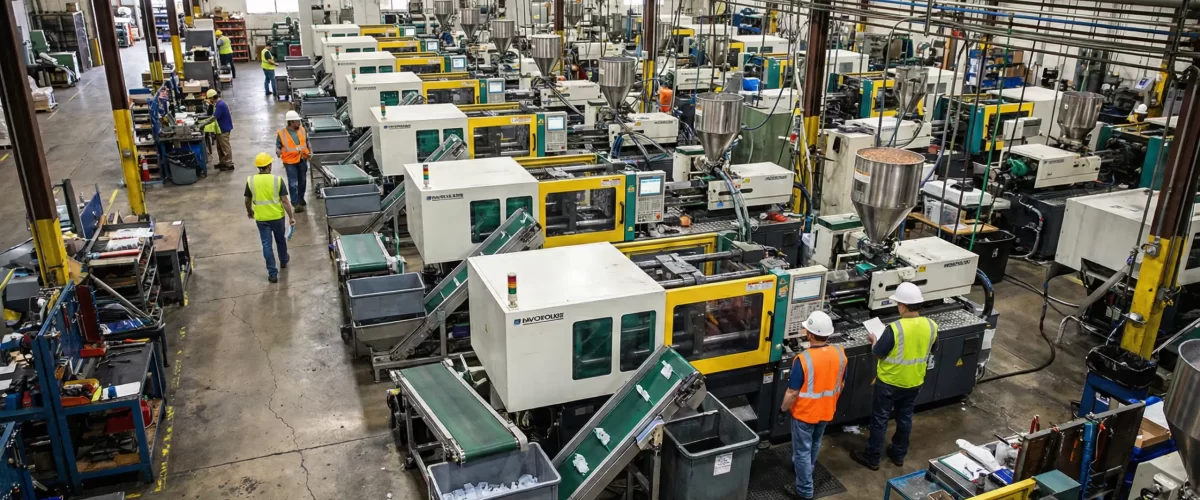
PCR is no longer an optional experiment; it’s becoming a procurement mandate, and more brands are moving towards PCR materials to meet their sustainability goals.
But here’s the catch: using PCR is not a simple “drop-in replacement.” It requires rethinking mould design, adapting process control, and tightening. Mould makers, suppliers, and OEMs are facing a new set of challenges in tooling and production!
Here’s what we’ve learned:
Why PCR Is No Longer Optional for Brands & Manufacturers
PCR is no longer an optional experiment; it’s becoming a procurement mandate, and more brands are moving towards PCR materials to meet their sustainability goals.
OEM pressures: Global brands are explicitly demanding PCR-compatible tooling as part of their sustainability scorecards.
Key Challenges When Moulding with PCR Materials
Material & Process Challenges
- Inconsistent MFI
Material inconsistency: Fluctuating MFI can lead to short shots, flash, or burn marks, especially in multi-cavity tools. - Shot-to-shot instability
Shot-to-shot inconsistency: Unstable melt flow affects product weight and performance; new IMM technologies can help address this. - Thermal degradation
Thermal Degradation: PCR is more prone to yellowing, brittleness, and poor weld lines under high heat and shear
Tooling & Equipment Challenges
- Tool wear
Impurities: Contaminants in PCR resins speed up tool wear, clog hot runners, and shorten life.
Accelerated HRS & Mould Wear: The abrasive nature of PCR materials can cause rapid wear and damage to HRS & mould components, leading to increased maintenance frequency and reduced tool life and cost.
- Hot runner damage
Impurities: Contaminants in PCR resins speed up tool wear, clog hot runners, and shorten life. - Metal contamination
Metal contamination: PCR resins can sometimes contain metal particles, posing a risk to hot runner systems. Nozzle filters and inline magnets are increasingly used to segregate metal particles. - Cooling non-uniformity
Cooling non-uniformity: Uneven cooling results in warpage and dimensional instability.
Aesthetic & Brand Challenges
- Colour shifts
Aesthetic variability: Colour shifts and surface defects are frequent, particularly in transparent packaging - Odour issues
Odour issues: Some PCR grades release unpleasant smells that clash with premium brand experiences. - Surface defects
Aesthetic variability: Colour shifts and surface defects are frequent, particularly in transparent packaging
Proven Design & Engineering Adaptations for PCR-Compatible Moulds
Through years of qualification and trials, EIPL has built a playbook of what works in PCR-compatible moulds:
Gate & Flow Optimisation
Gate optimisation: Larger or valve gates for better flow control
Steel Selection & Mould Coatings
Material choice for steel: Abrasion-resistant grades like H13 and P20+Ni extend mould life.
If the design allows, incorporate a gate insert into the mould to enable easy replacement in the event of wear.
Apply a coating to the inserts to enhance the mould life.
Venting, Filtration & Scientific Moulding Principles
Advanced venting: Tackles gases, odours, and burn marks.
Integrate nozzle filters and magnetic separators for cleaner melt flow
Scientific injection moulding: Utilise principles like fill balancing, V/P switchover, and controlled cooling.
Consider IMM technologies that enhance shot-to-shot consistency.
Process Adjustments: lower barrel temperatures, gentle screw temperature profiles, and reduced residence time help mitigate thermal degradation. Additives like UV/antioxidants during compounding further support stability.
Maintenance & Quality Control: Why PCR Tooling Needs Extra Discipline
PCR tooling isn’t “set-and-forget.” Proactive maintenance is key:
Testing Across Multiple Batches
Test across multiple PCR batches, not just a golden lot.
Adjust Cp/Cpk targets to reflect real-world material variability.
Tool Servicing & Predictive Maintenance
Increase tool servicing frequency, especially for hot runners and vents.
Maintain detailed tool performance logs for predictive maintenance.
At EIPL, we’ve seen that discipline in tool data management is what separates successful PCR programs from high-cost failures.
IMM Technologies That Deliver Consistent Results with PCR Resins
These technologies help ensure consistent quality when working with variable PCR resins:
- Arburg Allrounder
Arburg – Allrounder Series: Modular design with closed-loop control and cavity pressure sensor options for high repeatability. - ENGEL iQ Weight Control
ENGEL – iQ Weight Control: Automatically adjusts injection settings mid-cycle based on melt flow and part weight. - Krauss Maffei APC Plus
Krauss Maffei – APC Plus: Adapts in real-time to changes in material viscosity for stable shot-to-shot performance. - Sumitomo Smart Flow
Sumitomo – Smart Flow: Maintains consistent shot weight, even with fluctuating resin properties
A number of other IMM suppliers have respective technologies to tackle the PCR moulding and its challenges.
Building Future-Proof Tooling for a PCR-First World
The Road Ahead
Designing mould for PCR material is more than a sustainability checkbox; it’s about building future-proof tooling.
At EIPL, we’re helping partners hit their PCR targets and minimising the effect on performance, functionality or aesthetics of the components.
FAQ: Moulding with PCR Materials
- What is PCR material and how is it different from virgin plastic?
PCR (Post-Consumer Recycled) material is derived from recycled plastic waste. Unlike virgin plastic, it has variable properties due to prior use and processing. - What does PCR stand for in injection moulding?
PCR stands for Post-Consumer Recycled, referring to plastics recycled from consumer-used products. - Why are brands mandating the use of PCR materials in packaging?
Brands use PCR to meet sustainability goals, reduce carbon footprint, and comply with regulatory and environmental commitments. - Can PCR be used as a direct drop-in replacement for virgin resin?
No, PCR requires adjustments in mould design, processing conditions, and quality control due to variability. - Why does PCR cause short shots, flash, or burn marks in multi-cavity tools?
Fluctuating melt flow index (MFI) leads to inconsistent filling, causing defects like short shots, flash, and burn marks. - How do impurities in PCR resin affect hot runner systems?
Impurities can clog hot runners, increase wear, and reduce system efficiency, leading to maintenance issues. - What causes shot-to-shot inconsistency when moulding with PCR?
Variations in melt flow, viscosity, and material composition cause inconsistent shot weight and part quality. - How does PCR affect the surface finish and aesthetics of moulded parts?
PCR can cause colour variations, surface defects, and reduced clarity, especially in transparent applications. - What causes odour issues in PCR-based packaging and how can they be managed?
Residual contaminants cause odours. They can be managed using better material selection, additives, and processing controls. - How does metal contamination in PCR resins damage tooling?
Metal particles can damage hot runners and mould components, causing wear or blockages. - What is thermal degradation in PCR and how does it affect part quality?
PCR degrades faster under heat, leading to yellowing, brittleness, and poor weld lines. - What gate design changes are recommended for PCR-compatible moulds?
Larger gates or valve gates are recommended to improve flow control and reduce defects. - Which steel grades are best suited for moulds processing PCR materials?
Abrasion-resistant steels like H13 and P20+Ni are preferred for durability and extended tool life. - How does advanced venting help when moulding with PCR?
It removes trapped gases, reducing burn marks, odours, and surface defects. - What coatings can extend mould life when using PCR resins?
Protective coatings on inserts help reduce wear and improve mould longevity. - How do nozzle filters and magnetic separators protect hot runner systems?
They remove contaminants and metal particles, ensuring cleaner melt flow and protecting components. - What is scientific injection moulding and why is it important for PCR?
It uses controlled, data-driven parameters like fill balance and V/P switchover to ensure consistency with variable materials. - How should barrel temperature and screw profiles be adjusted for PCR?
Use lower temperatures, gentle screw profiles, and reduced residence time to prevent degradation. - How frequently should moulds be serviced when running PCR materials?
More frequently than virgin materials, especially for hot runners, vents, and wear-prone areas. - How do Cp/Cpk targets need to be adjusted for PCR material variability?
They should be slightly relaxed to reflect real-world variability while maintaining acceptable quality. - Which injection moulding machines are best suited for PCR processing?
Machines with closed-loop control and adaptive technologies perform best with variable PCR materials. - How does ENGEL iQ Weight Control help with PCR shot consistency?
It adjusts injection parameters in real-time to maintain consistent part weight despite material variability. - What does Krauss Maffei APC Plus do to handle viscosity changes in PCR?
It automatically adapts processing conditions to compensate for viscosity fluctuations. - How does PCR moulding support a brand’s sustainability scorecard?
It reduces reliance on virgin plastics and demonstrates commitment to circular economy goals. - What percentage of PCR content can typically be used without compromising part performance?
It varies by application, but typically ranges from 10% to 100%, depending on design, material quality, and performance requirements.