Key Takeaways
- IoT injection moulding is not just about sensors and dashboards. Discover how leading manufacturers are using connected moulds, real-time monitoring, and predictive analytics to improve uptime, quality stability, and production decision-making.
- Most smart manufacturing initiatives fail because systems remain disconnected. Learn why data integration, mould-level visibility, and phased implementation matter far more than simply deploying new technology.
- The future of mould engineering starts during design, not after production begins. Explore how EIPL approaches IoT-ready mould design and Mould Lifecycle Management (MLM) to build connected, scalable, and future-ready manufacturing programmes.
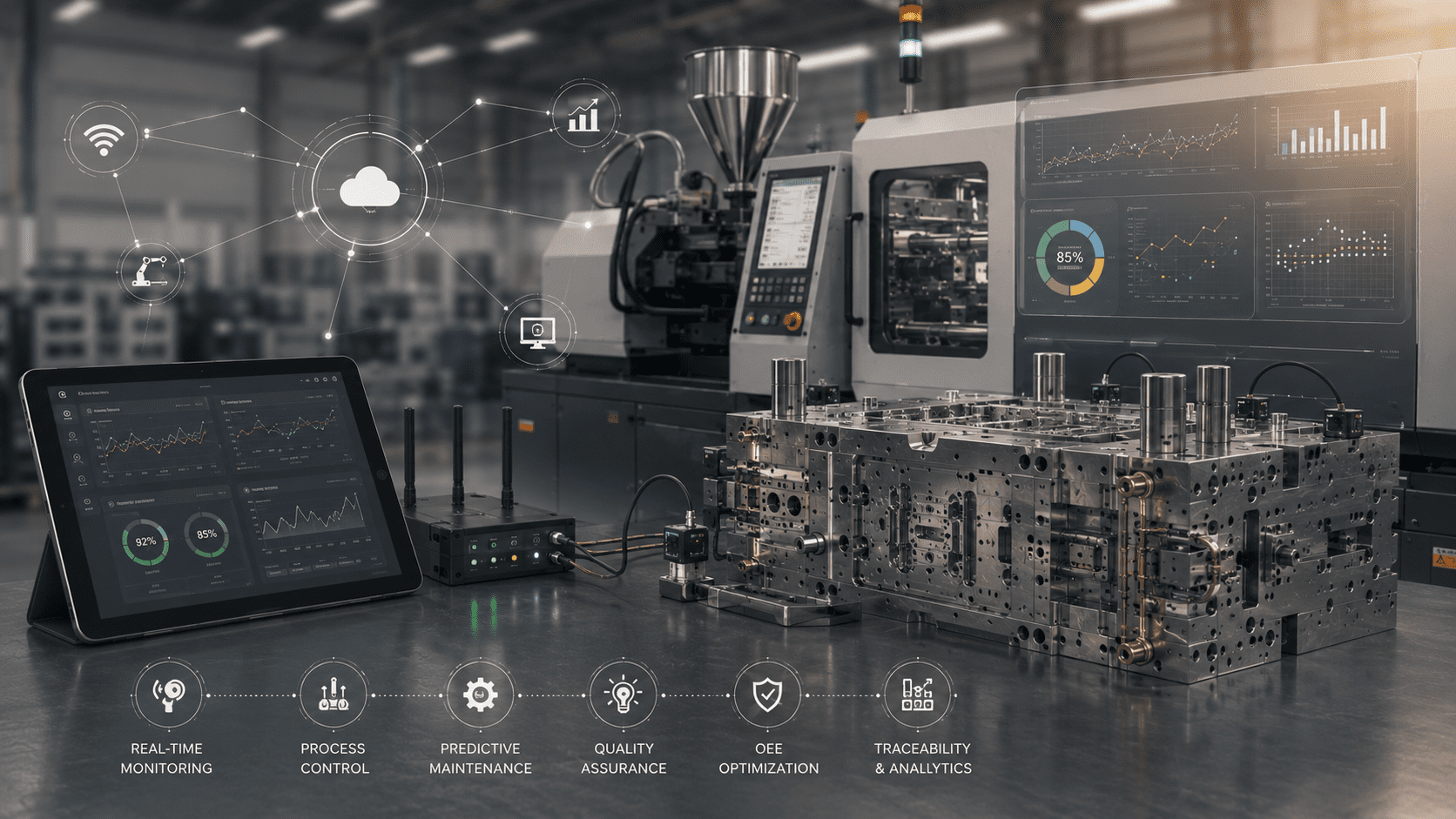
IoT injection moulding is transforming moulds from passive production tools into connected, data-generating assets capable of improving quality, uptime, maintenance planning, and overall manufacturing efficiency. But successful implementation is not about adding sensors everywhere, it requires a structured roadmap that connects machines, moulds, processes, and decision-making into a single intelligent production ecosystem.
In this guide, we explore how injection moulding facilities can practically implement IoT through phased deployment, predictive monitoring, data integration, and smart mould design. We also examine how EIPL integrates IoT readiness directly into mould engineering and Mould Lifecycle Management (MLM), enabling manufacturers to move beyond reactive operations toward connected, scalable, and data-driven production environments.
Implementing IoT in Your Injection Moulding Operation: A Practical Roadmap
Implementing IoT injection moulding is not a one-time technology upgrade. It is a phased transformation that moves operations from limited visibility and reactive troubleshooting toward connected, predictive, and data-driven manufacturing. Facilities that succeed typically follow a structured roadmap with clear priorities, measurable outcomes, and strong coordination between production, maintenance, tooling, and quality teams.
The goal is not to digitise everything immediately, but to build a reliable data foundation that improves decision-making, production stability, and mould lifecycle management over time.
1. Assess & Baseline: Understand Your Current Data Environment
Before deploying sensors or IoT platforms, manufacturers must first understand what operational data already exists and where the major visibility gaps remain. Many injection moulding facilities generate large volumes of machine and process data but struggle with disconnected systems, inconsistent records, or poor accessibility.
A proper baseline assessment should evaluate:
- Existing machine data such as cycle time, pressure, and temperature
- Sensors already installed on moulds, machines, or auxiliaries
- Manual logs, spreadsheets, and paper-based tracking still in use
- Data quality, consistency, and accessibility across departments
- Critical blind spots affecting downtime, quality, or maintenance decisions
The objective is to identify the highest-value information gaps rather than overcomplicate implementation from the start. In many facilities, a few missing measurements account for most operational uncertainty.
2. Start with High-Impact, Low-Complexity Applications
The most successful IoT injection moulding programmes begin with applications that deliver fast ROI without requiring major production disruption. Early wins help build organisational confidence and create support for broader digital transformation initiatives.
Common high-value starting points include:
- In-cavity pressure monitoring for direct visibility into part formation and process stability
- Machine-state monitoring for uptime, downtime, alarms, and cycle tracking
- Hot runner temperature monitoring to identify imbalance and heater failures early
- Basic OEE tracking to establish production performance baselines
These systems typically require moderate investment while delivering immediate improvements in quality consistency, downtime reduction, and process visibility.
3. Integrate Data Flows: Avoid Digital Silos
Collecting data alone does not create value. The real benefit of IoT injection moulding comes from integrating machine, mould, maintenance, and production data into a unified system that teams can analyse and act upon.
One of the most common implementation mistakes is deploying disconnected software and sensor platforms that cannot communicate with each other.
An effective IoT architecture should include:
- Centralised integration with MES, ERP, or dedicated IoT platforms
- Standardised data formats across machines and facilities
- Real-time dashboards for operations, maintenance, and management teams
- Historical data storage for trend analysis and compliance reporting
- Industrial cybersecurity and controlled user access
Integrated systems transform raw production signals into actionable operational intelligence across the entire manufacturing environment.
4. Build Predictive Capability: From Monitoring to Decision Support
Once reliable baseline data is established, manufacturers can shift from reactive monitoring toward predictive and prescriptive operations. This is where IoT injection moulding delivers its greatest long-term value.
Predictive applications typically include:
- Predictive maintenance scheduling based on mould wear and performance drift
- Statistical process control (SPC) using live production data
- Quality forecasting to detect defects before they occur
- End-of-life planning for tooling and equipment
- Capacity optimisation based on actual machine performance trends
As datasets mature, advanced analytics and machine learning models can begin recommending corrective actions automatically, reducing dependence on manual intervention and improving operational consistency.
Designing for IoT Readiness: The EIPL Perspective
The most cost-effective time to implement IoT capability is during mould design itself. Retrofitting sensors, wiring paths, and monitoring interfaces into existing tooling is often expensive, time-consuming, and disruptive to production.
At EIPL, IoT readiness is treated as a core part of modern mould engineering and mould lifecycle management. This includes:
- Provision for in-cavity sensors and monitoring ports
- Dedicated routing paths for wiring and connectors
- Compatibility with machine-level data systems
- Structural protection for sensors and electronic components
- Integration planning with the client’s digital manufacturing infrastructure
By designing moulds as connected assets from the beginning, manufacturers avoid costly retrofits and ensure long-term compatibility with future smart factory initiatives.
The Bottom Line
Implementing IoT in injection moulding is not about adding technology everywhere. It is about building structured visibility, integrating critical data flows, and gradually advancing toward predictive operations and smarter mould lifecycle management.
Facilities that follow a phased IoT roadmap achieve stronger process stability, faster troubleshooting, reduced downtime, improved quality control, and a smoother transition toward fully connected manufacturing operations.
IoT and EIPL’s Mould Lifecycle Management: The Technology Behind the Framework
EIPL’s Mould Lifecycle Management (MLM) framework was designed long before “smart manufacturing” became a buzzword, but at global scale it simply cannot function without IoT injection moulding infrastructure. Managing hundreds or thousands of tools across multiple plants, suppliers, and continents demands continuous visibility into condition, usage, maintenance status, and performance. Manual tracking breaks down quickly; connected data systems make disciplined lifecycle control possible.
EIPL’s MLM approach spans the entire life of the mould, not just its production phase. IoT acts as the connective tissue that keeps each stage informed by real operating data rather than assumptions or delayed reports.
- Planning & Design Phase
IoT readiness is built into the tooling architecture from the start. Sensor provisions, data interfaces, and monitoring access points are considered alongside mechanical design so the mould can participate in the client’s digital ecosystem from day one. - Commissioning & Qualification
Connected data enables faster validation by capturing real process signatures during trials. Instead of relying solely on sample inspection, engineers can confirm stability through pressure traces, temperature profiles, and cycle consistency. - Preventive Maintenance Programmes
Traditional time-based PM schedules are enhanced by real usage data. Shot counts, temperature exposure, and operating conditions inform when service is actually needed, reducing both under-maintenance and unnecessary downtime. - Condition Tracking & Health Scoring
Continuous data feeds support EIPL’s mould condition tracking methodology, including health scoring, utilisation monitoring, and early warning of deterioration trends that would otherwise remain invisible. - Physical Audits & Performance Reviews
IoT data provides context for on-site inspections. Auditors arrive with a history of anomalies, trends, and usage patterns, allowing targeted assessments rather than broad, time-consuming checks.
Without connected machines, sensors, and centralised data platforms, coordinating these activities across a global portfolio would rely on fragmented spreadsheets, delayed updates, and subjective reporting. IoT transforms MLM from an administrative exercise into a real-time asset management system.
Importantly, IoT is not a standalone product or optional add-on in EIPL’s approach. It is the enabling infrastructure that allows the framework to scale reliably across different regions, facilities, and supplier networks while maintaining consistent standards.
EIPL’s design philosophy reflects this reality. Every mould is engineered not only as a precision manufacturing tool but also as a data-generating asset capable of integrating into the client’s connected factory environment. In a modern production ecosystem, the most valuable mould is not just the one that makes good parts. It is the one that communicates its condition, performance, and risks before problems occur.
Conclusion: The Smart Factory Starts with a Smart Mould
IoT injection moulding delivers value not because the technology is advanced, but because it enables better decisions at every stage of production. With real-time data and connected systems, manufacturers can time maintenance accurately, detect defects before they propagate, reduce unplanned downtime, accelerate new product qualification, and respond to supply chain changes with confidence. The result is not just smarter machines, but a more resilient and efficient operation.
As a mould design and Mould Lifecycle Management partner, EIPL integrates IoT readiness directly into the tooling architecture. Sensors, data access points, and monitoring capability are considered during design, not retrofitted later. This approach ensures every mould can function as an intelligent node within a connected factory, supporting long-term performance, traceability, and scalability.
If you are developing new tooling or reassessing your smart manufacturing strategy and want a mould partner who designs for the connected factory from day one, EIPL’s team is ready to help.
Contact EIPL to discuss IoT-ready mould design, request a technical consultation, or evaluate your current tooling for smart manufacturing compatibility.
Frequently Asked Questions
Can IoT sensors be built into injection mould designs?
Yes. Modern moulds can include provisions for in-cavity pressure sensors, temperature probes, and monitoring ports. Designing for sensors from the outset is more reliable and cost-effective than retrofitting later.
What is OEE and how does IoT improve it in injection moulding?
OEE (Overall Equipment Effectiveness) measures availability, performance, and quality. IoT improves OEE by reducing downtime, stabilising cycle times, and lowering defect rates through real-time monitoring and automation.
What injection moulding machines support IoT and adaptive control?
Many modern platforms support IoT, including systems from ENGEL, Arburg, KraussMaffei, and Sumitomo. These machines integrate sensors, connectivity, and adaptive control algorithms for data-driven operation.
How does IoT in injection moulding support remote production facilities?
Cloud-connected dashboards allow engineers and managers to monitor production, machine health, and quality metrics from anywhere. Remote diagnostics and alerts enable faster response without requiring on-site presence.
How do I start implementing IoT in an injection moulding facility?
Begin by auditing existing data capabilities, then deploy high-impact sensors such as cavity pressure or machine-state monitoring. Integrate data into a central platform, ensure data quality, and gradually build predictive and automated capabilities.