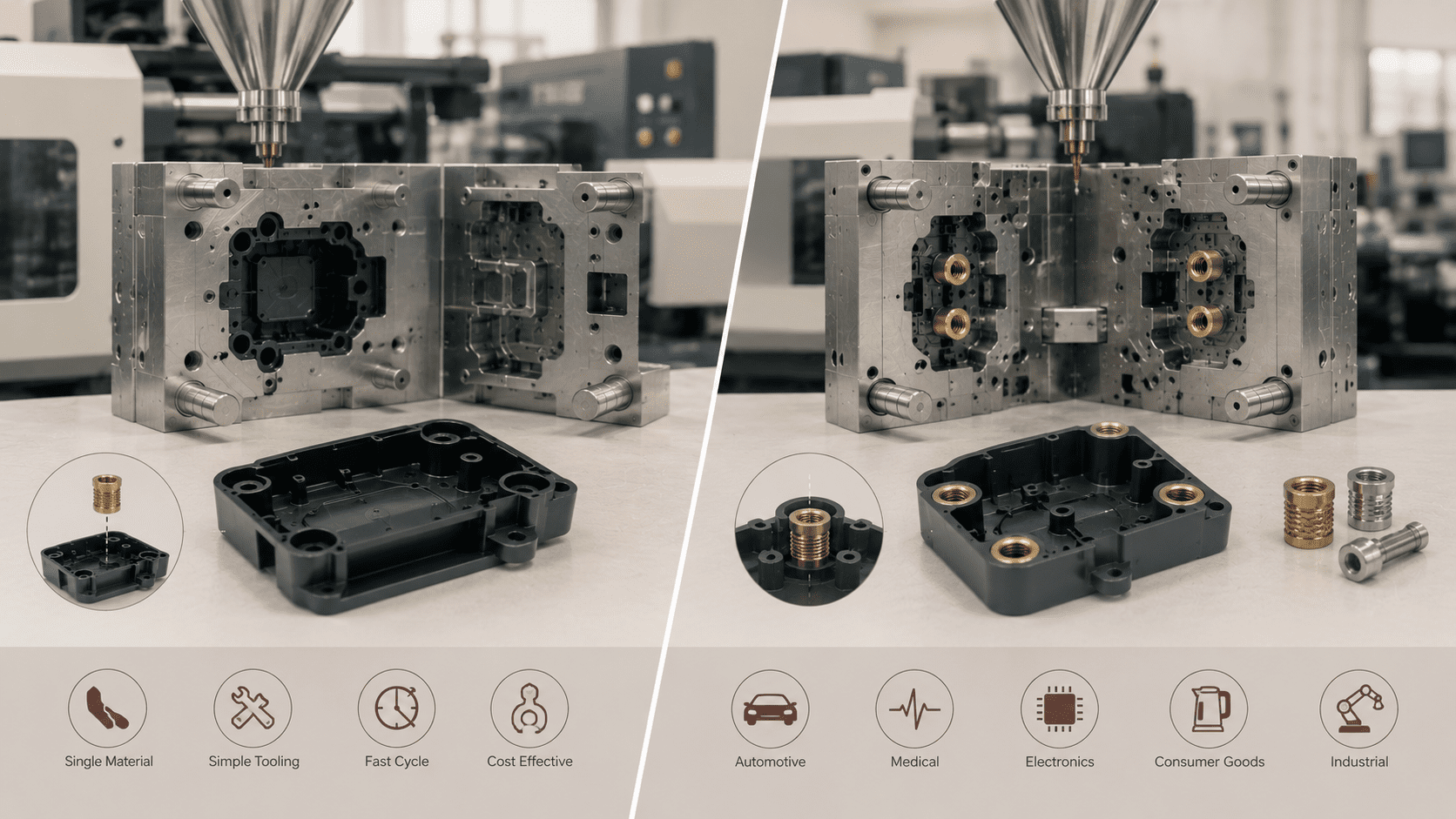
Key Takeaways
- Successful insert moulding begins long before tooling is built. Discover the design decisions around insert placement, retention, wall thickness, and mould architecture that quietly determine whether a programme scales smoothly or struggles later.
- Not every application should use insert moulding. Learn the practical engineering framework EIPL uses to evaluate strength requirements, assembly reduction, production volume, and long-term manufacturing economics before selecting a process.
- High-performance insert moulding programmes are engineered as complete systems, not isolated parts. Explore how DFM, tooling, automation, validation, and mould lifecycle management all connect to achieve reliable production at scale.
Insert moulding improves thread strength, assembly reliability, dimensional accuracy, and long-term product performance by integrating metal and plastic into a single component. But achieving these benefits depends heavily on early design decisions.
Factors such as insert placement, retention geometry, wall thickness, mould accessibility, and loading strategy directly affect manufacturability, tooling complexity, and production stability. Poor decisions at the design stage often lead to qualification delays, cosmetic defects, or expensive tool modifications later.
In this guide, EIPL’s engineers share practical insert moulding design guidelines, common DFM mistakes, and a decision framework to help manufacturers evaluate when insert moulding is the right choice over traditional injection moulding. We also explore EIPL’s capabilities across tooling, automation, validation, and mould lifecycle management for high-performance insert moulding programmes.
Insert Moulding Design Guidelines: What EIPL’s Engineers Recommend
The design rules for traditional injection moulded parts such as draft, constant wall thickness, and minimum wall sections apply to insert moulded parts without exception. In addition, insert moulding introduces five specific considerations that require attention at the design stage. These recommendations come from EIPL’s experience designing and qualifying insert moulding tooling across automotive, medical, electronics, and consumer applications.
Insert Placement: Accessibility, Depth & Location
Insert location is not just a product design decision. It drives the entire tooling architecture. Poor placement can make a part impossible to mould efficiently or reliably.
EIPL’s practical placement rules:
- Accessible loading direction: The insert must be reachable from the mould parting line or a defined insertion axis, whether manual or robotic.
- Edge distance control: Maintain adequate distance between the insert and part edges to prevent weld line weakness, sink marks, and cracking.
- Symmetrical layout: When multiple inserts are used, position them symmetrically to balance flow, pressure, and thermal effects during filling.
EIPL recommendation: Finalise insert locations early. They influence parting line selection, gate placement, and cooling channel routing.
Insert Retention: Undercuts, Knurling & Mechanical Locking Features
Retention strength must be engineered, not assumed. The polymer must mechanically lock the insert in place under service loads, vibration, and thermal cycling.
Common retention strategies include:
- Knurled outer diameter (most common): Allows molten polymer to flow into the pattern, creating a strong mechanical bond
- Annular grooves: Provide axial resistance against pull-out forces
- Undercuts or flats: Used for non-cylindrical inserts to prevent rotation
- Polymer compression zones: Designed wall geometry that grips the insert after cooling
EIPL guidance: Retention features should be selected based on calculated load cases including torque, pull-out force, fatigue, and temperature exposure.
Wall Thickness Around Inserts: Minimum Requirements & Sink Mark Prevention
Metal inserts conduct heat far more efficiently than polymers. This creates localized cooling gradients that can lead to sink marks, voids, or stress concentration if insufficient plastic surrounds the insert.
EIPL’s minimum guidance:
- Polymer wall thickness around a cylindrical insert should be at least 75% of the insert outer diameter
- Ideally, wall thickness equals the insert OD for structural parts
- Thicker sections increase cooling time and cycle duration, which must be considered in production planning
Proper wall design ensures structural integrity, dimensional stability, and cosmetic quality.
Mould Design Considerations: Insert-Holding Features & Tooling Implications
Insert moulding requires the mould itself to actively position and secure the insert during injection. These features add complexity but are essential for consistent results.
Key tooling considerations:
- Precision locating pockets or bosses matching insert geometry
- Holding features strong enough to resist injection pressure without deforming the insert
- Protection against insert tilt, float, or displacement during filling
- Optional robotic loading systems for high-volume or multi-cavity tools
EIPL recommendation: Engage the toolmaker during insert selection and part design. Retrofitting insert-holding features after design freeze often leads to costly tool changes.
Common Design Errors in Insert Moulding — and How to Avoid Them
Across DFM reviews, EIPL repeatedly encounters the same preventable mistakes. Addressing them early can save significant time and tooling cost.
Most frequent issues include:
- Inaccessible insert location
Leads to impractical tooling or manual placement every cycle, increasing cost and variability. - Insufficient polymer around the insert
Causes sink marks, stress cracking, and potential pull-out under load. - Over-specifying stainless steel inserts
Stainless steel adds machining cost and cycle penalties when brass would meet performance requirements. - Design finalised before tooling consultation
Often results in expensive rework during mould qualification due to manufacturability issues.
EIPL framing: These four problems account for a large proportion of insert moulding redesign work encountered during early programme audits.
Well-engineered insert moulding designs do not treat the insert as an add-on component. They treat it as an integral structural element whose placement, retention, and surrounding polymer geometry are co-designed with the mould itself.
Which Process Is Right for Your Application? A Decision Framework
Neither process is universally superior. The correct choice depends on your product’s performance requirements, production scale, assembly strategy, and cost targets. The framework below reflects how EIPL engineers evaluate programmes during Design for Manufacturability (DFM) reviews.
1. Thread and Mechanical Strength Requirements
If your application demands fastening strength comparable to metal, especially under repeated torque, vibration, or thermal cycling, insert moulding is typically the default choice.
- Plastic threads degrade over time through wear or creep
- Metal inserts maintain dimensional integrity and load capacity
- Critical applications such as automotive interiors, medical devices, and structural housings almost always require inserts
Use traditional moulding only when loads are low and service life requirements are modest.
2. Assembly Count and Integration Needs
Every additional component and assembly step introduces cost, time, and failure risk. Insert moulding integrates components into a single finished part.
- Traditional approach: mould part → insert installation → inspection
- Insert moulding approach: finished assembly produced in one cycle
- Fewer steps mean fewer alignment errors, reduced labour, and lower scrap
If your current design requires two or more components plus assembly, insert moulding deserves serious evaluation.
3. Production Volume
Volume is one of the strongest economic drivers in process selection.
- Low volume (typically below ~5,000 parts/year): Post-moulding insert installation or secondary operations may be more cost-effective
- Medium to high volume: In-mould inserts usually deliver lower per-part cost by eliminating assembly labour and improving consistency
- Automation further strengthens the economics at scale
Tooling investment must be evaluated against total lifecycle production.
4. Part Complexity and Structural Integration
When the metal element serves as a structural component, not just a functional feature, insert moulding often provides superior performance.
- Enables hybrid structures combining metal stiffness with polymer geometry
- Improves load distribution between materials
- Eliminates weak interfaces created by post-assembly
If the metal component contributes to strength, alignment, or structural stability, insert moulding is often the enabling technology.
5. Supply Chain Simplicity and BOM Reduction
Insert moulding consolidates manufacturing steps and suppliers.
- Traditional process may require multiple vendors or internal operations
- Insert moulding delivers a single finished component
- Reduced inventory management and logistics complexity
- Lower risk of assembly bottlenecks
For programmes seeking lean manufacturing and simplified sourcing, this consolidation can be a decisive advantage.
6. Weight Sensitivity and Lightweighting Goals
Many industries are aggressively reducing product weight without sacrificing performance.
- Insert moulding replaces all-metal assemblies with hybrid metal-plastic parts
- Significant mass reduction compared to machined metal components
- Supports fuel efficiency targets, portability, and ergonomic improvements
- Can reduce material usage and machining waste
This is particularly valuable in automotive, aerospace, consumer electronics, and medical devices.
If you are uncertain which process best serves your application, EIPL’s engineering team offers DFM reviews for both traditional injection moulding and insert moulding programmes. Early evaluation prevents costly tooling changes later and ensures the chosen process aligns with performance, cost, and lifecycle requirements.
EIPL’s Insert Moulding Capability: Design, Tooling & Production
At EIPL, we support insert moulding programmes across automotive, medical, electronics, and consumer goods sectors, where performance, reliability, and repeatability are non-negotiable. Our experience spans threaded metal inserts, structural reinforcement components, electronic contacts, shielding elements, and hybrid assemblies that combine multiple materials in a single moulded part.
We process a wide range of insert materials and geometries, including brass, stainless steel, aluminium, engineered composites, and precision electronic components. Depending on production volume and complexity, inserts can be loaded manually, semi-automatically, or through fully robotic systems integrated into the mould cell. Our teams also qualify compatible polymer materials, from commodity resins to high-performance engineering plastics, ensuring strong bonding and long-term durability.
At EIPL, we treat insert selection as part of the DFM process, not a decision made after the mould is built. Insert location, retention features, material compatibility, gate placement, cooling layout, and loading method are all engineered together to avoid late-stage redesigns and costly tooling modifications. This integrated approach ensures that the final tool is optimised for manufacturability, cycle time, and part quality from day one.
Our capabilities extend beyond tool design to full lifecycle support. We manage programmes from early feasibility studies through tooling design, manufacture, qualification trials, and production ramp-up. Where required, we also support automation integration, process development, and validation for regulated industries.
Insert-moulded tools are incorporated into EIPL’s Mould Lifecycle Management (MLM) framework in the same way as standard injection moulds. This includes preventive maintenance planning, condition tracking, refurbishment management, and physical audits to ensure consistent performance throughout the tool’s operational life.
The result is a single accountable partner who understands both the mechanical integration challenges of insert moulding and the long-term operational demands of high-volume production.
Conclusion: The Right Process Is the One That Serves the Part
Traditional injection moulding and insert moulding are not competing philosophies. They are complementary tools in an engineer’s process selection toolkit. The optimal choice depends on what the part must achieve in service, not on habit or precedent.
Three decision signals matter most. First, the mechanical requirement. If the application demands metal-level thread strength, wear resistance, or load capacity, insert moulding is often the enabling solution. Second, the assembly strategy. When a conventional approach requires multiple components and secondary operations, integrating inserts during moulding can dramatically reduce complexity, variability, and long-term cost. Third, the volume threshold. At lower volumes, post-moulding assembly may remain economical, but at medium to high volumes, insert moulding typically delivers superior per-part economics and supply chain simplicity.
Ultimately, the right process is the one that aligns mechanical performance, manufacturing efficiency, and business objectives in a single solution.
If you are working through a process decision for a new programme, EIPL’s engineering team is ready to review your design and recommend the most cost-effective path to qualification.
Frequently Asked Questions
What are the design guidelines for insert moulding?
Key guidelines include ensuring insert accessibility for loading, providing mechanical retention features (knurls or grooves), maintaining sufficient wall thickness around the insert, balancing insert placement, and designing the mould with precise locating features.
How does insert moulding improve part reliability?
It removes manual assembly steps that introduce misalignment, loosening, or variability. Inserts are positioned by the mould itself and locked in place by the polymer, resulting in consistent geometry, stronger joints, and better performance under vibration and thermal stress.
What industries use insert moulding most commonly?
Automotive, medical devices, electronics, and consumer goods frequently rely on insert moulding. Applications include sensor housings, surgical instruments, connector bodies, EMI shielding components, and durable consumer product handles.
Can I retrofit inserts into existing injection moulded parts instead of using insert moulding?
Yes, through methods such as press-fitting, heat staking, or ultrasonic insertion. However, these add cost, time, and potential failure modes. Insert moulding generally provides superior alignment, retention strength, and long-term reliability.
What are the most common design mistakes in insert moulding?
Typical errors include insufficient wall thickness around inserts, poor retention feature design, inaccessible insert locations, unnecessary use of expensive materials like stainless steel, and finalising part geometry without consulting the toolmaker early in the design process.