Key Takeaways
- From hidden data to real-time decisions: Discover how connected machines, sensors, and analytics are quietly reshaping injection moulding performance behind the scenes.
- Where the real ROI comes from: Learn why smart manufacturing is less about gadgets and more about uptime, quality stability, and operational control across the entire production ecosystem.
- What “IoT-ready” actually means for tooling: Get a preview of how forward-thinking mould design is evolving to function as part of a connected factory, not just a standalone production asset.
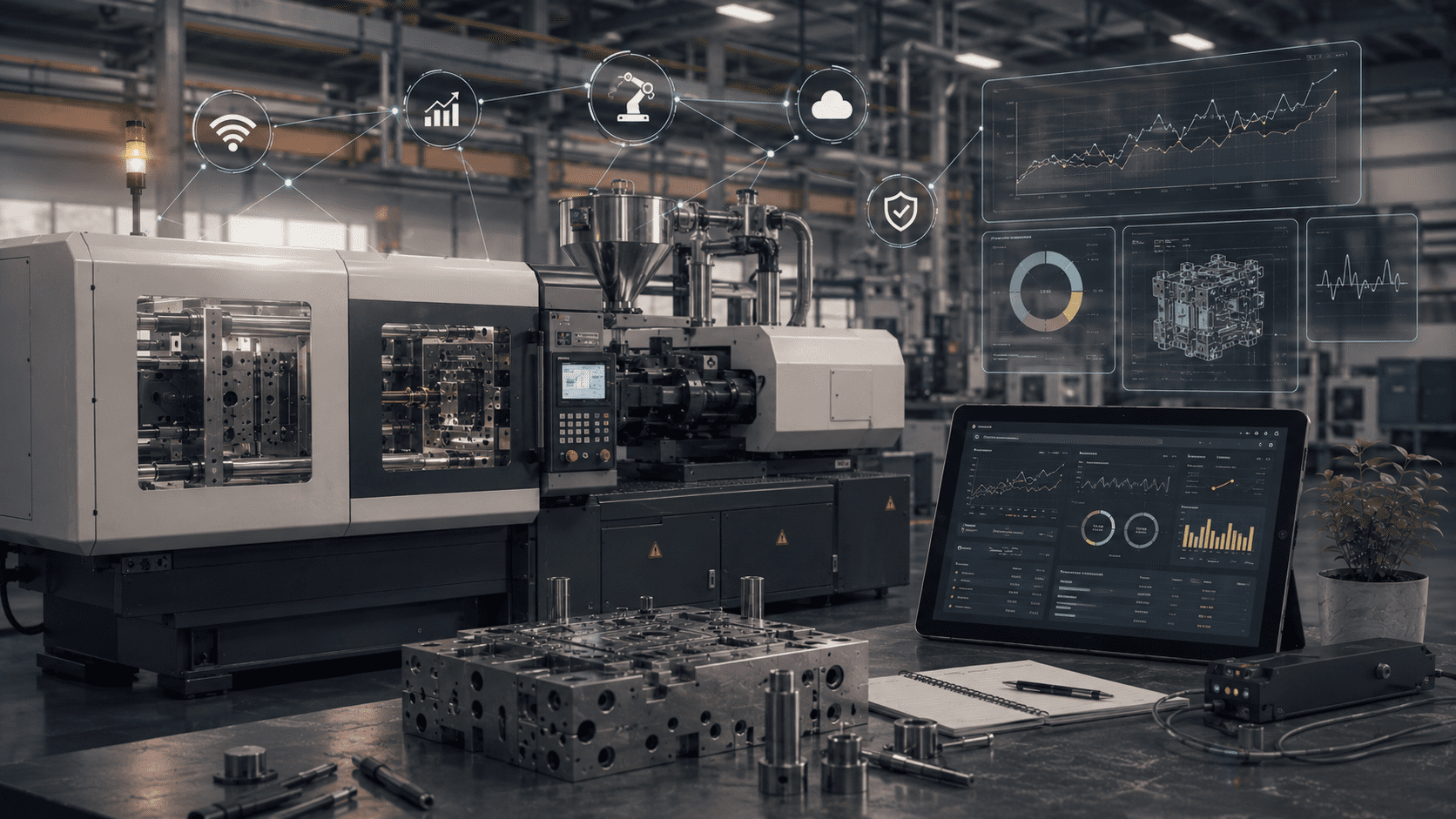
Injection moulding generates enormous amounts of production data. Every cycle produces information, from cavity pressure and melt temperature to cooling performance and cycle variation. Historically, much of this data was either not captured or reviewed too late to influence production outcomes. IoT injection moulding changes that by enabling real-time monitoring and decision-making across the moulding process.
In injection moulding, IoT refers to connected machines, moulds, sensors, and software systems that continuously exchange production data. This allows manufacturers to detect process deviations earlier, improve quality consistency, reduce downtime, and optimise machine and tool performance.
As smart manufacturing injection moulding continues to evolve, manufacturers are moving toward more connected, data-driven production environments. At EIPL, IoT readiness is approached from both the tooling and lifecycle management perspective, ensuring moulds are designed to support long-term digital manufacturing requirements.
This article explores how IoT is transforming injection moulding operations, the technologies enabling Industry 4.0 integration, and how EIPL designs tooling systems for connected manufacturing environments.
Industry 4.0 and Injection Moulding: Understanding the Transformation
Industry 4.0 is the integration of digital technology into physical manufacturing. It is not a single platform or machine upgrade, but a manufacturing approach built around connectivity, automation, and real-time production intelligence.
In injection moulding, Industry 4.0 injection moulding appears through connected machines, injection moulding sensors, closed-loop control systems, and digital production records that replace fragmented manual tracking.
On the shop floor, this enables:
- Machines that continuously share production data
- Sensors that monitor pressure, temperature, vibration, and tool performance
- Systems that automatically adjust process parameters to maintain stability
- Real-time quality and maintenance visibility across production lines
The operational impact is significant. Traditional moulding environments often rely on reactive troubleshooting after defects appear. In a connected factory injection moulding setup, deviations can be identified and corrected before they affect quality, uptime, or tool life.
This is especially important in high-volume programmes where consistency, traceability, and preventive maintenance directly affect total cost of ownership.
From a tooling perspective, the mould becomes part of the digital manufacturing infrastructure. Thermal control strategy, sensor integration, cavity balance, and maintenance accessibility all influence how effectively a mould performs within a smart manufacturing system.
At EIPL, this integration between tooling and digital production is built into the engineering process. As a mould maker and MLM partner, EIPL designs tooling systems that support lifecycle visibility, process monitoring, and long-term production stability.
This foundation enables the next stage of transformation, where IoT technologies actively improve efficiency, maintenance planning, and process control across injection moulding operations.
Six Ways IoT Is Transforming Injection Moulding Operations
IoT in injection moulding is not a single technology. It is a layered system of sensing, connectivity, data processing, and decision-making. When implemented correctly, these layers transform moulding from a reactive, experience-driven activity into a measurable, self-optimising production system.
Real-Time Process Visibility Through Advanced Sensors: Machine Data, In-Cavity Pressure & Hot Runner Monitoring
Modern moulding cells rely on a network of sensors that capture both machine performance and what is actually happening inside the mould. This dual visibility is essential because machine settings alone cannot guarantee part quality.
Key sensing layers include:
- Machine-mounted sensors: Monitor barrel temperature, injection pressure, screw position, cycle time, and clamp force
- In-cavity pressure sensors: Measure real polymer behaviour during fill and pack phases, revealing imbalance, blockage, or wear
- Hot runner temperature sensors: Track each zone and nozzle independently to detect deviations early
- Environmental sensors: Capture ambient conditions that influence material behaviour
The critical insight: machine data reflects intended conditions, while cavity data reflects actual conditions. EIPL tooling can be designed with built-in provisions for these sensors, enabling seamless integration into IoT-enabled production environments.
Intelligent Process Control: From Manual Adjustments to Self-Optimising Closed-Loop Systems
Traditional moulding relies heavily on operator experience to maintain stability. IoT transforms this into a data-driven control system that continuously adapts to changing conditions.
Two complementary control layers operate simultaneously:
Micro-level (in-cycle control)
- Real-time adjustments to injection speed, pressure, or packing
- Compensation for material variation, temperature drift, or machine fluctuations
- Reduced reliance on manual intervention
Macro-level (trend-based optimisation)
- Analysis across batches to identify process drift
- Detection of cavity imbalance or gradual equipment degradation
- Continuous improvement of validated process windows
For EIPL clients, these insights feed directly into mould lifecycle management strategies, ensuring that process behaviour informs maintenance and refurbishment planning.
Predictive Maintenance Using IoT Data: Preventing Failures Before They Occur
Predictive maintenance uses continuous performance data to identify early warning signs of component wear or impending failure. Instead of reacting to breakdowns or following rigid schedules, maintenance becomes condition-based and optimally timed.
Typical predictive indicators include:
- Gradual increases in vibration signatures
- Temperature drift in cooling circuits or hot runners
- Changes in injection pressure profiles
- Rising actuation force for slides or valve pins
- Cycle time instability
Benefits of predictive maintenance:
- Prevents catastrophic tool damage
- Minimises unplanned downtime
- Extends component life without unnecessary servicing
- Aligns maintenance with actual tool condition
Within EIPL’s lifecycle management framework, predictive maintenance represents the advanced evolution of traditional preventive maintenance programmes.
Real-Time Quality Assurance: Ensuring Repeatability and Detecting Defects During Production
IoT enables quality control to move upstream into the production process itself. Instead of waiting for inspection results, manufacturers can verify part quality during each cycle using process signatures.
Core quality assurance capabilities include:
- Cycle-by-cycle process fingerprinting based on pressure, temperature, and timing
- Automatic comparison to validated process windows
- Immediate detection of deviations that may produce defective parts
- Automated segregation or rejection of suspect components
- Comprehensive traceability records for regulated industries
In-cavity pressure monitoring is particularly powerful because it correlates directly with part formation. A stable pressure curve typically indicates consistent part quality, making it a reliable real-time acceptance criterion.
Remote Production Monitoring & Smart Dashboards: Full Plant Visibility From Anywhere
Connected moulding systems transmit operational data to centralised platforms, enabling stakeholders to monitor production in real time regardless of location. This is especially valuable for organisations managing multiple plants or global supply chains.
A typical smart dashboard provides:
- Overall Equipment Effectiveness (OEE) metrics
- Real-time production status and output rates
- Cycle time trends and anomalies
- Cavity-by-cavity performance data
- Active alarms and fault notifications
- Maintenance countdown indicators
- Energy consumption insights
Remote visibility allows faster decision-making, coordinated troubleshooting, and proactive management of distributed manufacturing networks. EIPL leverages these capabilities to support global mould programmes across facilities and continents.
Digital Twins & Virtual Commissioning: Validating Moulds and Processes Before Physical Production
Digital twin technology creates a dynamic virtual replica of a mould, machine, or production system that evolves using real operational data. This allows manufacturers to test scenarios, optimise parameters, and predict outcomes without interrupting physical production.
Key applications of digital twins in injection moulding:
- Virtual commissioning: Simulating production before installing the mould
- Process window development: Identifying optimal settings with minimal physical trials
- Performance prediction: Forecasting behaviour under different materials or conditions
- Wear modelling: Anticipating component degradation and replacement needs
- Training environments: Allowing operators to practice without risk
EIPL incorporates simulation-driven design and digital-twin readiness into tooling development, reducing qualification time while improving long-term reliability and adaptability.
Together, these six domains demonstrate that IoT injection moulding is not about isolated technologies. It is about building an intelligent manufacturing ecosystem where machines, moulds, and data work together to deliver consistent quality, higher efficiency, and resilient operations.
The Business Case for IoT in Injection Moulding: ROI Across the Production Ecosystem
For many manufacturers, the decision to invest in IoT injection moulding is not driven by technology curiosity but by measurable business impact. Plant managers, operations leaders, and procurement teams need to justify capital expenditure with clear returns across uptime, quality, cost, and delivery performance. When implemented effectively, IoT delivers value across the entire production ecosystem, not just the moulding machine.
1. Reduced Unplanned Downtime: Eliminating the Costliest Disruption
Unplanned downtime is typically the single most expensive failure mode in injection moulding operations. A stopped line does not only halt output; it disrupts labour utilisation, upstream material flow, downstream assembly, and customer delivery commitments.
IoT-enabled predictive maintenance reduces these risks by identifying failure signatures before breakdown occurs.
Key benefits include:
- Early detection of wear in screws, barrels, hot runners, and mechanical components
- Planned maintenance windows instead of emergency shutdowns
- Reduced overtime, expedited shipping, and penalty costs
- Improved equipment availability across the fleet
Industry observations suggest predictive maintenance can reduce unplanned downtime by 30–50% in mature implementations (figure subject to client verification).
2. Lower Scrap and Rework Costs: Quality Assurance During Production
Scrap is not just wasted material. It also consumes machine time, labour, energy, and often triggers additional inspection and sorting activities. Traditional quality control detects defects after production, when recovery options are limited.
IoT shifts quality control into the process itself.
Quality-related ROI drivers include:
- Real-time detection of process deviations before parts go out of specification
- Immediate correction of parameters to prevent defect propagation
- Reduction in end-of-line rejection rates
- Less need for manual inspection and rework operations
- Improved consistency across cavities and production batches
Many IoT-enabled facilities report scrap reductions of 20–40% once closed-loop quality systems are stabilised (benchmark to be validated for specific programmes).
3. Inventory and Supply Chain Optimisation: Producing What You Need, When You Need It
Uncertainty in production reliability forces companies to maintain safety stock buffers, tying up working capital and storage space. IoT-driven visibility allows planners to rely on real-time production data instead of assumptions.
Supply chain advantages include:
- More accurate production scheduling based on actual machine performance
- Reduced need for excess finished goods inventory
- Faster response to demand fluctuations
- Improved coordination with suppliers and logistics providers
- Lower risk of stockouts or overproduction
By increasing predictability, connected factories can move closer to just-in-time manufacturing models, improving cash flow and warehouse efficiency.
4. Improved OEE (Overall Equipment Effectiveness): The Compound Effect
OEE combines three factors: availability, performance, and quality. IoT influences all three simultaneously, creating a multiplicative impact rather than isolated gains.
IoT contributes to OEE improvement by:
- Increasing uptime through predictive maintenance
- Stabilising cycle times via adaptive process control
- Reducing defects through in-process monitoring
- Minimising micro-stoppages through early anomaly detection
- Enabling data-driven continuous improvement
Industry case studies indicate IoT-enabled plants often achieve 10–25% improvement in OEE after full deployment (SOURCE NEEDED: client to validate against sector benchmarks).
The Strategic Takeaway
IoT in injection moulding is not merely an operational upgrade. It is a shift from reactive manufacturing to predictive, data-driven production. The financial impact extends beyond the moulding cell to procurement, logistics, customer satisfaction, and long-term competitiveness.
For organisations operating at scale, these gains compound across every machine, mould, and production programme, turning IoT adoption into a strategic advantage rather than a technical enhancement.
Frequently Asked Questions
What is IoT in injection moulding?
IoT in injection moulding refers to connected machines, moulds, and sensors that collect and share real-time production data. This enables monitoring, automation, predictive maintenance, and data-driven decision-making across the manufacturing process.
How do IoT sensors improve injection moulding quality?
Sensors measure critical parameters such as cavity pressure, temperature, and cycle time. By detecting deviations instantly, systems can adjust processes or flag defects before parts leave the mould, improving consistency and reducing scrap.
What is the difference between IoT and Industry 4.0 in manufacturing?
IoT is the technology layer that connects machines and collects data. Industry 4.0 is the broader manufacturing paradigm that uses IoT, automation, analytics, and digital systems to create intelligent, data-driven factories.
How does IoT enable predictive maintenance in injection moulding?
Continuous sensor data reveals early signs of wear, vibration changes, temperature drift, or pressure anomalies. Analytics identify patterns that precede failures, allowing maintenance to be scheduled before breakdowns occur.
What is a digital twin in injection moulding?
A digital twin is a virtual replica of a mould, machine, or process that uses real production data to simulate performance. It helps optimise parameters, predict failures, and validate changes without disrupting actual production.