Key Takeaways
- Injection moulds rarely fail without warning. Learn how a structured physical audit injection mould process helps identify hidden wear, imbalance, and performance risks before they trigger costly downtime.
- Many plastic part defects are actually early mould failure signals. Discover how issues like flash, warpage, burn marks, and dimensional drift can reveal deeper tooling and process problems.
- A successful injection mould inspection goes far beyond surface checks. Explore the critical systems, from hot runner systems and cooling circuits to venting and ejection, that determine long-term mould reliability and production stability.
Undetected mould deterioration can lead to defective parts, downtime, delivery delays, and rising maintenance costs. A physical audit injection mould review helps identify early warning signs before they become major production failures.
Unlike full teardown inspections, a physical audit focuses on visible mould condition, process indicators, and operational risks directly on the shop floor. Conducted regularly, it helps manufacturers improve reliability, maintain production stability, and reduce long-term tooling costs.
Backed by over 15 years of tooling expertise, EIPL presents this guide as a practical resource for proactive injection mould inspection and mould health management.
What Is a Physical Audit of Injection Moulds? (And What It Isn’t)
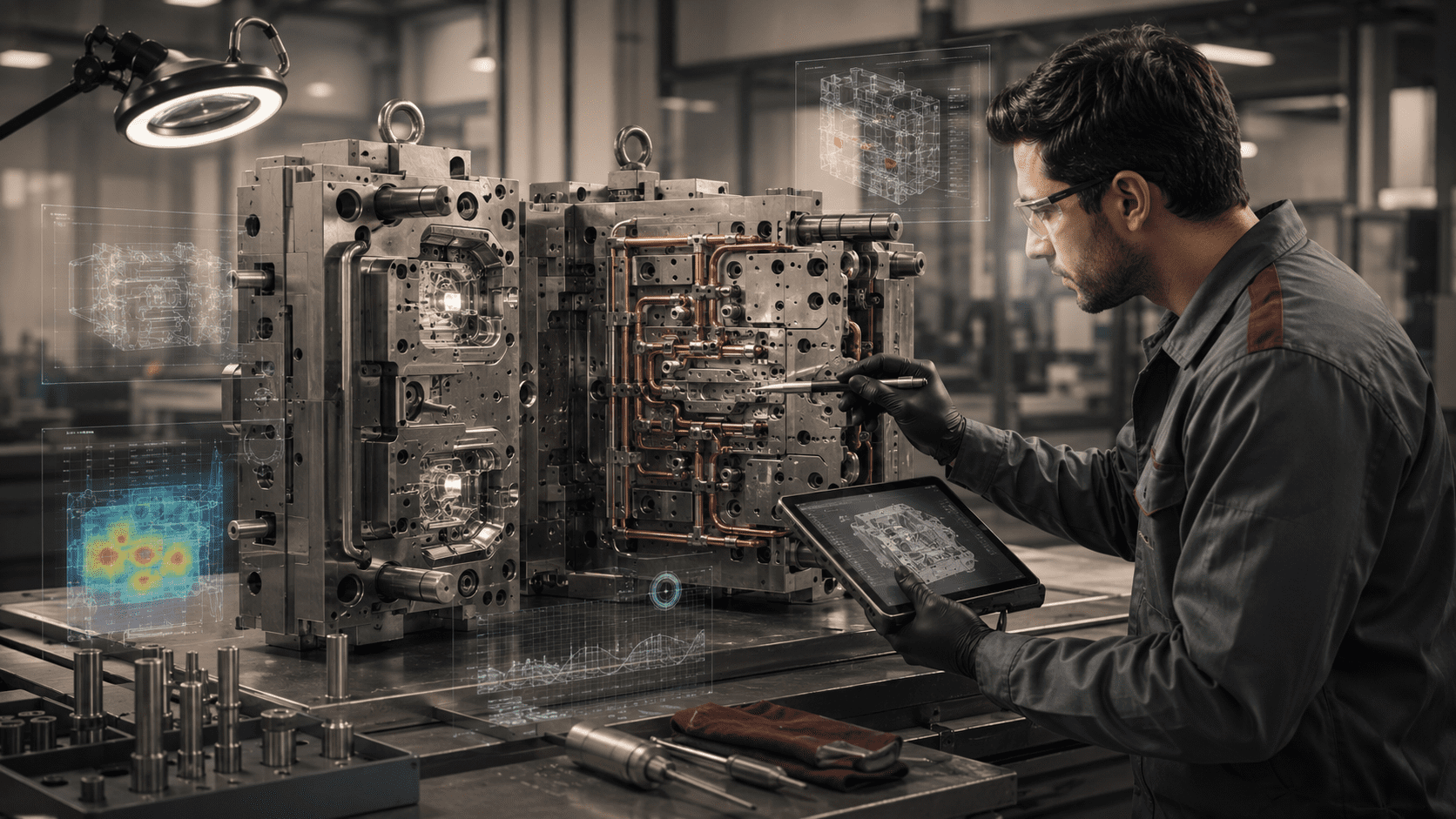
A physical audit is a structured on-floor injection mould inspection conducted without dismantling the mould. It helps identify visible wear, misalignment, contamination, cooling issues, and other operational risks that affect part quality and production stability.
What it IS:
- A non-intrusive evaluation of mould condition and performance
- A fast way to detect early deterioration
- A review of systems such as hot runners, cooling circuits, and clamping interfaces
- Useful during maintenance, troubleshooting, relocation, or new tool acceptance
What it is NOT:
- Not a full teardown or rebuild inspection
- Not a complete dimensional re-qualification
- Not a replacement for preventive maintenance
Because it requires minimal production disruption, a physical audit injection mould review can be performed regularly as part of proactive mould health management.
A comprehensive audit typically evaluates six key areas: design, process stability, quality performance, technology systems, cost inefficiencies, and maintenance effectiveness, helping manufacturers move from reactive repairs to proactive control.
Why Every Mould Programme Needs Regular Physical Audits
Injection moulds rarely fail suddenly. Wear, contamination, misalignment, and thermal stress build gradually until they cause scrap, downtime, quality issues, or costly repairs. Regular physical audit injection mould reviews help detect these risks early before they escalate into production failures.
The impact of poor audit discipline includes:
- Rising scrap and rework costs
- Emergency repairs and production stoppages
- Higher machine wear and energy consumption
- Delivery delays and recovery costs
In industries such as automotive, medical, and consumer goods, preventive controls are also critical for OEM compliance and supplier performance ratings.
Recommended audit frequency:
- Annual: Standard production moulds
- Quarterly or semi-annual: High-cavitation tools
- More frequent: PCR, glass-filled, or abrasive material programmes
- Immediate audit: After relocation, process changes, or recurring defects
Regular injection mould inspection helps manufacturers shift from reactive maintenance to proactive mould lifecycle management, improving uptime, consistency, and long-term tooling value.
Reading the Warning Signs: Plastic Part Defects That Demand an Audit
Plastic part defects often reveal mould deterioration long before major failures occur. Surface defects, dimensional variation, and cosmetic inconsistencies are key indicators that a physical audit injection mould review may be required. A structured mould defect detection approach helps connect visible defects to underlying tooling issues instead of treating them as process problems alone.
Sink Marks & Weld Lines
Sink marks and weak weld lines often point to cooling imbalance or poor material flow inside the mould.
Likely causes:
- Blocked or scaled cooling channels
- Gate wear or deformation
- Inadequate venting
Audit focus areas:
- Cooling flow and temperature balance
- Gate condition and erosion
- Vent cleanliness and depth
Correcting these issues improves packing consistency, weld strength, and part quality.
Flash at Parting Lines & Ejector Pins
Persistent flash usually signals mould wear or alignment problems rather than simple process variation.
Common causes:
- Worn parting surfaces
- Damaged or protruding ejector pins
- Guide pillar wear or plate distortion
Inspection focus:
- Parting face flatness
- Ejector pin condition and alignment
- Guide bushings and closing accuracy
Early detection helps prevent severe mould damage and downtime.
Flow Marks, Burn Marks & Surface Defects
Flow disturbances and trapped gases are common root causes of cosmetic defects.
Flow marks may indicate:
- Gate wear or damaged geometry
- Hot runner system imbalance
- Material or masterbatch variation
Burn marks often result from:
- Poor venting or blocked vents
- Air entrapment
- Resin degradation
Audit checks include:
- Hot runner system condition
- Nozzle alignment and temperature consistency
- Vent condition and cleanliness
Resolving the mould issue reduces reliance on unstable process adjustments.
Dimensional Drift, Warpage & Pin Misalignment
Gradual dimensional drift is a common sign of mould ageing and mechanical wear.
Typical causes:
- Worn guide pillars and bushings
- Poor lubrication
- Cooling imbalance
- Bent ejector pins
Physical auditors verify:
- Alignment and plate parallelism
- Lubrication condition
- Cooling uniformity
- Uneven wear patterns
Early corrective action helps avoid costly re-qualification or tooling replacement.
By treating defects as early warning indicators rather than isolated quality issues, manufacturers can use regular injection mould inspection to improve uptime, production stability, and long-term mould performance.
The Physical Audit Checklist: What to Inspect and Why
This is the operational core of a physical audit injection mould programme. At EIPL, inspections follow a structured, priority-based sequence focused on identifying deterioration, understanding its impact, and assessing the immediate risk to production continuity.
Mould Halves: Parting Surfaces, Mating Faces & Cavity Condition
Mould halves determine part geometry, sealing integrity, and cavity alignment. Even small defects here can affect every production cycle.
Inspect for:
- Cracks, dents, or weld repairs
- Scratches or scoring on sealing surfaces
- Burrs along parting lines
- Surface finish wear inside cavities
These issues may indicate:
- Clamp overload or trapped foreign material
- Improper handling or maintenance
- Abrasive material wear
- Excessive polishing damage
If ignored, they can cause:
- Flash and dimensional inaccuracies
- Cosmetic defects
- Progressive cavity misalignment
Since mould halves establish the dimensional baseline, deterioration in this area directly impacts overall part quality and mould reliability.
Hot Runner System (HRS): Nozzles, Manifolds & Valve Pins
The hot runner system is the highest-risk subsystem. Failures here can shut down production entirely, not just degrade part quality.
Inspect for:
- Nozzle leakage or material seepage at interfaces
- Gate area wear in cavity inserts and valve pins
- Inconsistent valve pin stroke or actuation pressure
- Manifold alignment and mounting integrity
EIPL diagnostic indicators of imbalance:
- Uneven part weights across cavities
- Cosmetic differences between cavities
- Stringing or drooling at specific gates
- Fill sequence irregularities
Root causes to verify:
- Heater malfunction or temperature variation
- Obstruction inside flow channels
- Valve pin wear or sticking
- Improper assembly after maintenance
Early detection prevents catastrophic damage such as heater failure, manifold cracking, or uncontrolled resin leakage.
Core, Cavities, Sliders & Guiding Elements
These components control part geometry, movement, and alignment. Wear or misalignment here directly translates into dimensional drift and functional defects.
Inspect for:
- Missing, loose, or damaged components
- Wear marks or scoring on sliding surfaces
- Condition of guiding bushings and pillars
- Pin-to-bush alignment accuracy
- Adequate lubrication presence
Why this matters:
Misalignment cascades through the mould structure. Even slight deviations cause uneven loading, accelerated wear, and inconsistent part geometry.
Potential part issues if ignored:
- Warpage or dimensional variation
- Flash in localized regions
- Difficulty in part release
- Progressive mould damage
Lubrication condition is evaluated simultaneously, as insufficient lubrication accelerates both wear and thermal distortion.
Ejection System: Pins, Plates & Return Springs
A degraded ejection system often manifests as handling defects rather than filling issues, making it easy to misdiagnose.
Check for:
- Bent, worn, or misaligned ejector pins
- Uneven pin protrusion heights
- Smooth travel of the ejector plate
- Integrity of return springs
- Debris accumulation at ejection points
What wear looks like on parts:
- Drag or scuff marks
- Pin witness marks or impressions
- Sticking or incomplete ejection
- Deformed or cracked components
Failure here can escalate into broken pins or jammed plates, potentially causing severe mould damage or machine downtime.
Cooling System: Channels, Manifolds & Seals
Cooling performance governs cycle time, dimensional stability, and long-term mould integrity. Degradation is often invisible until productivity drops.
Inspect for:
- Blocked or scaled cooling channels
- Corrosion inside water circuits
- Leaks at fittings or manifold connections
- O-ring condition and sealing effectiveness
- Signs of condensation or moisture intrusion
Production consequences of poor cooling:
- Increased cycle time
- Warpage and dimensional instability
- Uneven shrinkage across cavities
- Thermal fatigue of mould steel
High-humidity environments require special attention, as moisture-related corrosion can progress rapidly without obvious external signs.
Venting: Vent Depth, Condition & Placement
Effective venting prevents gas entrapment and material degradation during filling.
Check for:
- Resin buildup or contamination blocking vents
- Wear reducing vent depth or effectiveness
- Improper vent placement relative to last-fill zones
- Damage from cleaning tools or handling
Defects caused by poor venting:
- Burn marks from trapped gases
- Short shots due to air compression
- Weak weld lines
- Surface blemishes or discoloration
Venting issues often worsen gradually, making periodic verification essential.
Material & Plastic Grade Verification
A physical audit also confirms that the material being processed matches the mould’s design intent. Undocumented changes in resin or additives are a frequent hidden risk.
Verify:
- Resin grade and supplier consistency
- Masterbatch or colorant compatibility
- Presence of recycled or filled materials
- Moisture-sensitive material handling practices
Why this matters:
Even small formulation changes can alter flow behavior, shrinkage, or thermal response without triggering a formal process review.
Potential consequences:
- Unexpected dimensional drift
- Surface defects or color variation
- Increased wear on gates or runners
- Instability in cycle time
Material verification closes a critical gap between design assumptions and real-world production conditions.
A structured checklist ensures that audits capture root causes rather than symptoms. By systematically evaluating each subsystem in order of risk and impact, manufacturers can prevent failures before they escalate into costly downtime or customer issues.
How Often Should You Conduct a Physical Mould Audit?
Audit frequency should be determined by risk, not by a fixed calendar. Different tools experience vastly different stress levels depending on cavitation, material type, production intensity, and criticality to the business.
Recommended framework:
- Minimum baseline: Annual audit for standard production programmes
- High-risk tools: Quarterly or per-campaign audits for high-cavitation moulds or those running PCR, glass-filled, or abrasive materials
- Dormant tools: Mandatory pre-production audit before reactivating stored moulds
- After anomalies: Immediate audit following unexplained defects, shutdowns, crashes, or quality excursions
A useful rule of thumb is simple: the higher the production risk and replacement cost, the more frequently the tool should be audited. Proactive audits prevent failures that would otherwise emerge suddenly during peak production.
Conclusion
A structured physical audit injection mould programme is one of the most effective ways to protect mould reliability, production stability, and long-term tooling performance. By identifying early signs of wear, imbalance, contamination, cooling inefficiencies, and hot runner system issues, manufacturers can prevent costly downtime, scrap, and emergency repairs before they escalate.
Unlike reactive maintenance, regular injection mould inspection creates a proactive framework for managing mould health across the entire production lifecycle. From mould halves and guiding elements to venting, cooling circuits, and ejection systems, every subsystem plays a role in part quality, cycle consistency, and operational efficiency.
At EIPL, we view physical audits as more than maintenance checks, they are strategic tools for improving uptime, reducing risk, and maximizing mould asset value in demanding production environments.
Frequently Asked Questions About Runner Systems
What is a physical audit of an injection mould?
A physical audit is a structured on-shop-floor evaluation of a mould’s visible condition, functionality, and risk areas without full disassembly. It identifies wear, damage, imbalance, and maintenance gaps before they lead to defects or downtime.
How is a physical audit different from a full mechanical mould inspection?
A physical audit is non-intrusive and conducted without dismantling the tool. A mechanical inspection involves full disassembly, measurement, repair, or refurbishment. Audits are preventive and quick; inspections are corrective and time-intensive.
How often should injection moulds be physically audited?
At minimum, annually for standard programmes. High-cavitation tools, abrasive materials, or PCR programmes may require quarterly or per-campaign audits. Dormant moulds should be audited before reactivation.
What are the most common defects found during a physical mould audit?
Typical findings include parting surface wear, HRS imbalance, blocked vents, cooling inefficiencies, ejector misalignment, cavity damage, and lubrication issues. Many of these directly correlate with flash, warpage, burn marks, or dimensional drift.
What does the hot runner system inspection cover in a physical audit?
It evaluates nozzle condition, gate wear, leakage signs, valve pin movement, manifold alignment, heater integrity, and balance across cavities. Since HRS issues can stop production entirely, this is a high-priority inspection area.