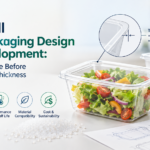
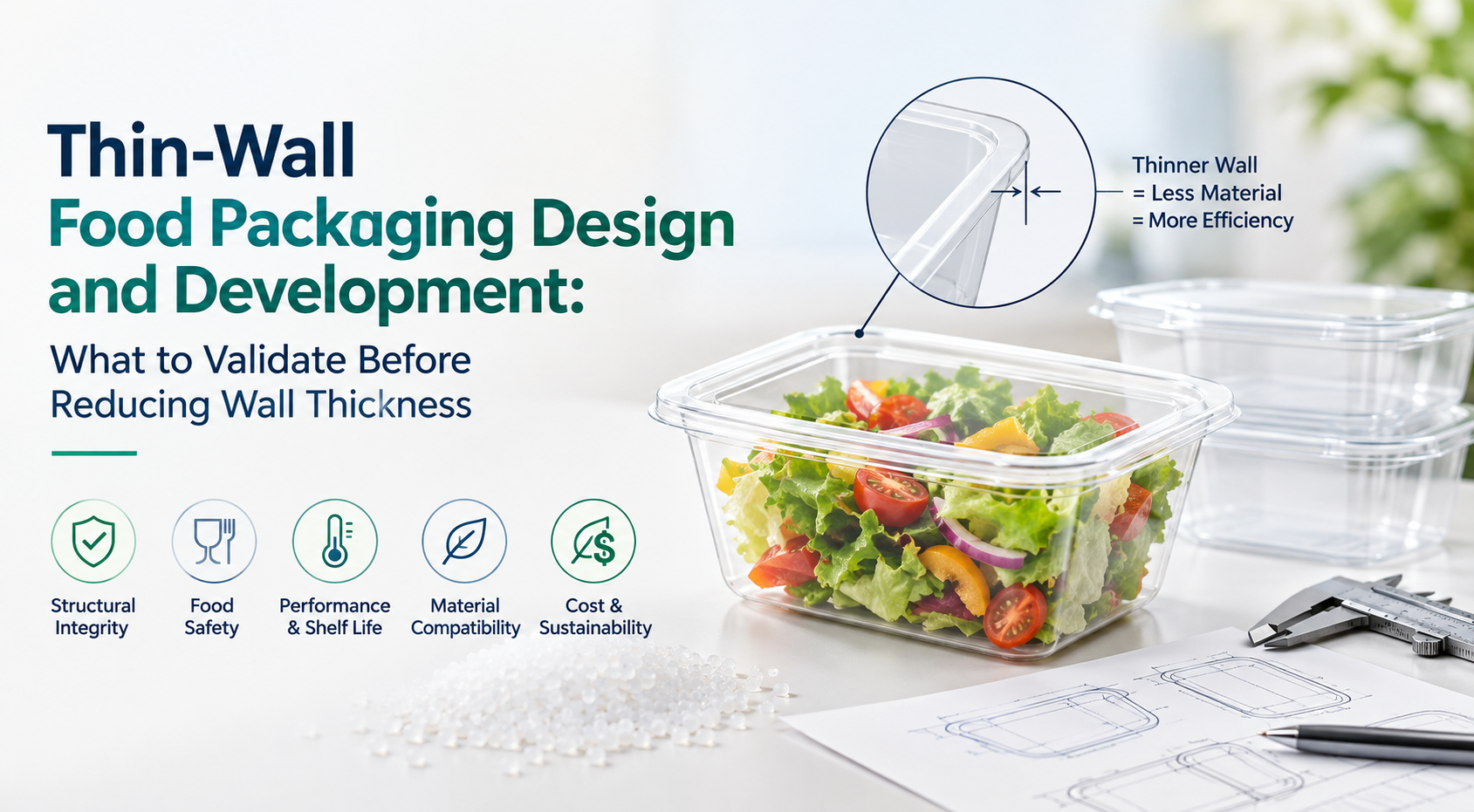
One of the simplest approaches to improve material efficiency is to cut down on the thickness of plastic packaging walls. Less plastic serves the purpose of lowering the cost of packaging, weight, and usually price of shipment. However, thinner does not necessarily mean better. A packaging component that uses only a few grams less of the plastic resin but fails to fulfil its function in terms of stacking, quality of moulding or protecting the product results in much greater costs compared to those that have been saved with thinner wall material.
The necessity of proper validation becomes obvious in this case. Prior to introducing any changes to the thickness of packaging materials into practice, thinness of packaging elements should be proved in terms of the quality of design, material, mould and process used.
What Is Thin-Wall Food Packaging Design?
Thin-wall packaging refers to the use of strong rigid plastic containers (tubs, cups, trays, lids) made with thinner than normal walls but still providing the required level of protection, strength, and usability. Thin-wall containers are usually manufactured by means of the injection moulding process in which molten plastic passes through both narrow wall sections of the mould in a very short time before solidifying.
In terms of wall thickness, some trade-offs must be considered:
Strength: A thinner wall can improve its rigidity, mechanical performance, and load-bearing abilities only if the wall section comes up with an appropriate shape.
Weight: A Less material lowers the weight of the package and consumption of resin.
Manufacturability: A very thin section will be difficult to fill, cool, and eject out of the mould.
In food packaging design, material usage is aligned with injection moulding practices. Any change is bound to alter the other aspects, hence thickness can never be reduced alone.
What to Validate Before Reducing Packaging Wall Thickness?
Any approval regarding wall thickness reduction should come only after analysing and approving the following areas, since one weak part of the whole system may ruin all advantages brought by other good parts.
Structural Strength and Load-Bearing Capacities
The thinner construction should be tested under the actual loads which it is going to operate in real life: it could be loads of loaded pallets in warehouses, contact during a transport operation, drops and impacts, fitting a lid. The stiffness of the walls, bottom and rim may appear more important than wall thickness itself. Using ribs, corrugation and shaping can make the wall strong without adding much material.
Material Selection and Flow Behaviour
Not every resin can be used for thin wall moulding. The flow properties of the material will help determine if it will be able to fill a thin cavity and freeze. It is also important to make sure that impact resistance and mechanical behaviour are suitable for the product regardless of the way of storage (refrigerated, frozen, packed hot).
Mould Design and Thin-Wall Injection Moulding Feasibility
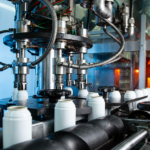
Thin wall packaging design tends to place greater stress on the tools. Take into account the location and kind of the gating, the design of the runner, venting, length of flow compared with the thickness of the section, and the rigidity of the mould. The process often calls for high injection pressures and velocities making it essential for the equipment and tooling to be able to withstand them for a long period of time.
Filling, Cooling and Cycle Time
Simulation technologies should be used to predict short shots, weld lines, trapped air and the pressure needed even before cutting the steel. It is just as important to consider cooling design: uneven cooling will cause warping. Thinner sections cool more quickly at shorter cycle times but only if the configuration and the window are correct.
Food Safety and Product Protection
The food packaging design must serve the purpose. The need for barriers, seal integrity and both leak and lid performance must be verified. It is also necessary to ensure that materials are compliant with relevant food safety rules established by the target market.
Prototype Testing and Production Trial Validation
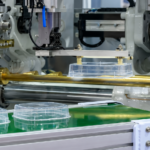
Simulations and calculations serve as a foundation rather than a conclusion. Make prototypes, test them in real-world conditions, and perform production tests to detect their repeatability, dimensional stability, and process reliability. Testing with real filling, sealing, stacking, and shipping conditions leads to detecting the problems overlooked during bench tests.
A Simple Validation Flow:
- Current Design Assessment
- Wall Thickness Optimisation
- Moulding Feasibility Review
- Prototype and Trial Testing
- Performance Validation
- Production Approval
Key Factors Affecting Plastic Packaging Wall Thickness
There cannot be a single answer as to what is the correct thickness of the product due to the fact that many project-specific variables that should be determined before the start of development are involved.
Food: The significant aspects regarding the amount of stress and heat that need to be withstood by the wall are weight, acidity, fat content, filling temperature and storage conditions.
Package Shape: The position of plastic in the walls, corners, bottom and rim often is more significant than simple thickness, as ribs and tapered areas create extra rigidity.
Material Properties: Stiffness, toughness and melt flow define minimum performance thickness from technology point of view, thus each resin grade needs to be compared.
Forces Acting On The Package: The main aspect is stress made on the package during the period in storage and in transport.
Production Capability: Machine pressure, equipment quality, and the quantity of products produced determine consistent processes, particularly for very simple and thin parts produced at high speeds as part of thin wall packaging development.
Compliance Regulations: The rules regarding food contact must be taken into account regardless of the thickness of the product and any alterations in the material or additives should be verified for a particular market.
Common Challenges in Thin-Wall Packaging Development
Engineers behind thin wall packaging development face a consistent series of challenges and knowing them beforehand helps minimize expensive corrective work after the tool has been made.
Short Shots: The polymer can solidify before making it to the end of the long wall and since the corners and sides of the part are missing, the results can be disappointing.
Warpage: Significant temperature difference causes uneven cooling resulting in distortion of the lid or tub and preventing them from working properly.
Reduced Stiffness: Even if the container feels perfect when it is empty, it can bulge, break or become crushed under weight.
Uneven Thickness: Poor flow balance leads to the presence of weak points in the design.
Process Sensitivity: Due to high speed and pressure, there is a small process window leaving very little room for temperature or material deviations to make rejects occurring.
Leakage Risk: The thickness of both lid seals, rim flatness and barrier performance are the factors determining possible leak occurrences during liquid and oily products testing.
Benefits of Thin-Wall Food Packaging Optimisation
If validated correctly, optimisation may result in:
- Less material use and lighter packaging.
- Possible savings in materials and transportation costs.
- Increased material efficiency and resource utilisation.
- Improved cycle time owing to improved moulding parameters.
- More efficient packaging that still fulfils requirements.
Applications of Thin-Wall Food Packaging Design
The principles of thin-wall design are found to be relevant for different types of rigid food packaging such as food packaging tubs, containers, cups, lids, and alike. One should be able to determine whether or not specific applications meet requirements by examining information provided by Efficient Innovations regarding its product development capabilities and standards in manufacture.
Why Choose Efficient Innovations for Food Packaging Design and Development?
The combination of design, tooling and production is essential for the success of thin wall packaging design. Efficient innovations provide:
- Design based on engineering principles allows us to create packaging that performs as required.
- Material efficiency and manufacturing design of packaging ensures that savings will be achieved.
- Mould making design and production principles built in right from the beginning.
- Technical validation in order to ensure the quality and production readiness of products.
FAQs About Thin-Wall Food Packaging Design
1. What is thin-wall food packaging?
This kind of packaging made of hard plastic can be found in the shape of containers, cups, and lids and is made with reduced plastic packaging wall thickness. The way to manufacture such packages is usually through injection moulding.
2. How do you determine the right wall thickness for plastic food packaging?
It is necessary to consider aspects like product weight, storage conditions, way of transporting products, characteristics of the packaging materials, and the possibilities of using given plastic material.
3. What are the risks of reducing packaging wall thickness?
There might occur short shots, deformation of walls, lost strength, inconsistency with quality requirement, increased sensitivity of the production process, and product spoiling or even losing its package.
4. How does thin wall injection moulding affect production?
It is important to operate at higher pressures and speeds, have a clean design of the gating and venting systems, and provide excellent cooling. When optimised, the process of thin wall injection moulding results in improved material usage and shorter production times, but it requires stronger tooling and processing.
5. How can packaging material optimisation reduce costs without compromising performance?
Costs can be reduced by distributing materials correctly, using geometry for achieving a desired stiffness, choosing the proper material type and checking the design before starting production.
Looking to optimize your food packaging design without compromising performance? Connect with Efficient Innovations for engineering-led packaging design and development support.