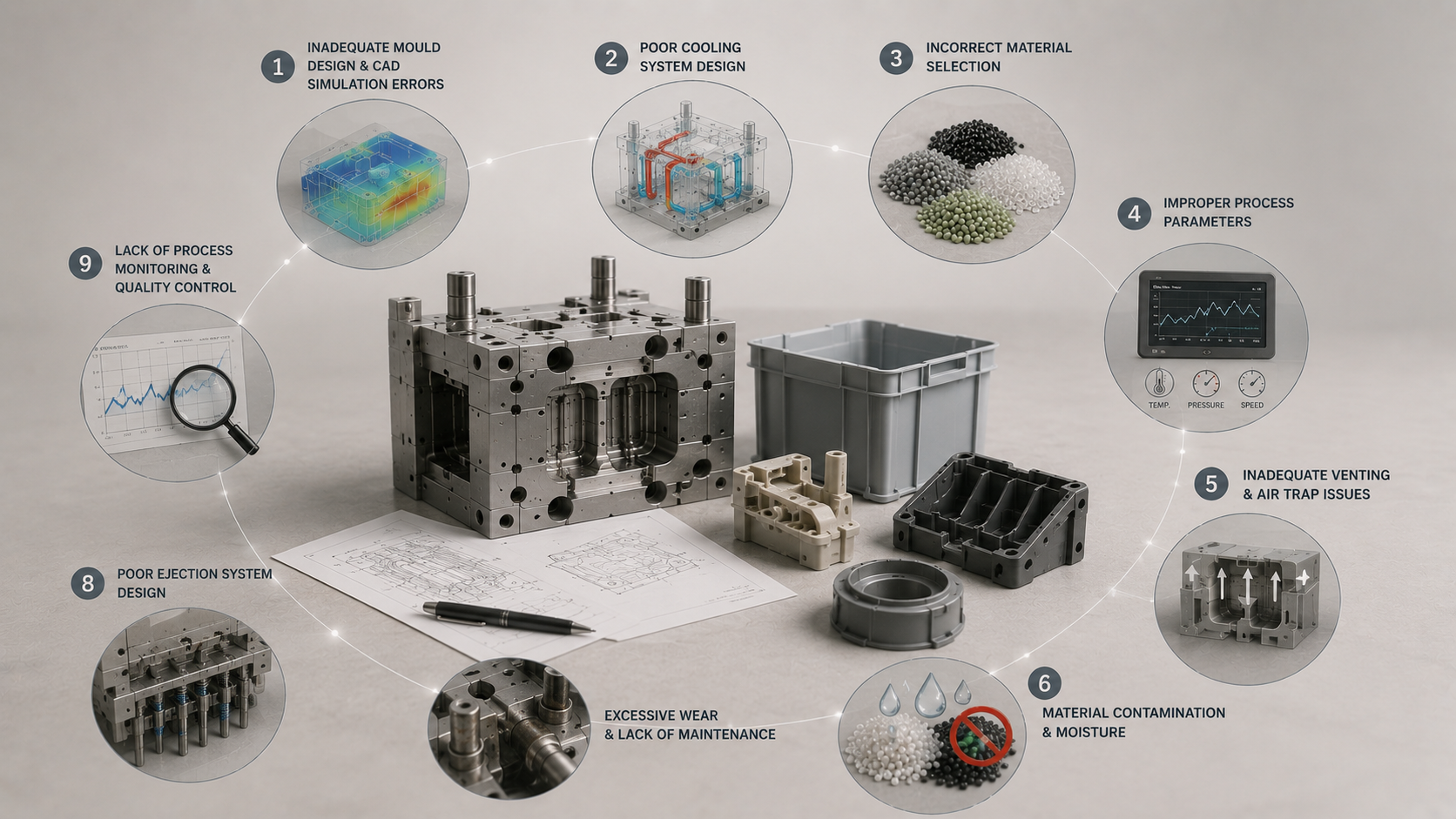
Key Takeaways
- Injection mould failures are rarely sudden. Most defects in injection moulding begin with small process, design, or maintenance gaps that quietly escalate over time.
- From predictive maintenance and real-time monitoring to simulation-driven validation, discover how modern manufacturers are preventing injection moulding defects before they impact production.
- The real shift is from reactive troubleshooting to proactive control, where smart systems, process analytics, and structured prevention frameworks are redefining quality injection molding operations.
Preventing injection mould failure is no longer about reacting to defects after they occur. Modern quality injection molding depends on proactive systems that identify risks early and maintain stable production performance.
Most injection moulding defects and causes originate from design flaws, process instability, material inconsistencies, or poor maintenance. These issues often lead to defects in injection moulding such as flash, warping, voids, and dimensional variation, increasing downtime and production costs.
This blog explores the systems, monitoring tools, and best practices manufacturers use to prevent failures, from simulation-driven mould validation and predictive maintenance to real-time process analytics and material quality control. It also highlights how smart manufacturing technologies are helping companies move toward more reliable, data-driven production operations.
Prevention Framework: The Efficient Innovations Approach
Preventing injection moulding defects requires more than troubleshooting after problems occur. The most successful manufacturers implement a structured prevention framework that integrates design validation, process monitoring, material management, and predictive maintenance.
While many companies address defects in injection moulding reactively after failures appear, Efficient Innovations focuses on a proactive methodology. This approach combines advanced engineering analysis, predictive monitoring technologies, and structured quality control systems to eliminate root causes before they affect production.
Key elements of this framework include:
- Advanced mould design validation using simulation-driven engineering
- Predictive maintenance programs that monitor mould health continuously
- Real-time process analytics for early detection of parameter deviations
- Strict material quality control protocols
By integrating these capabilities, Efficient Innovations creates a comprehensive strategy for preventing injection moulding defects and causes, rather than simply correcting them after they occur.
Advanced Mould Design & Simulation Best Practices
Modern mould engineering relies heavily on simulation technologies to prevent design-related injection moulding defects.
Key tools include:
- Finite Element Analysis (FEA) to analyze structural stress and durability
- Mould flow simulation to predict material flow behavior inside the cavity
- Thermal analysis to evaluate cooling efficiency and temperature distribution
Through 3D CAD modeling and digital simulation, engineers can identify potential weaknesses such as flow imbalance, uneven cooling, or stress concentrations before the mould is manufactured.
These tools allow manufacturers to predict and prevent up to 85% of potential mould failures during the design stage.
Efficient Innovations follows a structured design verification process that includes:
- CAD-based design validation
- Flow and cooling simulations
- Stress and durability analysis
- Final manufacturability review
This layered approach significantly reduces the likelihood of downstream injection moulding defects and solutions issues during production.
Preventive Maintenance & Condition Monitoring
Even well-designed moulds require systematic maintenance to sustain quality injection molding performance.
A structured maintenance program typically includes:
- Scheduled inspection of cavities, cores, and ejector systems
- Monitoring of wear patterns and component tolerances
- Cleaning of cooling channels and venting systems
- Replacement of worn components before failure occurs
Traditional maintenance approaches rely on periodic inspections. However, modern manufacturing environments increasingly use IoT-enabled condition monitoring systems.
These systems track:
- Temperature fluctuations
- Pressure variations
- Cycle counts and mechanical wear
With predictive monitoring, manufacturers can detect early signs of mould degradation. Studies show that predictive maintenance programs can reduce unplanned downtime by up to 40%, improving production reliability.
Process Control & Real-Time Data Analytics
Stable process control is essential for preventing defects in injection moulding. Modern injection molding operations rely on real-time monitoring systems to track critical production parameters.
Important process variables include:
- Melt temperature
- Injection pressure and speed
- Cooling time
- Holding pressure profiles
Advanced monitoring systems continuously record these parameters and trigger alerts when values move outside predefined limits.
Key benefits of real-time data analytics include:
- Immediate detection of process deviations
- Automated alarm thresholds for quality control
- Trend analysis for identifying recurring process variations
By analyzing historical process data, manufacturers can identify patterns that contribute to injection moulding defects and causes, enabling early intervention before defects appear.
Material Management & Quality Assurance
Raw material quality plays a major role in preventing injection moulding defects and solutions challenges.
Effective material management includes:
- Material certification and supplier verification
- Moisture control for hygroscopic resins
- Controlled storage environments
- Regrind ratio management
Moisture contamination is one of the most common causes of defects such as bubbles, surface blemishes, and weak mechanical performance.
To prevent these issues, manufacturers must follow strict material drying and handling protocols, along with regular testing of incoming material batches.
Industry studies show that proper material management can prevent up to 30% of defect-related failures in injection molding operations.
By integrating material verification, environmental controls, and supplier quality audits, Efficient Innovations helps manufacturers maintain consistent resin quality and stable production outcomes.
Common Injection Moulding Defects & Their Causes
Understanding injection moulding defects becomes much easier when manufacturers can connect visible part defects with their underlying process or tooling issues. Many production teams encounter defects such as sink marks, warping, voids, or flash without immediately identifying the root cause.
In reality, most defects in injection moulding originate from a limited set of process, design, or material problems. By mapping these injection moulding defects and causes, engineers can quickly diagnose issues and implement corrective actions.
The table below provides a quick overview linking common injection moulding defects and solutions to their most likely root causes.
Defect | Typical Root Causes |
Sink Marks | Insufficient holding pressure, uneven wall thickness, poor cooling |
Warping | Uneven cooling, mould temperature imbalance, internal stresses |
Voids | Insufficient packing pressure, trapped air, excessive material shrinkage |
Flash | Excessive injection pressure, mould misalignment, worn parting surfaces |
Short Shots | Low injection pressure, poor material flow, inadequate venting |
Flow Marks | Inconsistent injection speed, poor gate design, improper temperature |
Weld Line Weakness | Multiple flow fronts meeting improperly, poor gate placement |
Burn Marks | Air traps due to poor venting, excessive injection speed |
Dimensional Inaccuracy | Uneven shrinkage, inconsistent cooling, mould wear |
By linking defects directly to root causes, manufacturers can dramatically reduce troubleshooting time and stabilise production quality.
Quick Reference: Defect Diagnosis Matrix
The following matrix provides a more structured diagnostic tool for identifying which of the nine root causes of injection mould failure may be responsible for specific defects.
Injection Moulding Defect | Likely Root Cause(s) | Corrective Action |
Sink Marks | Poor cooling system performance, insufficient holding pressure | Increase packing pressure, optimize cooling channels |
Warping | Temperature imbalance, uneven cooling | Balance mould temperature, improve cooling uniformity |
Voids | Material degradation, inadequate packing pressure | Adjust pressure profile, verify material drying |
Flash | Excessive injection pressure, mould misalignment | Reduce pressure, inspect mould alignment |
Short Shots | Low injection pressure, gate restriction | Increase injection pressure, redesign gate size |
Flow Marks | Improper injection speed, poor gate design | Optimize injection speed and gate placement |
Weld Lines | Gate placement issues, low melt temperature | Adjust gate location, increase melt temperature |
Burn Marks | Air traps due to poor venting | Improve venting channels and air escape paths |
Dimensional Variation | Worn mould components, cooling imbalance | Replace worn components, improve thermal control |
This defect diagnosis matrix helps engineers quickly connect visible product issues to their underlying injection moulding defects and causes. Instead of relying on trial-and-error troubleshooting, teams can follow a structured approach to identifying the most probable root causes.
Manufacturers using systematic diagnostic frameworks, combined with real-time process monitoring, are able to resolve quality issues significantly faster and maintain more stable quality injection molding operations.
Technology & Tools: Equipment That Prevents Mould Failure
Modern injection molding facilities increasingly rely on advanced technology to prevent injection moulding defects and extend mould life. Traditional troubleshooting methods often react to problems after they occur, whereas modern equipment enables real-time monitoring and predictive intervention.
By integrating smart sensors, data analytics, and automated inspection systems, manufacturers can detect early signs of process instability and eliminate many injection moulding defects and causes before they affect production.
Key technologies driving defect prevention include:
Real-Time Temperature Sensors
Temperature fluctuations are a major cause of defects in injection moulding, particularly warping, shrinkage, and material degradation.
Advanced sensors continuously monitor:
- Barrel temperature
- Nozzle temperature
- Mould surface temperature
When deviations occur, the system automatically triggers alerts or parameter adjustments, ensuring stable thermal conditions throughout the molding cycle.
Pressure Monitoring Systems
Injection pressure directly affects cavity filling, packing efficiency, and part consistency. Modern pressure monitoring tools track:
- Injection pressure profiles
- In-cavity pressure levels
- Holding pressure stability
These systems help detect abnormalities such as short shots, flash, or voids, enabling engineers to adjust parameters before defects spread across production batches.
Machine Vision & Automated Inspection Systems
High-speed vision inspection systems are increasingly used to identify visible injection moulding defects and solutions issues in real time.
These systems analyze molded parts for:
- Surface imperfections
- Dimensional deviations
- Flash formation
- Incomplete filling
Because inspection occurs directly on the production line, defective parts can be detected and removed immediately, preventing defective batches from reaching downstream processes.
IoT-Enabled Mould Monitoring
IoT-based monitoring platforms provide continuous visibility into mould health and production conditions. Sensors embedded in the mould or machine collect data such as:
- Cycle counts
- Temperature trends
- Pressure fluctuations
- Mechanical wear indicators
By analyzing this data, manufacturers can identify patterns that lead to injection moulding defects, allowing engineers to correct process variables before failures occur.
Predictive Maintenance Software
Predictive maintenance systems use historical process data and machine learning algorithms to forecast potential equipment failures.
These platforms monitor variables such as:
- Mould wear patterns
- Cooling efficiency changes
- Pressure deviations
- Cycle time variations
Instead of waiting for breakdowns, manufacturers can schedule targeted maintenance actions before mould degradation causes defects in injection moulding.
The Impact of Smart Manufacturing Technologies
When combined, these technologies create a smart manufacturing ecosystem capable of reducing failure rates and improving process stability.
Key benefits include:
- Faster detection of injection moulding defects and causes
- Reduced scrap rates and production waste
- Longer mould lifespan
- Improved process consistency and product quality
Manufacturers that adopt advanced monitoring and predictive maintenance technologies are able to significantly reduce mould failures while maintaining stable, high-performance quality injection molding operations.
Industry Benchmark: How Efficient Innovations Outperforms Competitors
In the world of quality injection molding, preventing injection moulding defects requires more than advanced machinery. It depends on a structured approach that combines design validation, process monitoring, predictive maintenance, and real-time data analysis.
While many manufacturers focus on individual aspects such as machine performance or tooling precision, Efficient Innovations takes a system-wide approach, addressing the root causes behind defects in injection moulding before they impact production.
The comparison below highlights how Efficient Innovations performs against leading industry competitors in critical areas of defect prevention and process optimization.
Company | Design Verification Capability | Monitoring & Process Analytics | Maintenance Protocols | Defect Prevention Approach | Estimated Defect Prevention Rate |
Efficient Innovations | Advanced CAD + simulation-driven validation | Real-time process monitoring & analytics | Predictive maintenance with IoT diagnostics | Integrated design + process + material optimization | Up to 90% defect prevention through root-cause control |
RD Plast Mould | Standard CAD design review | Limited monitoring | Periodic maintenance | Reactive troubleshooting | Moderate |
Husky | Equipment-level validation | Advanced machine diagnostics | Scheduled maintenance | Machine performance focus | High |
ENGEL | Advanced process engineering | Machine-integrated monitoring | Structured maintenance | Process optimization | High |
Milacron | Tooling and equipment validation | Machine-level monitoring | Standard preventive maintenance | Process adjustments | Moderate |
Battenfeld | Equipment-focused validation | Basic monitoring tools | Preventive maintenance | Machine performance optimization | Moderate |
Sumitomo | Precision engineering systems | Sensor-based monitoring | Structured maintenance programs | Process stability improvement | High |
Niigata | Equipment validation | Basic process monitoring | Preventive maintenance | Machine-driven process control | Moderate |
JSW | Machine and tooling optimization | Limited process analytics | Standard maintenance schedules | Production efficiency focus | Moderate |
Nissei | Equipment precision focus | Limited monitoring capability | Periodic maintenance | Reactive troubleshooting | Moderate |
Key Differentiators of Efficient Innovations
Several factors distinguish Efficient Innovations in addressing injection moulding defects and causes:
- Design-First Engineering Approach
Defect prevention begins at the design stage through advanced CAD simulation, mould flow analysis, and stress testing, eliminating many potential defects before production begins. - Integrated Monitoring Systems
Real-time monitoring systems track pressure, temperature, and flow parameters continuously, enabling early detection of process deviations that may lead to injection moulding defects. - Predictive Maintenance Programs
Unlike reactive maintenance strategies used by many competitors, predictive systems analyse mould health data to identify wear patterns and prevent failures before they occur. - Root-Cause Diagnostic Expertise
Efficient Innovations focuses on solving injection moulding defects and solutions at their source rather than applying temporary fixes. - End-to-End Quality Optimization
From material verification to cooling system performance and parameter tuning, the company applies a holistic defect prevention framework that significantly reduces production variability.
As a result, manufacturers working with Efficient Innovations benefit from higher production stability, lower scrap rates, and significantly fewer defects in injection moulding, helping maintain consistent quality across high-volume production environments.
Conclusion
Preventing injection mould failure requires a proactive approach built on process control, predictive maintenance, and real-time monitoring. Most injection moulding defects and causes can be minimized through early detection, stable process management, and structured quality systems.
Manufacturers that invest in preventive strategies and smart monitoring technologies are better positioned to reduce defects in injection moulding, improve mould life, and maintain consistent quality injection molding performance.
Frequently Asked Questions
Can mould failures be prevented entirely?
While failures cannot be eliminated completely, most defects in injection moulding and mould failures are preventable. Proper design validation, process optimisation, preventive maintenance, and real-time monitoring can reduce failure risks by a significant margin.
What is the cost of mould failure vs. preventive maintenance?
Mould failure can cause production downtime, material waste, and repair costs that are significantly higher than preventive maintenance. In many cases, investing in maintenance programs costs a fraction of the losses caused by unexpected mould failure.
How does real-time monitoring prevent mould failure?
Real-time monitoring systems track parameters such as temperature, pressure, and cycle time. By detecting abnormal patterns early, these systems help engineers correct process deviations and prevent injection moulding defects and solutions issues before they affect production.
What’s the difference between reactive maintenance and predictive maintenance for moulds?
Reactive maintenance addresses problems only after a failure occurs, while predictive maintenance uses sensors and data analysis to detect wear patterns early. Predictive approaches help prevent failures and maintain consistent quality injection molding performance.
How often should injection moulds be inspected?
Routine inspections are recommended daily for basic cleaning, weekly for component checks, and monthly for detailed maintenance. Regular inspection helps detect wear, misalignment, and cooling system issues before they lead to production defects.