Key Takeaways
- Consistent quality injection molding is rarely achieved through machinery alone. Hidden factors like mould alignment, process control, and maintenance discipline often determine long-term production stability.
- From injection speed and holding pressure to real-time monitoring and preventive maintenance, discover the systems that quietly influence defect rates, cycle efficiency, and mould lifespan.
- The real advantage lies in proactive control, where data-driven monitoring, SPC, and predictive maintenance transform injection moulding from reactive troubleshooting into a stable, high-performance manufacturing process.
Achieving consistent quality injection molding is not just about having a well-designed mould or advanced machinery. Long-term production quality depends on how effectively manufacturers control process variables, maintain tooling systems, and monitor production performance in real time. In high-volume manufacturing environments, even minor variations in pressure, temperature, alignment, or maintenance routines can quickly lead to defects, downtime, and rising operational costs.
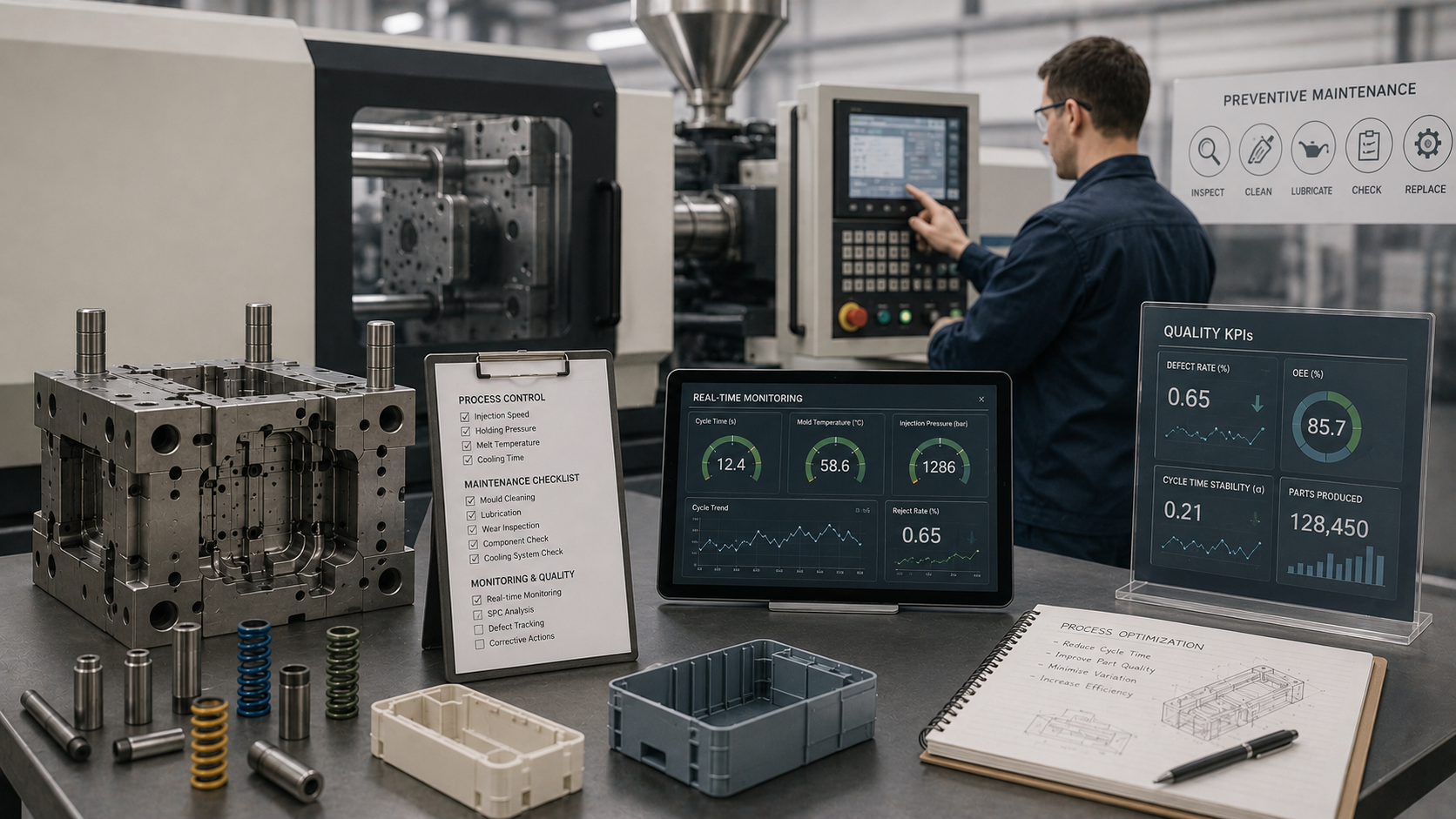
Modern injection moulding operations are therefore moving beyond reactive troubleshooting toward proactive process control and predictive quality management. Manufacturers today rely on a combination of process optimization, preventive maintenance, real-time monitoring systems, and data-driven analysis to ensure stable and repeatable production outcomes.
This blog explores the critical systems and practices that directly influence injection moulding quality across production cycles. It examines how mould components such as ejector pins, guide pins, and springs impact operational stability, why mould alignment and surface finishing affect dimensional consistency, and how injection speed, holding pressure, and cooling performance must be precisely controlled to avoid common defects.
You will also gain insight into the growing role of preventive maintenance, Statistical Process Control (SPC), IoT-enabled monitoring, and quality KPIs in maintaining high-performance molding operations. In addition, the blog breaks down common production defects, explains how to troubleshoot them systematically, and highlights the financial value of investing in quality-focused process improvements.
Whether you are new to injection moulding or optimizing mature production systems, this guide provides a practical understanding of how process control, maintenance, and monitoring work together to achieve stable, efficient, and high-quality injection molding performance.
Standard Parts & Component Quality (Ejector Pins, Guide Pins, Springs)
Often overlooked, mould standard components such as ejector pins, guide pins, and springs are essential for maintaining reliable mould operation and ensuring quality injection molding.
Key considerations include:
- Precision tolerances for smooth movement and alignment
- Material hardness and wear resistance
- Proper lubrication and maintenance schedules
Low-quality components can cause issues such as:
- Ejector pin sticking
- Mould misalignment
- Surface damage to molded parts
- Premature mould wear
Investing in premium-grade components can significantly improve operational reliability. Studies show that high-quality standard parts can reduce production downtime by up to 22%.
To maintain consistent mould performance, Efficient Innovations integrates premium-standard components with tighter tolerances, ensuring long-term stability and reduced maintenance disruptions.
Mould Surface Finishing & Texture
Surface finishing is a critical element of quality injection molding, directly affecting both the functional performance and visual appeal of plastic parts. The level of mould polishing determines the surface texture transferred to the molded component.
Industry-standard finishing levels follow the SPI (Society of the Plastics Industry) scale:
- SPI A (Mirror Finish) – Highly polished surfaces used for optical components and high-gloss consumer products.
- SPI B (Semi-Gloss Finish) – Suitable for many consumer goods and packaging products.
- SPI C (Matte Finish) – Produced with stone polishing for moderate texture.
- SPI D (Textured Finish) – Sandblasted finishes used where gloss reduction or grip is required.
Additional finishing techniques include:
- Texture imprinting to create aesthetic patterns or functional grip surfaces.
- Electroplating or coating to improve wear resistance and corrosion protection.
Surface finish also influences paint adhesion, part release behavior, and contamination resistance. Regular maintenance of polished mould surfaces is essential, as oxidation or contamination can degrade finish quality over time.
Mould Assembly & Alignment Precision
Accurate mould assembly ensures consistent cavity alignment and is fundamental to quality injection molding. During assembly, engineers verify precise positioning of core and cavity components.
Typical alignment tolerances are maintained within ±0.05 mm, ensuring that molded parts maintain dimensional accuracy and surface consistency.
Critical verification steps include:
- Core-cavity alignment checks
- Leak testing of cooling channels
- Functional verification of moving components
Misalignment can lead to several production issues:
- Flash formation along parting lines
- Incomplete filling of cavities
- Cosmetic surface defects
To prevent these issues, Efficient Innovations implements multiple assembly QC checkpoints, ensuring that each mould is validated for structural integrity and operational precision before production begins.
Injection Speed & Flow Rate Optimization
Injection speed plays a major role in determining the flow behavior of molten plastic during the quality injection molding process. Proper flow control ensures balanced cavity filling and prevents defects caused by turbulent material movement.
Key considerations include:
- Fill pattern control across complex cavity geometries
- Fiber orientation management in reinforced plastics
- Avoidance of gate jetting and turbulence
Incorrect injection speed can cause defects such as:
- Excessively high speed: air traps, burn marks, and surface defects
- Too slow injection: incomplete filling and weld lines
Modern injection molding machines allow variable-speed injection control, enabling engineers to adjust flow rates during different phases of cavity filling.
When optimised correctly, injection speed control can reduce molding defects by approximately 14%, improving both productivity and product consistency.
Post-Injection Holding Pressure & Time
After the cavity is filled, holding pressure and holding time become critical factors in maintaining dimensional stability during quality injection molding.
During this stage, additional pressure compensates for material shrinkage as the plastic cools and solidifies.
Key process parameters include:
- Holding pressure profile across the cooling stage
- Holding time duration until gate freeze-off occurs
- Material shrinkage compensation
If holding pressure is insufficient, defects such as sink marks, internal voids, and dimensional inconsistencies may appear.
Research shows that proper optimisation of holding pressure and timing can reduce void formation by up to 25%.
Through detailed process monitoring and simulation, Efficient Innovations develops optimised pressure profiles that ensure uniform part density and dimensional accuracy.
Preventive Maintenance & Mould Care
Long-term performance in quality injection molding depends heavily on preventive mould maintenance. Without systematic care, moulds experience wear, contamination, and thermal fatigue that compromise production quality.
A typical maintenance schedule includes:
Daily Maintenance
- Cleaning mould surfaces and cavity areas
- Checking lubrication points
Weekly Maintenance
- Inspecting ejector systems and cooling channels
- Checking alignment and wear indicators
Monthly Maintenance
- Full mould inspection and servicing
- Thermal stress monitoring
Well-maintained moulds can operate 2–3 times longer than poorly maintained tools, significantly reducing replacement costs.
To enhance reliability, Efficient Innovations integrates predictive maintenance using IoT-enabled sensors, enabling early detection of wear patterns and potential failures.
Quality Testing & In-Process Monitoring
Modern quality injection molding operations rely on continuous monitoring systems to maintain consistent production quality.
Advanced monitoring technologies include:
- In-cavity pressure sensors to track material behavior during filling
- Temperature monitoring systems for process stability
- Weight and dimensional inspection tools for quality verification
Many manufacturers implement Statistical Process Control (SPC) techniques to analyze production data and identify deviations early.
With real-time monitoring, modern injection molding systems can detect potential defects before the part is ejected, preventing defective parts from reaching downstream processes.
Efficient Innovations supports clients with real-time quality dashboards, allowing engineers to monitor key process variables and maintain stable production performance.
Industry Standards & Regulatory Compliance (ISO, AS9100, IATF)
Compliance with international quality standards is essential for achieving consistent quality injection molding, particularly in regulated industries.
Important standards include:
- ISO 9001 – General quality management systems
- IATF 16949 – Automotive industry quality requirements
- AS9100 – Aerospace manufacturing standards
These frameworks define requirements for:
- Process documentation
- Quality traceability
- Continuous improvement systems
- Risk management and corrective actions
Different industries impose additional requirements:
- Automotive: strict dimensional tolerances and traceability
- Medical devices: validated processes and material certifications
- Consumer goods: safety and durability standards
With strong compliance capabilities and audit-ready processes, Efficient Innovations helps manufacturers meet international certification requirements while maintaining consistent production quality.
Key Quality Metrics & KPIs
Successful quality injection molding operations track performance through measurable production indicators. Monitoring these metrics helps manufacturers identify process inefficiencies and maintain high-quality standards.
Key performance indicators include:
- Defect Rate (%) – Percentage of defective parts produced
- First-Pass Yield (FPY) – Percentage of parts meeting quality standards without rework
- Scrap Rate (%) – Amount of material wasted during production
- Cycle Time – Time required to complete one molding cycle
- Cavity Balance – Uniformity of filling across multi-cavity molds
In high-performance manufacturing environments, a first-pass yield of 95% or higher is considered a strong benchmark.
Through advanced mould diagnostics and process optimization, Efficient Innovations helps clients consistently achieve FPY rates exceeding 95% while reducing scrap and cycle time variability.
Troubleshooting Common Quality Defects
Even in well-controlled processes, defects can occur during quality injection molding. Rapid diagnosis and correction are essential to minimize production disruption.
Below is a simplified troubleshooting framework:
Defect | Common Causes | Possible Solutions |
Flash | Excessive injection pressure, poor mould alignment | Reduce pressure, verify mould alignment |
Sink Marks | Insufficient holding pressure, uneven wall thickness | Increase holding pressure, redesign thickness |
Voids | Inadequate cooling or insufficient packing pressure | Adjust temperature and cooling parameters |
Weld Lines | Slow material flow or poor gate placement | Optimize injection speed and gate design |
Using structured defect analysis techniques, Efficient Innovations provides rapid defect diagnostics with turnaround times of 24–48 hours, helping manufacturers quickly restore stable production conditions and maintain consistent product quality.
Cost-Benefit Analysis: Quality Investments
Investing in quality injection molding improvements often delivers measurable financial returns. While upgrades such as mould optimisation, process monitoring, and premium components require upfront costs, the long-term savings typically outweigh the investment.
Key financial benefits include:
- Reduced scrap and material waste
- Lower rework and defect correction costs
- Shorter cycle times and improved productivity
- Faster time-to-market for new products
For example:
- Investment: $10,000 in mould optimization and process tuning
- Savings: $50,000 annually through scrap reduction and improved efficiency
ROI calculation example
- Annual savings: $50,000
- Initial investment: $10,000
- Payback period: ~2–3 months
Beyond direct savings, quality improvements also generate indirect value such as improved customer satisfaction, reduced warranty claims, and stronger supplier relationships. When manufacturers treat quality as a strategic investment rather than a cost, they often unlock significant operational and financial gains.
Conclusion
Achieving consistent quality injection molding requires more than optimized machinery or tooling. It depends on how effectively process control, preventive maintenance, and real-time monitoring are integrated across the production environment.
From mould alignment and cooling efficiency to SPC tracking and predictive maintenance, every element influences production stability, defect rates, and long-term mould performance. Small process improvements can create significant gains in quality, efficiency, and operational reliability.
As manufacturing becomes more data-driven, companies that invest in proactive monitoring and disciplined process control will be better positioned to maintain stable, scalable, and high-performance quality injection molding operations.
Frequently Asked Questions
How can we reduce injection moulding defects like flash and sink marks?
Defects can be minimized by optimizing mould alignment, injection pressure, holding pressure, and cooling time. Ensuring proper gate design and maintaining consistent process parameters also helps. Regular mould inspection and DFM reviews are effective ways to prevent flash, sink marks, and other common molding defects.
What is first-pass yield, and why is it important?
First-pass yield (FPY) measures the percentage of parts produced correctly without rework. High FPY indicates stable processes and efficient production. Manufacturers targeting strong quality injection molding performance typically aim for 95% or higher FPY.
How often should injection moulds be maintained, and what does maintenance include?
Routine maintenance typically includes daily cleaning, weekly inspection of moving components, and monthly servicing of cooling channels and alignment systems. Proper lubrication, surface cleaning, and wear monitoring help prevent unexpected failures and extend mould life.
What are SPC (Statistical Process Control) and why is it used in injection moulding?
SPC is a quality monitoring method that analyzes production data to detect variations in real time. By tracking parameters such as pressure, temperature, and cycle time, manufacturers can identify process deviations early and prevent defective parts from being produced.
How can we calculate the ROI of quality improvements in injection moulding?
ROI is calculated by comparing the cost of improvements (such as mould optimization or process monitoring) against savings from reduced scrap, lower rework, and improved productivity. Many quality upgrades deliver payback within months through improved efficiency and material savings.