Key Takeaways
- Mould development is no longer just engineering, it is a strategic function where small design decisions can make or break production performance.
- Behind reliable tooling lies a deeper system of design optimisation, material science, and process control that most teams only discover after costly mistakes.
- The real advantage comes from expert intervention early on, where technical consulting quietly transforms risk, cost, and timelines into predictable, high-performance outcomes
In today’s high-precision manufacturing landscape, mould development is no longer a purely technical exercise; it is a strategic business function. Companies across automotive, medical, packaging, and consumer goods sectors depend on reliable tooling to deliver consistent quality at scale. Even minor design weaknesses can cascade into production instability, defects, and missed delivery commitments.
This is where experienced mould experts and technical consultants create measurable value. By combining deep engineering knowledge with cross-industry experience, they help manufacturers anticipate risks, optimise designs, and ensure that moulds perform reliably over their full lifecycle. In an environment defined by tighter tolerances, faster product launches, and global competition, technical consulting transforms mould development from trial-and-error into a structured, data-driven process; a clear strategic advantage.
Why Mould Development Quality Matters in Modern Manufacturing
High mould quality is the foundation of reliable manufacturing. A well-engineered mould delivers stable cycle times, precise dimensions, and consistent part quality at scale, while poor development leads to variability, inefficiency, and higher costs.
Key business impacts include:
- Production downtime from tool failures or repeated adjustments
- Increased scrap due to dimensional or surface defects
- Higher rework and maintenance costs
- Regulatory risks in controlled industries
- Loss of competitiveness due to unreliable supply
Organizations that invest in strong mould development gain operational stability, predictable costs, and faster time-to-market.
The Cost of Inadequate Technical Guidance
Without expert input, mould issues often surface during production, when fixes are most expensive. Flaws in cooling, venting, or gate design can lead to persistent defects that require major tool modifications.
Common consequences:
- Material waste from rejected parts
- Project delays due to redesign and requalification
- Unplanned maintenance and repair costs
- Production interruptions affecting delivery timelines
For example, uneven cooling can cause part warpage, forcing slower cycle times and increasing unit costs. In severe cases, moulds may require early refurbishment or replacement, turning a capital investment into a liability.
Market Demands for Precision and Innovation
Modern manufacturing demands both precision and speed. Products are becoming more complex, tolerances tighter, and lifecycles shorter, while regulatory expectations continue to rise.
Key drivers include:
- Complex geometries requiring high precision
- Faster product development cycles
- Strict compliance in safety-critical industries
- Sustainability requirements for material efficiency
- High expectations for aesthetics and functionality
These pressures make advanced mould development essential. With the right expertise, manufacturers can apply proven design methods and simulation tools to create tooling that is both reliable and future-ready.
Understanding Technical Consulting in Mould Development
Technical consulting in mould manufacturing is not just advisory. It is a structured, end-to-end engineering approach that ensures tooling is production-ready, efficient, and reliable. Experts evaluate the entire mould lifecycle, from design to long-term performance, aligning cost, quality, and durability.
Core areas include:
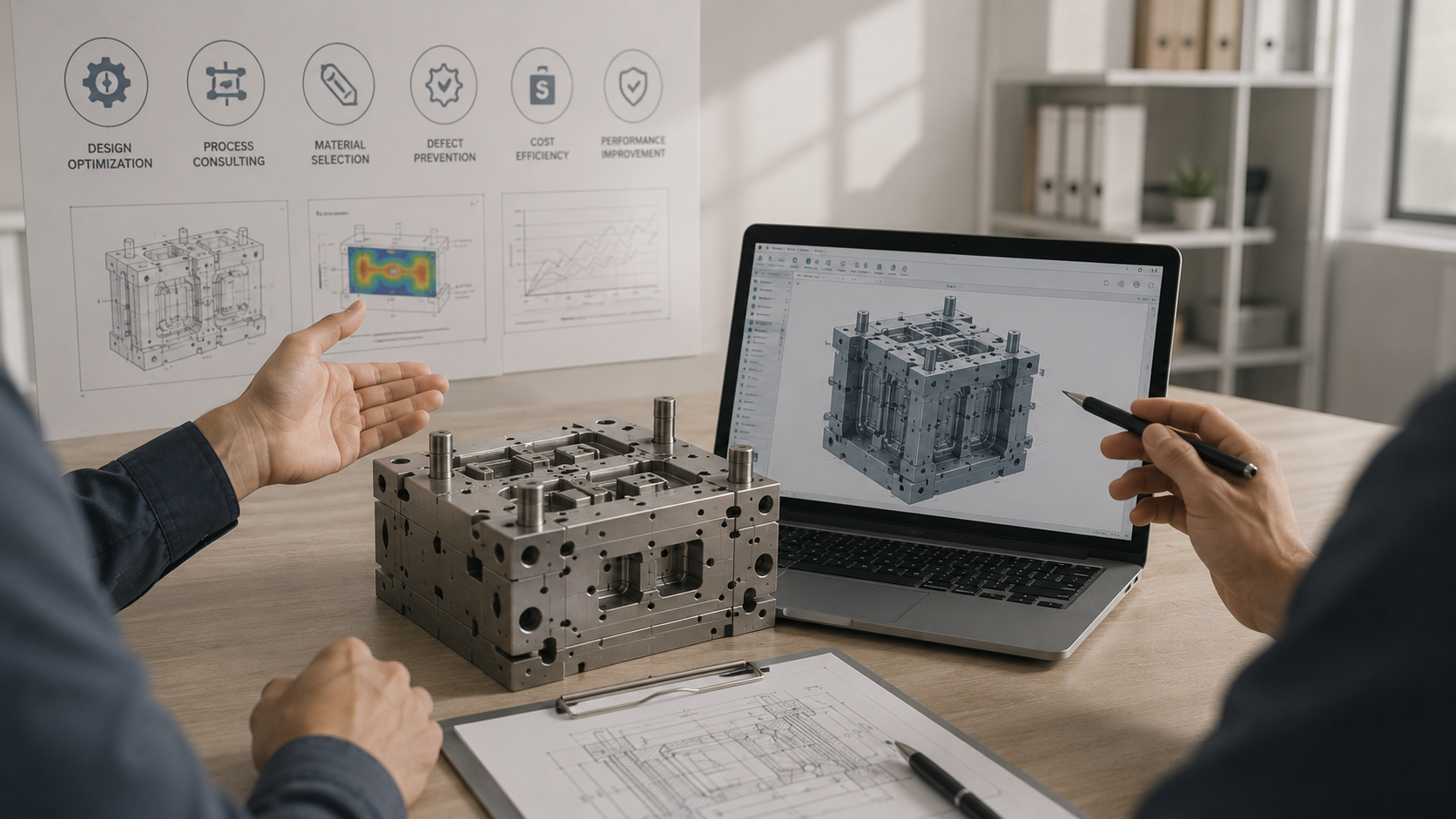
- Design optimization to prevent structural and functional issues
- Material selection based on performance and cost requirements
- Process optimization for stable cycles and consistent output
- Thermal and flow analysis to minimize defects
- Quality planning aligned with industry standards
- Early risk identification and mitigation
By integrating these elements, technical consulting turns moulds into high-performing assets, reducing rework, accelerating timelines, and improving overall manufacturing efficiency.
What Do Mould Experts Bring to Your Project?
Seasoned mould experts contribute deep, specialised knowledge that spans multiple engineering disciplines. Their value lies not only in technical skill but also in experience gained from solving complex problems across industries and applications.
Key expertise areas include:
- Advanced CAD and simulation capabilities for accurate design validation
- Material science knowledge to match tool steel and polymers to performance needs
- Thermal analysis for efficient cooling and temperature control
- Tooling optimisation techniques to improve durability and cycle efficiency
- Injection moulding process expertise for stable production parameters
- Failure analysis skills to prevent recurring defects
This multidisciplinary insight allows technical consultants to anticipate issues that may not be visible during initial design stages, preventing costly corrections later in the project lifecycle.
How Consulting Differs From In-House Resources
While in-house engineering teams are essential for day-to-day operations, external mould experts provide complementary advantages that are difficult to replicate internally. Consulting support is typically engaged during critical phases, new product development, complex tooling programs, or when persistent production issues arise.
Key differences include:
- Broader experience across industries and mould types
- Access to specialised tools and technologies is not always available internally
- Objective, unbiased assessment free from internal constraints
- Faster problem resolution due to prior exposure to similar challenges
- Cost efficiency, as expertise is accessed without permanent staffing costs
- Scalability, allowing support to expand or contract as needed
Perhaps most importantly, external technical consulting often accelerates time-to-market. By applying proven methodologies and avoiding trial-and-error approaches, mould experts help organizations achieve reliable outcomes faster while minimizing technical and financial risk.
Key Areas of Technical Consulting for Mould Development
Effective technical consulting spans several critical domains that collectively determine whether a mould performs reliably over its lifecycle. Rather than focusing on a single aspect, experienced consultants integrate mould design, process optimisation, and quality assurance to deliver tooling that meets both technical specifications and business objectives.
Core consulting areas typically include:
- Design optimisation to ensure manufacturability and durability
- Material selection aligned with performance and operating conditions
- Thermal and flow behaviour analysis for stable production
- Quality planning and validation to guarantee repeatable outcomes
- Lifecycle considerations, including maintenance and refurbishment
Addressing these domains holistically allows mould experts to prevent problems before they occur, reducing development risk and accelerating production readiness.
Design Optimization and CAD Expertise
Design optimization is one of the highest-impact contributions technical consultants make. Using advanced CAD tools and simulation-driven insights, mould experts refine geometry to eliminate weaknesses, simplify manufacturing, and improve long-term performance. The goal is not just a functional design, but one that produces consistent parts efficiently.
Key focus areas include:
- DFM (Design for Manufacturability) principles to reduce complexity and cost
- Gate placement optimization for balanced material flow and minimal defects
- Cooling channel design for uniform temperature distribution
- Draft angles and parting line strategy to ensure smooth ejection
- Component standardization to simplify maintenance and replacement
Through CAD optimisation, consultants can identify and resolve issues such as warping, sink marks, or incomplete filling long before tooling fabrication begins.
Material Selection and Performance Analysis
Selecting the right materials for mould construction is essential for durability, thermal stability, and cost control. Technical consultants apply material science expertise to match tool materials with production demands, part materials, and expected lifecycle.
Critical considerations include:
- Tool steel grades (e.g., P20, H13, NAK80) based on hardness and wear resistance
- Thermal conductivity for efficient cooling and cycle time reduction
- Corrosion resistance for aggressive plastics or humid environments
- Surface treatments and coatings to improve lifespan and release properties
- Alloy specifications tailored to high-cavity or high-volume applications
Proper material selection directly influences mould performance, maintenance frequency, and total cost of ownership.
Thermal and Flow Analysis
Thermal behavior and material flow inside the mould determine part quality, cycle time, and process stability. Consultants use advanced simulation techniques, including CFD and thermal analysis, to predict real production conditions and optimize performance before manufacturing begins.
Key analytical areas include:
- Cooling efficiency optimization to prevent hot spots and warpage
- Flow path balancing to ensure uniform cavity filling
- Gate and runner design refinement for pressure stability
- Pressure distribution analysis to reduce internal stresses
- Cycle time optimization through heat transfer improvements
By modeling these factors digitally, mould experts can avoid costly trial-and-error adjustments during production ramp-up.
Quality Assurance and Testing Protocols
Robust quality assurance ensures that the mould not only performs initially but continues to deliver consistent results over time. Technical consultants establish structured testing and validation frameworks tailored to the application and industry requirements.
Essential QA components include:
- Dimensional accuracy verification against engineering specifications
- Surface finish evaluation for functional and aesthetic requirements
- Durability and wear testing under simulated production conditions
- Process capability studies to confirm repeatability
- Documentation and validation procedures for compliance
These protocols create a measurable standard of performance, enabling manufacturers to maintain consistent product quality while minimising defects and rework.
The 5 Critical Benefits of Technical Consulting in Mould Development
Engaging specialised technical expertise transforms mould development from a trial-and-error exercise into a controlled, data-driven process. For manufacturers, this translates directly into faster launches, lower costs, higher quality, and reduced operational risk. In today’s competitive environment, technical consulting is not an optional add-on; it is a strategic enabler of reliable, scalable mould development.
1. Accelerated Time-to-Market
Speed matters, especially in industries where product lifecycles are shrinking and competitive pressure is intense. Experienced consultants streamline development by preventing mistakes before they occur and resolving technical challenges quickly.
Key acceleration factors include:
- Fewer design iterations through simulation-led decision making
- Early identification of manufacturability issues
- Faster troubleshooting during trials
- Reduced downtime caused by unexpected failures
- Smoother transition from prototype to production
By eliminating avoidable delays, technical expertise helps manufacturers launch products sooner without compromising quality.
2. Significant Cost Reduction
While consulting involves upfront investment, the long-term savings are often substantial. Poor mould decisions can trigger cascading costs, scrap, rework, downtime, and premature tool replacement. Optimized development minimizes these hidden expenses.
Major cost benefits include:
- Reduced material waste during trials and production
- Lower rework and modification expenses
- Optimized cycle times that cut operating costs
- Extended mould lifespan through proper design and materials
- Lower maintenance frequency and spare-part consumption
Overall, technical consulting shifts spending from reactive problem-solving to proactive efficiency.
3. Superior Mould Quality and Durability
High-quality tooling is the foundation of consistent manufacturing performance. Mould experts design robust moulds capable of maintaining dimensional accuracy and surface quality over millions of cycles, even under demanding conditions.
Quality improvements typically involve:
- Optimized structural design to prevent deformation and wear
- High-performance material selection and surface treatments
- Balanced thermal management to avoid stress concentration
- Precision alignment and tolerance control
- Validation processes that confirm long-term reliability
The result is sustained mould quality, fewer defects, and predictable production outcomes.
4. Enhanced Innovation and Competitive Advantage
External specialists bring exposure to diverse projects, technologies, and industries, enabling them to introduce solutions that internal teams may not consider. This infusion of fresh expertise can unlock meaningful performance gains and differentiation.
Innovation benefits include:
- Adoption of advanced manufacturing techniques and automation
- Integration of new materials with improved performance characteristics
- Breakthrough design concepts for complex parts
- Process innovations that boost productivity
- Identification of opportunities for lightweighting or sustainability
Organisations that leverage expert insight often move ahead of competitors, still relying on conventional approaches.
5. Risk Mitigation and Compliance
Mould development carries technical, financial, and regulatory risks. Errors can lead to production failures, safety issues, or non-compliance with industry standards. Technical consultants help anticipate and control these risks systematically.
Key risk-reduction contributions include:
- Early detection of design vulnerabilities
- Compliance alignment with ISO standards and industry certifications
- Validation protocols to ensure process stability
- Documentation support for audits and regulatory reviews
- Contingency planning for potential failure scenarios
Through structured risk management, manufacturers achieve greater confidence in both performance and compliance outcomes.
Conclusion
Technical consulting brings clarity and control to mould development, replacing trial-and-error with a structured, data-driven approach. It ensures that design, material selection, and process parameters are aligned from the start, reducing inefficiencies and improving overall reliability.
By addressing risks early and optimizing key variables, it enables faster time-to-market, lower lifecycle costs, and consistent tooling performance. The result is not just better moulds, but more stable and predictable manufacturing outcomes.
For organizations operating in competitive, high-precision environments, early expert involvement is a strategic advantage. It transforms mould development from a potential risk into a dependable, performance-driven foundation for long-term success.
Frequently Asked Questions
What exactly do technical consultants do for mould development?
They provide specialized expertise across design optimization, material selection, simulation, manufacturability, and validation. Consultants identify risks early, recommend improvements, and guide teams through development to ensure the mould meets performance, quality, and production targets efficiently.
How much can technical consulting save on mould development costs?
Savings vary, but optimized designs, reduced rework, fewer trial iterations, and longer tool life commonly deliver 15–40% total cost reduction across the mould lifecycle, often far exceeding the consulting investment.
What industries and product types benefit most from technical mould consulting?
High-precision and regulated sectors benefit the most, including automotive, medical devices, packaging, consumer goods, aerospace, and electronics, especially where tolerances, durability, or compliance requirements are stringent.
How do mould experts use CAD, simulation, and other advanced tools?
They use 3D CAD, flow simulation, thermal analysis, and structural modeling to predict performance before manufacturing, optimising gate placement, cooling efficiency, stress distribution, and cycle time.
Can technical consultants help with existing mould problems or only new development?
They can do both. Consultants frequently diagnose defects, performance issues, or premature wear in existing tools and recommend corrective actions to restore quality and extend mould life.