What Are Flip Top Caps?
Flip top plastic closures, also called flip-top caps or flip-flap caps, are a type of plastic closure used for bottles and containers. They’re called a “flip-top” closure because you can easily open and close the lid by flipping it open and snapping it closed.
These closures are often used for containing a variety of products, including liquids, food items and personal care products, and have a hinged lid that can be flipped open and closed to allow easy access to the contents of the container. Such a high degree of functional accuracy is usually achieved by specialist plastic packaging design and development to ensure that it is both manufacturable and durable over time.
Flip Top Closures Material
Thermoplastic materials, such as polypropylene (PP) and high density polyethylene (HDPE) are generally used to make flip top closures. They are cheap, light, durable and easily available and this makes them a cheap option for manufacturers. Further research on injection molding and material optimization improves the performance and processing behavior of these materials, which are critical for dimensional accuracy and structural integrity. They can be made to different shapes and sizes to fit different types of containers and bottle neck diameters.
Anatomy & Design of Flip Top Closures
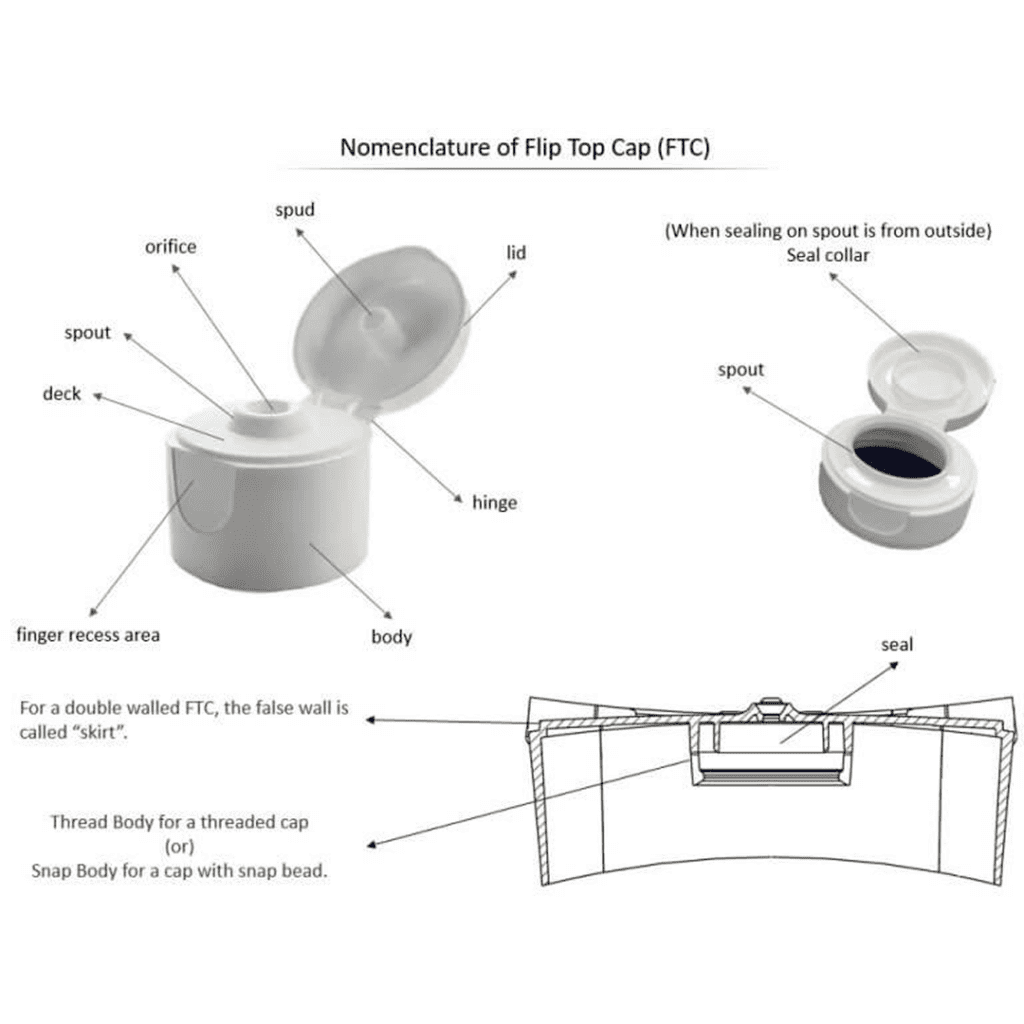
The closure design is a flip top. The lid is joined to the base of the closure by a living hinge. The lid opens and closes on a hinge mechanism. The closure also has a sealing gasket which provides a leak-proof seal between the container and the closure. The closure should be such that the lid is firmly attached to the base and the seal is leakproof to avoid spillage or leakage. When there are sealing inconsistencies or leakage concerns, mold investigation and diagnostic services are employed to find the root causes and improve the overall closure performance.
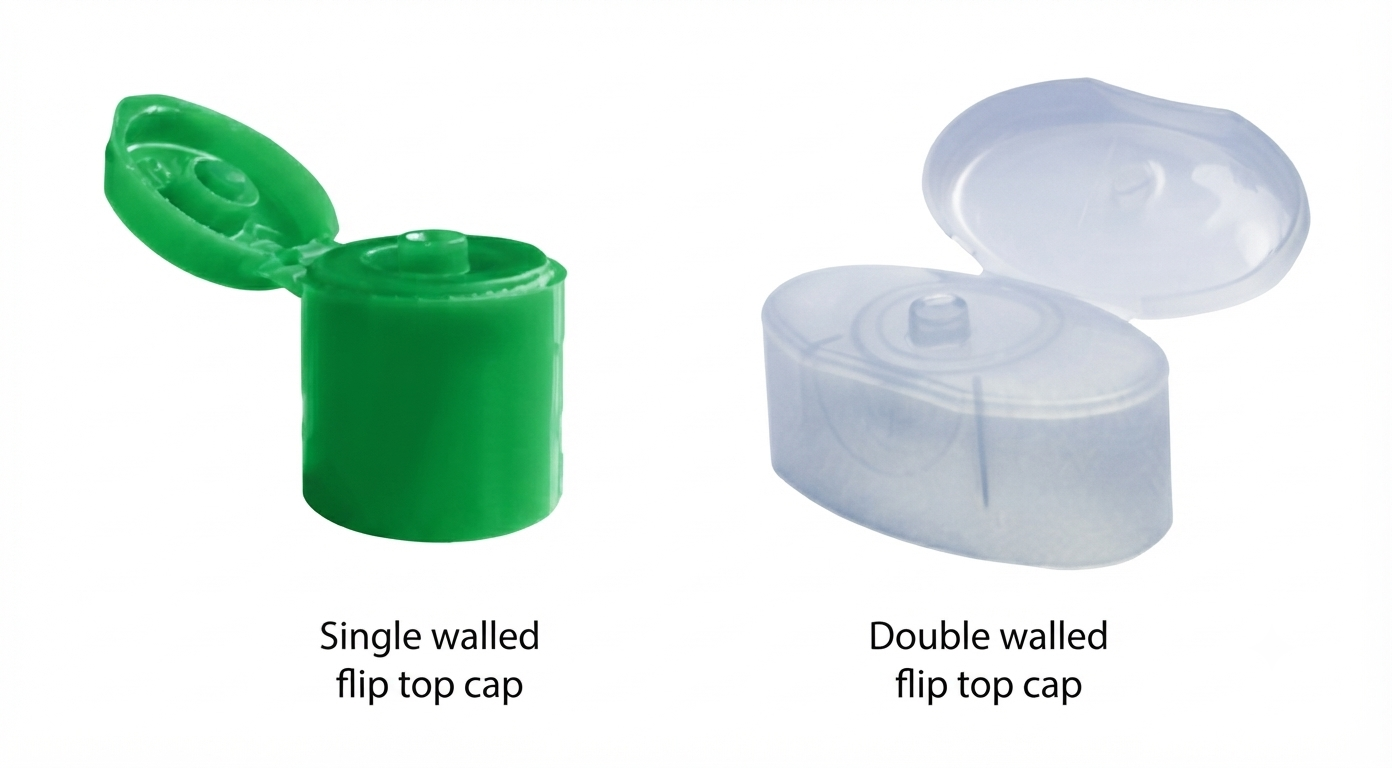
Flip top caps can be single or double walled closures depending on the type of flush that is desired on the bottle.
Sealing Systems: Getting a Leak-Free Fit
The sealing system must be designed to ensure a leak proof seal. Some of the common types of seals used are plug seal, flat seal, crab claw seal and v-seal. The details are below:
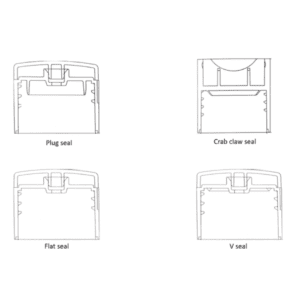
- Plug Seal is simplest and most commonly used sealing system. The seal is located within the inner diameter of the bottle giving it very good surface contact. Therefore, to obtain a good fitment the ID of the bottle/jar must be well controlled. And the closure between bottle and cap should also be perfect.
- Flat Seal the land of the bottle is directly connected to the deck of the cap. Flat seal packs should only be packed with high viscosity fluids. There is no additional sealing feature to stop leakage.
- Crab Claw Seal has screwcaps. The seal is the thin flexible type which is pressed against the land on the neck of the bottle. 5. This will have a small contact surface under sufficient pressure. This type of seal is used for EBM bottles where the ID of the bottle is comparatively higher as compared to ISBM bottles. The wall of the jar or bottle should be generally thick enough to have enough land for sealing.
- V-Seal has a V notch projection either in the cap as shown in the image below or on the land of the bottle. Under enough pressure the notch will be punctured and slightly flattened, changing from line to surface contact.
Crab claw and V-seal are great for threaded closures. Plug seal is a good sealing alternative for threaded or snap lock closures .
Hinge Designs: Where Function and Heart Converge
The hinge design is important and so is the closing functionality. The hinge must be strong enough to withstand the lid opening and closing. But still it must be flexible enough and able to hold the lid tight in place. A common design for the hinge is a thin strip of material molded into the closure to be a flexible joint that will allow the lid to move freely. This type of design is known as a “living hinge,” and it’s manufactured from the same material as the rest of the closure. Hinge designs can be:
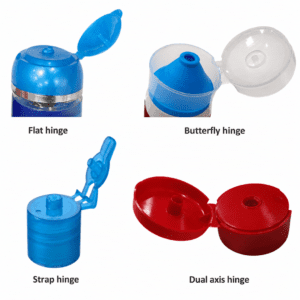
- Flat / Dead Hinge Flat plastic strip, cut or uncut. The cut is to allow the section to flex on the hinge at a spot, so the lid can flex.
- Butterfly Hinge is shaped like a butterfly. The body with the thin plastic wings is the main pivot. These thin plastic wings act as a spring. After a certain angle is reached, the lid opens or closes automatically.
- DUAL AXIS HINGE like a butterfly hinge but without the center pivot.
- Strap Hinge is made up of a strap at the center of the hinge and two pivot hinges on the sides. This hinge also functions as a spring when you open or close the cap.
Technical Performance Characteristics
Application Torque
This is the term for threaded caps, which is an important point from the perspective of the filling line. If the application torque is not adequate, then the probability of caps opening up during transit will be high. Good interference between the cap and bottle threads will guaranty the torque for the target application. Such precision is often achieved by optimizing clamping force in injection molding processes to ensure constant thread dimensions and fitment accuracy.
Factors that affect application torque are:
- Thread type/profile. For caps and bottles.
- Masterbatch
- Resins
- Surface finish and frictional force generated by it.
- Product in bottle, spillage on neck of bottle can occur in a filling line that is not fully controlled. This can lead to poor lubricating quality which in turn reduces the torque force.
- Temperature at which the product is filled in bottles and the change in properties
- Filling line speed or application speed.
Force of Capping
The force required to put the cap on the bottle is known as capping force. It is applicable to caps with latch/snap bead. Usually the upper limit is defined by a cap. This is either the max pressure the bottle can take from the top load capacity (load at which the bottle will buckle) or max pressure (not more than 80%) that the filling line chucks can exert.
The capping force is affected by:
- Development of the Spud and Orifice Interference
- Additives
- Masterbatch Resin
- Parameters for processing
- Speed of fill line
- Product in bottle
- Part temperature at capping time
Lid Open Force (LOF)
Lid opening force (LOF) is the force needed to open the lid. LOF of a cap should be selected properly within a range. Too low and the cap will easily open during transit leading to leakage of pack. And too high LOF will create customer complaints. A right trade-off is required to achieve the target LOF.
Factors influencing the LOF are:
- Design of the spud and orifice interference based on:
- Interference between spud and orifice bead and base diameter
- Additives
- Resin
- Masterbatch
- Processing parameters
- Lid closing time [Manual/In Mold Closing (IMC)/Out mold closing (OMC)]
- Temperature at time of closure in part
- LOF methodology of assessment
Why use Flip Top Closures? Main Benefits
- Ease of Use: The flip top closures have a hinged lid that allows easy access to the contents of the container thus decreasing the likelihood of spilling and leaking. This makes them well suited to a variety of applications from packaging liquids to food products to personal care items.
- Cost-effectiveness: Flip top closures are constructed from lightweight, durable materials and are simple to manufacture, presenting a cost-effective choice for manufacturers and consumers alike.
- Customization: Flip top closures can be customized with different colors, designs and logos which allow manufacturers to create unique packaging that stands out on store shelves.
- Versatile: With flip top closures in different sizes and shapes, they can be used on many types and sizes of containers.
We have done some of the flip top caps.
Conclusion: Intelligent Packaging for the Markets of Today
Flip top plastic closures are a versatile, cost effective and convenient solution to package a wide variety of products. They are easy to use, leak-proof and can be customized to suit each user’s needs, which is why manufacturers and consumers like them. The flip top closures provide tamper evident sealing options. When combined with sustainable packaging strategies for FMCG brands, these closures can aid in environmentally responsible packaging solutions. They are made of thermoplastic materials which makes them durable and lightweight, as well as easy to produce. Thus, they are an economical option for manufacturers. Efficient Innovations provides manufacturers full engineering expertise and lifecycle optimization support to improve durability, sustainability and operational efficiency.
Efficient Innovations has a long history of working with many kinds of flip top caps in many shapes and sizes. Efficient Innovations experts can help you facilitate the overall design and qualification process.
FAQ (Frequently Asked Questions)
- What is Flip Top Closure & How it Works?
A flip top closure is a hinged cap with a lid that opens and snaps closed. Easy to open and close with one hand but still creates a good seal so nothing leaks out.
- What is a living hinge in a flip top cap?
The lid is attached to the cap by a living hinge. It is a strip of flexible plastic It lets you open it and close it and open it and close it and it doesn’t snap.
- Difference between a flip top cap and a normal screw cap?
Screw tops require turning, whereas flip tops are simple to open with one hand. Flip tops are generally easier to use.
- Which products have a flip top lid?
They are used extensively in personal care, food, liquid packaging and household products.
The lids are plastic flip tops.
- What materials are flip top closures made from?
Usually they are made from thermoplastics such as polypropylene (PP) and high density polyethylene (HDPE).
- Are flip top closures food-safe?
All flip top closures are food grade.Provided they are made from food grade materials such as PP or HDPE they are safe for food and beverage applications.
- Can flip top closures be made from recycled materials?
Yes, flip top closures are made out of recycled materials.They can be made from recyclable or recycled plastics, depending on the manufacturing needs.
- What type of seals are used with flip top closures?
The common types of seals are plug, flat, crab claw and V-seal
- What seal is best for liquid products?
Plug seals are often used with liquids as they fit internally tight and offer good sealing against leaks.
- What Distinction Between Single Wall Vs Double Wall Flip Top Cap?
Single wall caps are single layer, double wall caps are more esthetics, strength and flush fitting.
- What is a plug seal? When would I use a plug seal?
A plug seal is inserted into the bottle opening to form a tight seal. Ideally suited to where a watertight seal for liquids is required.
- What is the longest-lasting hinge type for everyday use?
The spring-like action and durability of the butterfly and strap hinges make them ideal for high frequency use.
- What is the Lid Opening Force (LOF)? What’s the point?
LOF is the force required to open the lid. This permits the cap to be closed during transport, while being easy for the user to open.
- What is the capping force of a flip top closure?
The sort of material, the interference of the design, additives, processing conditions and the speed of the filling line are these.
- How to measure application torque on threaded flip-top closures?
The application torque is the force applied to tighten the cap onto the threads to prevent it from coming loose during transportation.
- What’s the best way to choose the capping force for my filling line?
Within the capacity of the machine and the strength of the bottle. Below the maximum load capacity to avoid deformation.
- Can flip top closures be recycled?
Yes most are recyclable especially PP and HDPE types depending on the local recycling system.
- Can I have my logo and brand colors on flip top closures?
Yes, they can be customized with colors, textures and branding elements for better shelf appeal.
- How do flip top closures work with tamper evident packaging?
They might also have tamper-evident features such as breakable seals or bands that indicate if they have been previously opened.
- What are the monetary advantages of flip top closures over other types of closure?
They are cheaper, the materials are lighter, they are easier to manufacture and the packaging is simpler.