In the 3rd of our series on Mold Lifecycle Management, we will look at how we should maintain the molds. In our earlier articles we discussed the inputs and effort required in the planning and qualification phase. In case you missed them here they are:
Planning – Mold Life Cycle Management
Mold Lifecycle Management – Start-up
How does maintenance fit within the mold lifecycle?
Maintenance: In between Commissioning & Scrappage
Following a successful commissioning trial, our mold is now ready for production.
The Maintenance Window From Commissioning to Scrapping
Someone rightly commented there is birth, there is death and in between there is maintenance. The same applies to any mechanical product. A mold is no exception. Any mold not properly maintained haunts the owner with the cost and trouble for repair, refurbishment or even a repeat mold. In such cases the structured mold life cycle management corrective maintenance is unavoidable and often more expensive than preventive strategies.
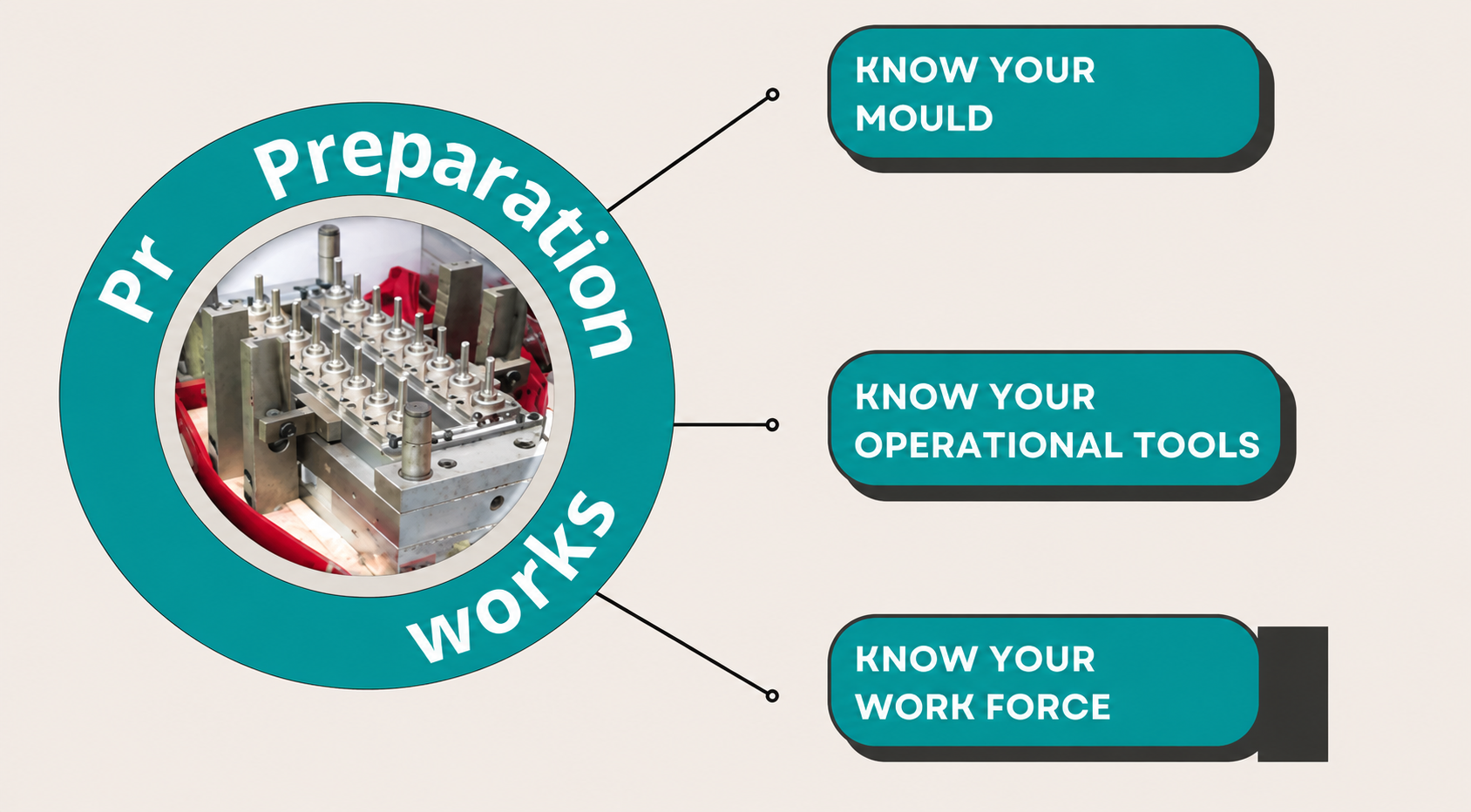
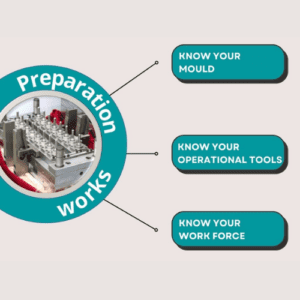
Maintenance Pre-requisites: 3 Things You Need To Know
Pre-Maintenance Must Haves
Before we get into the nitty gritty of maintenance, here is a list of precautions that are necessary before maintenance operations:
Know Your Mold
Similar parts may have similar layouts but the design will be different for different parts. As the owner you need to know the mold design thoroughly. You wouldn’t want to damage it in the course of maintenance, after all.
Check all circuits in the mold (electric, hydraulic and pneumatic) before or during maintenance and understand the actions required for individual circuits. For e.g. before starting the installation, maintenance or repair works, make sure that all electric connections are switched off.
Suppliers need to be trained in molding by a qualified molder.
They also have to get a maintenance manual from the mold maker and study it thoroughly.” The manual shall specify the maintenance activity required and the method of its performance.
The abbreviations used in the mold for the cooling circuit, hydraulic or pneumatic networks and the cavity layout numbering must be known by the supplier.
Know Your Maintenance Tools
Every tool has its purpose.
If the proper tool is not used, it can lead to injury to the operator or damage to the mold and other parts.
Tool and inventory management is also important for better productivity, reduce downtime of your work force and cost associated with the same.
Meet Your Employees
A mold can be simple or complicated. Consequently, mold maintenance is not always an easy task. And never underestimate that, either.
It is recommended to use only qualified personnel with experience to ensure correct maintenance.
The Importance of Preventive Maintenance for Business
Durability: Why Maintenance Matters
Once we have covered these points we are good to go with the maintenance plan. But before that let us answer a question which is naturally in all your minds – why is maintenance needed? Or, on a somewhat different note, what if the mold is not properly maintained?
Increasing Mold Life & Reducing Repair Costs
The investor would like to run the asset for a long time with a low level of maintenance costs and troubles. Mold that is kept up regularly stays healthy. This in turn extends the useful life of the mold compared to a mold that is not maintained properly.
Timely maintenance reduces total cost of repair or refurbishment in two ways. For one, they lengthen the time between repairs.
Reducing Unscheduled Downtime & Delivery Penalties
Secondly, and more importantly, they prevent unscheduled downtimes which require extravagant emergency repairs. These downtimes can also affect your delivery schedule, and you may risk financial penalties from the client.
How to Keep Mold: The Two Ways
Maintenance can generally be divided into two types:
Preventive Maintenance (Condition Based)
Corrective Maintenance (Time Based)
The subject of this article is time-based maintenance and an article on the other type will be published later.
What is Preventive Maintenance (PM)? How does it work?
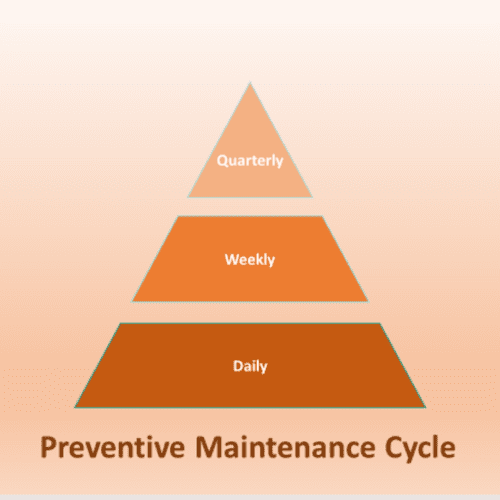
Preventive maintenance (PM), as the name suggests, involves regular and routine maintenance to prevent any unplanned downtime. A planning and scheduling process should be part of such a PM cycle to avoid any loss of supply during the mold downtime.
Such maintenance depends on the length of time or number of shots produced as per the maintenance plan provided by the mold maker. PM is usually done after 3 intervals i.e. daily, weekly and monthly.
Daily maintenance: Lubrication and inspection
The object here is to lubricate all the moving and accessible parts of the mold, and clean them up. These include the surfaces of the mold forming the part while the mold is in operation.
“Suppliers need to check for any visible issues in the part quality or functioning of the mold and take necessary actions to mitigate the same.
Weekly Maintenance: Leaks & Moving Parts
This type verifies the leakages of the injection mold in each water and oil connection, and eliminates them. The steps are as follows:
Check all moving parts for proper operation and stability. Tighten screws if necessary.
Slide the stripper or ejector plate forward and clean the tapers and surfaces behind it.
Visually inspect the mold for any unusual wear or damage.
Quarterly Maintenance: Full Strip Down & Full Inspection
Maintenance is done every 3 months and involves stripping down the mold and checking it for any signs of wear, damage, loose components and water leakage and taking appropriate action if necessary. The procedure includes:
Clean all mold parts.
Clean the water lines by scraping any rust build-up (especially on core and cavity inserts).
Clean and lubricate wear areas with a light layer of grease or as permitted.
Verify that all band heaters and thermocouples are operating correctly and are in the proper location.
Mold Storage: The Forgotten Part of Preventive Maintenance
Storage of molds is an important part of preventive maintenance. Molds carry out demand based production. Some are open 24/7. Others may be producing a seasonal item and so only be in business for a limited time. But in your production plant you have to protect the functionality of the mold and the quality of the part during the mold lifecycle. For this reason, mold storage is part of PM.
Things to do Before Disconnecting the Mold
For proper storage, before disconnecting the mold from the machine do the following:
Mold polystyrene, polypropylene or polyethylene to flush out any corrosive resin from the hot runner.
Remove all moisture from the lines and keep them dry.
Install dust caps on all air, water and hydraulic lines.
Dry any condensation on the mold or molding surfaces.
Apply a protective coating to all accessible surfaces and molding surfaces.
Close the mold and fit latches and lifting bar.
Install dust caps on electrical connectors.
Storage precautions after cleaning and protecting the mold
When the mold is thoroughly cleaned and lubricated and protected from corrosion, take the following storage precautions:
Place on a sturdy skid / pallet to protect from water spillage.
Just hold it all together. If stored in sections, tie the mold down to protect the molding surfaces from damage and from being tipped over.
Shrink / stretch the mold and its parts like temperature controller, electric cable & other parts so that foreign particles do not accumulate.
Store the last shot produced by the mold as a quality measure to know if there was any issue was observed when the mold was in production.
When Preventive Maintenance Is Not Enough: The Next Steps
Preventive Maintenance: Necessary and Nearly Enough
Now all these measures minimize any risk or damage to mold. But as we all know there is a limit to everything. No matter how hard you maintain them, issues do arise in the lifecycle of a product.
What happens if a non-conformity is found during a quality check on a plastic part? Or does the supplier gradually and evenly block the mold cavity of either one? Or suddenly the situation changes and you, the owner of the mold, get to know about several clogged cavities and a request to get a new mold?
We’ll see this in our next article, which will cover corrective maintenance.
We have been Mold Lifecycle Consultants for 15 years and are very knowledgeable in plastic mold maintenance aspects. Get in touch with Efficient Innovations for the best professional services.
FAQ (Frequently Asked Questions)
- What is Mold Lifecycle Management (MLM) for Injection Molding?
MLM is handling a mold from its design to commissioning, maintenance and final scrappage to maximize its usage.
- What are the stages of life of a mold?
The main stages include planning, commissioning, production, maintenance and disposal.
- The difference between corrective maintenance of a mold and preventive maintenance of a mold?
Preventive maintenance is scheduled and performed routinely while corrective maintenance is performed after a failure or fault occurs.
- When does maintenance start during the mold lifecycle?
Maintenance is performed during the production stage, immediately after the commissioning.
- Before starting work, why it is important to read the mold maintenance manual?
It tells you the right procedures to avoid damage and to make sure you are storing things in the right way.
- What circuits should I check before starting mold maintenance?
You need to know electrical, hydraulic and pneumatic circuits and how to work safely with them.
- What Skills Should Mold Maintenance Workers Have?
They need to be trained, experienced and knowledgeable of the mold design and mold maintenance procedures.
- Why is tooling and inventory management important to mold maintenance?
“It makes you more efficient, saves you downtime and saves damage from using the wrong tool.”
- How Routine Preventative Maintenance Can Extend the Life of a Mold
It reduces wear and downtime and provides consistent performance over time.
- Financial Risks of Neglecting or Delaying Mold Maintenance What are the financial risks of not doing or delaying mold maintenance?
This can result in increased repair costs, unplanned downtime and the possible need to replace molds.
- Mold with poor maintenance can lead to penalties on delivery.
Unplanned breakdowns can stop production, cause missed deadlines and contractual penalties.
- Maintenance of the die on daily basis?
Lubrication, cleaning and visual control of the surfaces of molds and moving parts .
- What is checked during the weekly mold maintenance?
Check for leaks. Mobile element inspection. Tightened screws. Fit analysis.
- What Is Quarterly Mold Maintenance?
Fully strip down and clean. Inspect and repair any parts that are worn or damaged.
- What is the normal preventive maintenance schedule – time or shots?
It is based on time interval or number of production shots depending on the mold plan.
- How often do I need to check and tighten the mold screws and moving parts?
Maintenance is generally weekly or as needed for use.
- What lubrication is recommended for maintenance on the wear areas of the mold?
Often a thin coat of grease is used if permitted.
- How to prepare a mold for storage after extraction from machine?
Clean surfaces, coat, tighten all connections, flush materials, dry water lines out.
- Why must water lines be purged dry before a mold is put away?
To prevent corrosion and internal damage.
- During storage, what protective coatings should be applied to the mold surfaces?
Coatings or sprays on surfaces that can be reached to prevent corrosion.
- Why retain the mold’s final shot?
It is used to check the quality of parts, and to find problems before storage
- How to store and wrap mold to prevent contamination?
Store on pallets and protect with shrink or stretchwrap to protect from dust and damage.
- Why do you purge hot runners with polypropylene or polyethylene prior to storage?
To prevent damage and to remove corrosive residues.
- What if preventive maintenance isn’t enough to keep a mold running?
Problems multiply causing breakdowns, defects and corrective maintenance.
- What is corrective maintenance? What’s the difference between preventive maintenance and corrective maintenance?
Corrective maintenance is for failures that have occurred. Preventive maintenance is to proactively avoid failures.