Key Takeaways
- Choosing between insert moulding vs injection moulding is not just a tooling decision. Discover how the right process directly impacts strength, reliability, assembly complexity, and long-term production cost.
- Insert moulding eliminates more than assembly steps. Learn why industries like automotive, medical, and electronics increasingly use integrated metal-plastic designs to improve durability, alignment, and performance.
- Higher tooling complexity does not always mean higher total cost. Explore how factors like volume, thread strength, part weight, and supply chain simplification completely change the economics of manufacturing decisions.
Every engineer eventually encounters a design that pushes beyond the limits of single-material plastic parts. You may need metal-to-plastic integration, thread strength that pure polymers cannot provide, or multi-material performance in a compact component. At that point, the decision between insert moulding vs injection moulding becomes critical.
This guide clarifies both processes, compares them across six engineering and business criteria, and shares EIPL’s design and tooling perspective to help you choose the right manufacturing path for performance, cost, and reliability.
Traditional Injection Moulding: Process, Strengths & Limitations
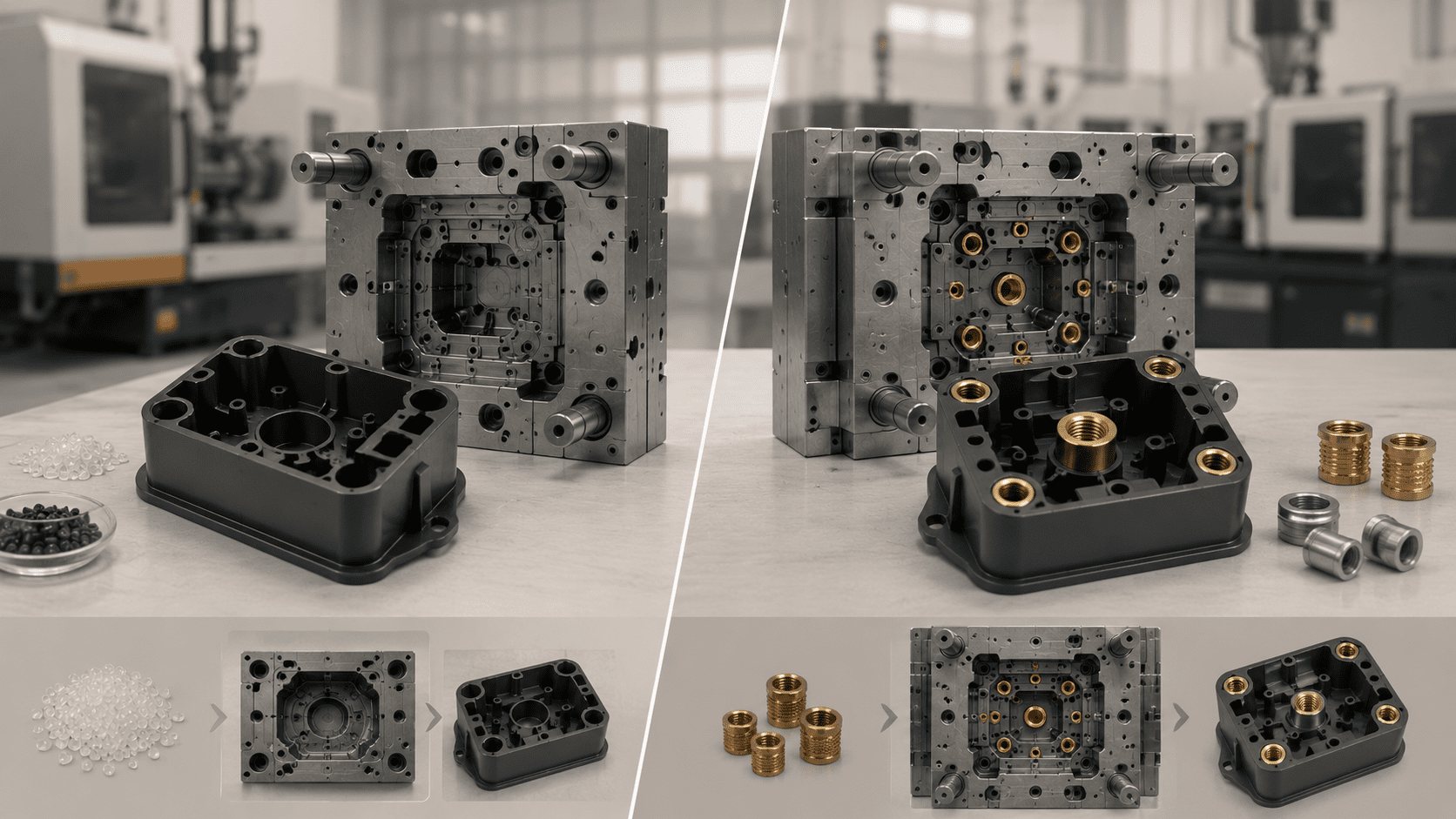
Traditional injection moulding is the standard manufacturing process for most plastic components. It involves injecting molten thermoplastic resin into a mould cavity, cooling it, and ejecting a finished single-material part in one continuous cycle.
Core Strengths
- High-volume cost efficiency — Low per-part cost at scale once tooling is validated
- Excellent consistency — Reliable dimensional accuracy across high production volumes
- Broad material compatibility — Supports commodity and engineering-grade plastics
- Fast cycle times — Optimised moulds run continuously with minimal downtime
- Mature manufacturing ecosystem — Extensive tooling standards, simulation tools, and supplier expertise
Key Limitations in This Comparison
- Limited thread and load-bearing strength — Plastic threads can creep, strip, or fail under stress
- Secondary assembly required — Metal inserts, seals, or electrical components must be added separately
- Higher assembly risk — Additional steps increase tolerance variation, handling damage, and process inconsistency
- Higher total system cost for complex parts — Labour, fixtures, and quality checks can offset moulding efficiency
Traditional injection moulding remains the preferred solution for many plastic parts. The key engineering decision is identifying when insert moulding delivers better strength, reliability, or overall production efficiency.
Insert Moulding: Process, Strengths & Applications
Insert moulding is a specialised form of injection moulding where a pre-manufactured insert is placed inside the mould before plastic injection. The polymer then encapsulates or mechanically locks the insert into a single integrated component, eliminating secondary assembly operations.
Typical Process Sequence
- Inserts are loaded manually or through automation
- The mould closes and secures the insert position
- Molten plastic is injected around the insert
- The part cools and solidifies
- A fully assembled component is ejected
Insert moulding supports metals, ceramics, magnets, and electronic components, combining the strength of metal with the flexibility of plastics in one production cycle.
Typical Industry Applications
- Automotive: Threaded bosses, sensor housings, structural trim
- Medical Devices: Cannulas, surgical grips, reinforced housings
- Electronics: EMI shielding, terminals, connector bodies
- Consumer Goods: Knobs, appliance handles, ergonomic tools
Insert moulding is ideal where load-bearing performance, durability, and compact integration are more important than tooling simplicity.
Types of Inserts: Materials & Selection Criteria
Selecting the right insert material directly affects durability, manufacturability, and production cost.
Brass (Most Common)
- Excellent machinability and thread performance
- Good corrosion resistance
- Strong bonding with plastics
- Cost-effective for most applications
Stainless Steel
- High strength and wear resistance
- Superior corrosion resistance
- Higher machining cost
- Best for demanding thermal or chemical environments
Aluminium
- Lightweight alternative to brass
- Suitable for weight-sensitive applications
- Moderate structural strength
Electronic or Composite Inserts
- Used for shielding, thermal management, and electrical integration
- Common in sensors and electronic connectors
Material selection should always be application-driven. Higher-cost materials like stainless steel should only be used when performance requirements justify them.
How Insert Moulding Eliminates Secondary Operations
A major advantage of insert moulding vs injection moulding is the elimination of post-mould assembly processes such as:
- Press-fitting inserts
- Ultrasonic welding
- Heat staking
- Manual assembly
These additional operations increase:
- Labour and equipment cost
- Cycle time
- Quality risk
- Potential part damage
Insert moulding removes these risks by locking the insert directly into the polymer during the moulding cycle itself.
Key Benefits:
- Fewer manufacturing steps
- Reduced labour and handling
- Lower assembly-related scrap
- Improved dimensional alignment
- Higher long-term reliability
In medium- and high-volume production, consolidating assembly into a single moulding cycle often delivers significant overall cost savings despite higher tooling complexity.
Head-to-Head Comparison: Insert Moulding vs Traditional Injection Moulding
Neither process is universally superior. The right choice depends on your part geometry, volume requirements, mechanical performance targets, and overall assembly strategy. Insert moulding excels where integrated strength and reliability are critical, while traditional injection moulding remains the most efficient path for purely plastic, high-volume components. The following criteria break down how the two approaches differ in real production environments.
Mechanical Performance: Thread Strength, Wear Resistance & Load Capacity
Plastic threads formed directly in moulded parts degrade under repeated tightening cycles, especially under thermal expansion, vibration, or elevated loads. Typical failure modes include thread stripping, deformation, and creep over time.
Metal inserts fundamentally change this performance envelope:
- Brass and stainless steel inserts provide thread strength comparable to the fastener itself
- Load transfer occurs through the insert body into the surrounding plastic
- Failure typically shifts from the thread interface to the fastener or surrounding structure
- Superior resistance to torque cycling, vibration, and temperature fluctuations
Glass-filled polymers can improve plastic thread strength in traditional moulding, but they introduce trade-offs such as increased brittleness, tool wear, and higher material cost. For critical fastening applications, insert moulding delivers far greater durability.
Part Weight & Material Efficiency
Insert-moulded parts are often significantly lighter than equivalent all-metal assemblies because only the load-bearing features remain metal while the bulk structure is polymer.
Key considerations:
- Weight reduction comes from replacing a fully machined metal part with a hybrid plastic-metal component
- Reduced material consumption lowers raw material cost and machining waste
- Lighter components improve handling, shipping efficiency, and end-product ergonomics
- Particularly valuable in automotive lightweighting and portable medical devices
The commonly cited “up to 50% lighter” figure depends heavily on geometry and application [SOURCE NEEDED]. The comparison is against metal assemblies, not against standard plastic parts.
Production Cost: Tooling, Cycle Time & Assembly Economics
A true cost comparison must consider the entire manufacturing chain, not just moulding cost alone.
Tooling Cost
- Insert moulds are more complex
- Require insert retention features, alignment mechanisms, and sometimes robotics
- Typically higher upfront investment than standard moulds
Cycle Time
- Manual insert loading increases cycle time
- Robotic loading reduces this penalty at higher volumes
- Cooling time is similar to comparable plastic parts
Assembly Economics
- Eliminates press-fitting, welding, heat staking, or manual assembly
- Reduces labour, handling, equipment, and scrap costs
- Removes assembly-related defects
Decision Insight:
Low volumes often favour post-mould assembly due to lower tooling cost. Medium to high volumes usually favour insert moulding because assembly savings dominate total cost.
Part Complexity, Size & Design Freedom
Insert moulding enables hybrid structures that cannot be manufactured efficiently by other means. Structural metal elements can be integrated directly into complex plastic geometries.
Advantages of Insert Moulding
- Combines structural metal with complex polymer shapes
- Enables integrated functionality in a single component
- Reduces part count and assembly interfaces
Constraints Introduced
- Inserts must be accessible for loading
- Retention features must be designed into the plastic
- Minimum wall thickness is required around inserts
- Gate placement and cooling design become more restricted
Traditional injection moulding offers greater freedom for purely plastic designs. If the metal element is structural, insert moulding is often the enabling solution. If the metal feature is minor, post-moulding insertion methods may be more flexible.
Reliability & Assembly Quality
Reliability differences largely stem from whether assembly occurs inside the mould or afterward.
Insert Moulding Advantages
- Insert position controlled by mould tolerances (very tight)
- Eliminates cumulative tolerance stack-up from assembly
- Mechanical locking prevents loosening under vibration
- Consistent part-to-part alignment
- Reduced operator dependence
Traditional Moulding + Assembly Risks
- Misalignment due to tolerance variation
- Insufficient press-fit force or inconsistent heat staking
- Loosening under thermal cycling
- Operator variability in manual processes
Because the mould itself defines insert placement, insert moulding typically produces more repeatable assemblies.
Volume, Lead Time & Supply Chain Considerations
Production scale strongly influences the optimal process choice.
Volume Thresholds
- Insert moulding typically becomes cost-effective at medium volumes (often ~5,000+ parts/year, depending on complexity)
- Very low volumes favour secondary assembly due to lower tooling investment
Lead Time
- Insert moulding consolidates multiple operations into one
- May reduce overall production lead time despite longer per-cycle time
- Eliminates separate assembly scheduling
Supply Chain Impact
- Traditional approach requires moulding plus additional assembly operations or suppliers
- Insert moulding produces a finished component in one step
- Simplifies bill of materials (BOM) and vendor management
For complex products, supply chain simplification alone can justify insert moulding.
At-a-Glance Comparison Table: Insert Moulding vs Traditional Injection Moulding
Criterion | Traditional Injection Moulding | Insert Moulding |
Thread / Mechanical Strength | Low–Medium (plastic-limited) | High (metal insert strength) |
Part-to-Part Assembly | Required | Not required |
Tooling Cost | Lower | Higher |
Production Cost (Medium Volume) | Medium–High (due to assembly) | Lower (assembly eliminated) |
Part Weight (vs metal assembly) | Medium | Low (lighter hybrid part) |
Design Complexity | High for plastic parts | High for hybrid parts |
Industries and Applications Where Insert Moulding Excels
Insert moulding delivers the greatest value where products require the strength of metal combined with the flexibility and weight advantages of plastics. It is commonly chosen when traditional injection moulding or secondary assembly cannot deliver the required reliability or performance.
Automotive Applications: Precision, Vibration Resistance & Lightweighting
Automotive components must withstand vibration, thermal cycling, and long service life. Insert moulding provides targeted metal reinforcement while reducing overall part weight.
Typical applications include:
- Threaded bosses in dashboards and trim assemblies
- Sensor housings with metal mounting points
- Steering column and structural components
- Lightweight hybrid brackets and assemblies
This approach improves fatigue resistance, dimensional stability, and long-term fastening reliability.
Medical Applications: Sterilisation Compatibility & Reliability
Medical devices require high durability, structural integrity, and compatibility with sterilisation processes.
Common applications include:
- Metal cannulas in catheter bodies
- Reinforced surgical instrument handles
- Implantable device housings
- Precision electrical and fluid connectors
By eliminating secondary assembly, insert moulding reduces contamination risk and improves consistency in critical applications.
Electronics Applications: Shielding & Thermal Management
Electronic products often require conductive or heat-dissipating components integrated into plastic structures.
Typical applications include:
- EMI shielding inserts
- PCB mounting hardware
- Connector bodies with embedded contacts
- Integrated heat sinks
Insert moulding improves electrical performance, alignment accuracy, and long-term reliability in compact electronic devices.
Consumer Goods Applications: Durability & Premium Feel
In consumer products, insert moulding combines strength, ergonomics, and aesthetics within a single component.
Common applications include:
- Hand tools with reinforced metal cores
- Precision dial and knob mechanisms
- Appliance handles and control shafts
- Repetitive-use mechanical components
The result is a durable, premium-feel product that remains cost-effective at scale.
Across industries, insert moulding is ultimately chosen for performance integration, delivering capabilities that plastic or metal components alone often cannot achieve reliably.
Conclusion
Choosing between insert moulding vs injection moulding depends on the balance between strength, assembly complexity, production volume, and long-term manufacturing efficiency.
Traditional injection moulding is ideal for high-volume single-material parts, while insert moulding offers major advantages where metal reinforcement, thread durability, vibration resistance, or multi-material integration are required. By eliminating secondary assembly operations, insert moulding can also improve reliability, alignment accuracy, and overall production efficiency.
At EIPL, we help manufacturers evaluate insert moulding vs traditional injection moulding from both an engineering and cost-performance perspective to ensure the right fit for long-term production success.
Frequently Asked Questions
What are the design guidelines for insert moulding?
Key guidelines include ensuring insert accessibility for loading, providing mechanical retention features (knurls or grooves), maintaining sufficient wall thickness around the insert, balancing insert placement, and designing the mould with precise locating features.
How does insert moulding improve part reliability?
It removes manual assembly steps that introduce misalignment, loosening, or variability. Inserts are positioned by the mould itself and locked in place by the polymer, resulting in consistent geometry, stronger joints, and better performance under vibration and thermal stress.
What industries use insert moulding most commonly?
Automotive, medical devices, electronics, and consumer goods frequently rely on insert moulding. Applications include sensor housings, surgical instruments, connector bodies, EMI shielding components, and durable consumer product handles.
Can I retrofit inserts into existing injection moulded parts instead of using insert moulding?
Yes, through methods such as press-fitting, heat staking, or ultrasonic insertion. However, these add cost, time, and potential failure modes. Insert moulding generally provides superior alignment, retention strength, and long-term reliability.
What are the most common design mistakes in insert moulding?
Typical errors include insufficient wall thickness around inserts, poor retention feature design, inaccessible insert locations, unnecessary use of expensive materials like stainless steel, and finalising part geometry without consulting the toolmaker early in the design process.